
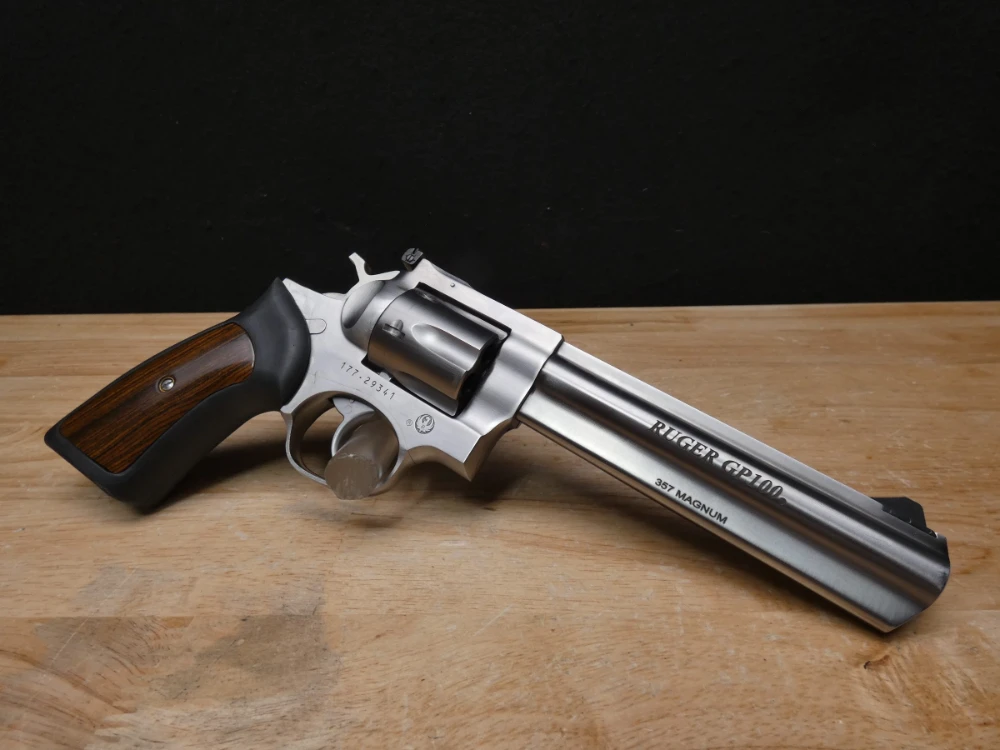
The Ruger GP100 is a renowned double-action revolver, classified as a handgun and celebrated for its robust construction and reliability. As a non-NFA item, it navigates the firearms market with straightforward legality. Understanding its value involves assessing its specific model, condition, and the current market landscape. This guide provides a comprehensive breakdown of the factors that determine the resale price of your GP100, from its mechanical condition and cosmetic appearance to the nuances of private versus dealer sales.
What Determines Your Ruger GP100’s Worth
The value of a Ruger GP100 is primarily influenced by its specific model, overall condition, and included features rather than distinct manufacturing generations. A standard used model in very good condition typically fetches a private party price between $500 and $600, with an average of around $601. Special variants, such as the Match Champion or Wiley Clapp editions, will command different prices based on their rarity and market demand. Other key factors include the revolver’s caliber, barrel length, and finish. Ultimately, a well-maintained, desirable configuration will always hold a higher value than a common model with significant wear.
2026 Price Breakdown by Generation
Standard Models (Blued & Stainless)
The most common Ruger GP100 variants are the standard blued and stainless steel models, which form the baseline for the revolver’s market value. While the manufacturer’s suggested retail price for a new GP100 can be as high as $1,089, the average new street price is closer to $823. In the used market, these standard models in good to very good condition consistently sell in the $500 to $600 range. This price point reflects their widespread availability and reputation as durable, reliable workhorse revolvers, making them a popular choice for both new and experienced shooters.
Condition plays the most significant role in the value of these standard models. A firearm in 80% condition may see a price reduction of around 27% compared to its new price. However, because of the GP100’s legendary durability, internal wear is less of a concern than external cosmetic damage. Scratches, holster wear, or damage to the grips will detract from the value, while a pristine example that has been well-cared-for will command a price at the higher end of the typical used range. Original packaging and paperwork can also add a small premium.
Special Variants (e.g., Match Champion)
Special variants of the Ruger GP100, such as the Match Champion, are valued differently than standard production models. These firearms are designed with enhanced features for competitive shooting, including polished actions, custom grips, and often a fiber optic front sight. Because they are produced in smaller numbers and cater to a specific niche in the market, their value is more dependent on current demand and rarity. A used Match Champion will typically command a higher price than a standard GP100, reflecting its premium features and higher initial cost. The exact value fluctuates based on market trends for competition-ready revolvers.
When assessing a special variant like the Match Champion, its unique features must be in excellent condition to retain maximum value. Any modification or damage to the specialized components, such as the tuned action or custom grips, could negatively impact its price more than similar wear on a standard model. Sellers should highlight these factory enhancements in their listings, as they are the primary drivers of the firearm’s premium value. These models appeal to discerning buyers who are willing to pay more for out-of-the-box performance, setting them apart from the general-purpose GP100s that define the bulk of the market.
Wiley Clapp Editions
The Wiley Clapp series of GP100 revolvers represents another category of special variants that command a premium price. Designed in collaboration with the renowned gun writer, these models feature specific enhancements tailored for concealed carry and defensive use, such as Novak sights, a unique grip profile, and a distinctive finish. Like the Match Champion, their value is driven by their limited availability and desirable feature set. These editions are highly sought after by collectors and enthusiasts, which helps them retain their value better than standard models. The used price will depend heavily on condition and the specific configuration of the Wiley Clapp model in question.
For sellers, owning a Wiley Clapp GP100 means its value is less about round count and more about its condition and originality. Since these are often considered collector’s pieces as much as functional firearms, maintaining the original sights, grips, and finish is crucial. Any deviation from the factory configuration could diminish its appeal to the collectors who drive up its market price. Documenting the specific features of the Wiley Clapp edition is essential for achieving its full potential value in a private sale or trade, as these details are what separate it from the more common GP100 offerings.
Other Calibers and Barrel Lengths
Beyond specific named editions, the value of a Ruger GP100 is also influenced by its chambering and barrel length. While the .357 Magnum is the most common and defines the baseline price, models in other calibers can have different market values based on ammunition availability and shooter preference. Likewise, barrel length plays a significant role; standard 4-inch and 6-inch models are plentiful, but less common lengths may attract more interest and a higher price from specific buyers. For example, a snub-nosed GP100 may be more valuable in areas with a high demand for concealed carry firearms.
The interplay between these features creates a varied market. A GP100 with a less common barrel length combined with a desirable finish or caliber can become a more sought-after piece. Sellers should research the current market demand for their specific configuration. Highlighting these unique attributes—whether it’s a 3-inch barrel, a 7-shot cylinder, or a less common chambering—is key to justifying a price above the standard $500 to $600 range. The value is not just in the GP100 name, but in the specific package of features the revolver offers to a potential buyer.
How Modifications Affect Value
The market for modified Ruger GP100 revolvers lacks a clear consensus on what adds or detracts from its value. Unlike semi-automatic pistols where certain trigger upgrades or slide cuts have established market acceptance, modifications to a revolver are highly subjective. Custom work like trigger jobs or specialized coatings may appeal to a very small niche of buyers but will not necessarily increase the general resale value. In many cases, a potential buyer may prefer an unmodified firearm, viewing custom work as a potential risk or simply a matter of personal taste they do not share, making it difficult to recoup the cost of the modifications.
Because there is no established guide for how specific modifications impact the GP100’s price, sellers should not expect to receive a dollar-for-dollar return on their investment in aftermarket parts or gunsmithing. Permanent alterations, such as milling the frame for a red dot sight or a non-factory finish, can significantly limit the pool of potential buyers and may even lower the firearm’s value. Reversible modifications, like aftermarket grips or sights, are less risky. It is often advisable to retain all original parts, as including them with the sale can reassure buyers and help preserve the revolver’s baseline value.
Regional Price Variations in 2026
The value of a Ruger GP100 can be influenced by state and local laws, which dictate both legality and market demand. In states with restrictive firearm laws like California, the GP100’s presence on the Roster of Handguns Certified for Sale makes it a desirable and legally accessible option. This sustained legality can stabilize its price, as consumers have fewer choices for new handguns. Similarly, the GP100 is compliant with New York state laws, and as a revolver, it avoids many of the feature-based restrictions that apply to semi-automatic pistols, ensuring a consistent market in that region as well.
Conversely, in states with more permissive firearm laws, the market is saturated with a wider variety of handguns, which can create more price competition for a used GP100. While the revolver’s reputation for quality ensures it always has value, the final sale price may be slightly lower in these areas due to the abundance of alternative options. Sellers should be aware of their local market dynamics; a GP100 in a restrictive state may sell faster and for a slightly higher price than the exact same model in a less-regulated market with more consumer choice.
Online vs Local Sales
Selling a Ruger GP100 locally through a private sale offers the benefit of a direct, in-person transaction, but it requires adherence to state and local laws, which can vary significantly. While federal law does not mandate a bill of sale for private transfers, the ATF highly recommends one to document the legal change of ownership. A comprehensive bill of sale should include the names of the buyer and seller, the firearm’s details like make, model, and serial number, and the date and price of the sale. This documentation protects both parties and provides a clear record of the transfer.
Selling a GP100 online to a buyer in another state introduces federal regulations that must be followed. It is illegal for a private individual to directly ship a handgun to a resident of another state. The transaction must be facilitated by a Federal Firearms Licensee (FFL) in the buyer’s home state. The seller is required to ship the revolver to the buyer’s chosen FFL, where the buyer will then complete the necessary federal paperwork and background check before taking legal possession. This process ensures the transfer is compliant with federal law but adds shipping and transfer fees to the overall cost.
Furthermore, the logistics of shipping a handgun like the GP100 are strictly regulated. Private sellers are prohibited from shipping handguns via common carriers like UPS or FedEx. These companies require the shipper to be a licensed firearms dealer with an approved shipping agreement. Therefore, a private individual must take the firearm to their local FFL, who will then handle the lawful shipping. The FFL will follow specific carrier protocols, such as declaring the firearm to the carrier and using mandatory overnight air services, which adds to the expense and complexity compared to a local sale.
The FFL Buying Advantage
Selling your Ruger GP100 to a Federal Firearms Licensee (FFL), such as a local gun store, offers a significant advantage in speed and convenience. The process is immediate—you can walk in with your firearm and walk out with cash, bypassing the complexities of finding a private buyer and navigating transfer laws. This is particularly beneficial given the legal requirements for shipping handguns, as an FFL handles all necessary logistics. However, this convenience comes at a cost, as a dealer’s offer will be lower than the private market value to allow for their own profit margin upon resale.
Typically, a gun dealer will offer a trade-in or cash value for a used GP100 that is approximately 65% of its private party market value. For example, a model with an established private sale value of around $601 would likely receive a dealer offer in the neighborhood of $391. While this is a substantial reduction, it reflects the immediate, guaranteed nature of the sale and the dealer’s absorption of all risks and responsibilities associated with reselling the firearm. For sellers who prioritize a quick, hassle-free transaction over maximizing their financial return, selling to an FFL is an excellent option.
What Increases Your Offer
To maximize the offer for your Ruger GP100, proper presentation is paramount. Start with a thorough pre-sale cleaning. A full field strip is generally not necessary; instead, focus on cleaning the bore and cylinder chambers until patches come out clean, and ensure the ejector rod area is free of debris. A common mistake to avoid is leaving harsh cleaning solvents on the firearm’s finish, which can cause damage. After cleaning, wipe everything down and apply a light coat of protective oil. Be cautious with lead remover cloths on the cylinder face, as they can be abrasive.
High-quality photographs are crucial for attracting potential buyers, especially in online listings. Use even, natural lighting to avoid harsh shadows and ensure the photos are sharp and in focus. A modern smartphone is perfectly capable of producing excellent results. Place the revolver on a simple, neutral background to make it the center of attention. Capture images from all angles, including both sides, the top, and close-ups of any important markings, the serial number, and any noticeable blemishes. Clear, comprehensive photos build buyer confidence and can lead to higher offers by accurately representing the firearm’s condition.
Finally, the overall condition is the most significant factor. A GP100 that is mechanically sound and cosmetically clean will always fetch a better price. While the revolver is known for its durability, meaning a high round count has minimal impact on value, visible damage does. A standard model in 80% condition can see its value reduced by over 25% compared to its new price. Heavy cosmetic damage can result in a reduction of 40% to 60%. Presenting a well-maintained firearm, both mechanically and aesthetically, is the best way to secure a top-dollar offer from any potential buyer.
When to Sell Your Ruger gp100
Timing the sale of your Ruger GP100 can have a noticeable impact on the final price and the speed of the transaction. The firearms market experiences predictable seasonal trends, creating periods of high and low demand. The most opportune times to sell are generally during tax return season, which runs from February through April, and in the months leading up to major hunting seasons, typically August through October. During these windows, more buyers are actively looking to purchase firearms, which can lead to a quicker sale and potentially a higher selling price due to increased demand.
Conversely, certain times of the year are known to be slower for firearm sales. The month of July and the period immediately following the Christmas holidays are often considered the weakest sales months. During these times, potential buyers may have their disposable income allocated to vacations, holiday expenses, or other priorities. Listing your GP100 during these slower periods could result in it sitting on the market for longer and may require you to lower your asking price to attract interest. By aligning your sale with peak seasons, you increase your chances of connecting with a motivated buyer.
Understanding these market fluctuations allows you to strategically plan your sale. If you are not in a rush, waiting for a peak demand period like early spring or late summer can be a wise financial decision. The increased pool of buyers during tax season and before hunting season creates a more competitive environment, which naturally benefits the seller. By avoiding the post-holiday slump and the mid-summer lull, you position yourself to get the best possible return on your well-maintained and highly regarded Ruger GP100 revolver, a firearm that remains in steady demand among knowledgeable shooters.
Common Pricing Mistakes
One of the most common mistakes when pricing a Ruger GP100 is overestimating its value based on its reputation alone, without considering its specific model and condition. For a standard, common variant, paying for a professional appraisal is often an unnecessary expense. The market value for these models is well-established, typically falling between $500 and $600 for a firearm in good condition, and this information is readily available through online resources and forums. An appraisal is better reserved for rare or unique variants where the value is not as clearly defined, preventing you from spending money for a valuation you could find yourself.
Another frequent error is significantly devaluing the revolver due to a high round count. The Ruger GP100 is widely regarded as an exceptionally durable firearm, capable of handling tens of thousands of rounds with minimal wear. In fact, many shooters report that the trigger and action often improve with use, becoming smoother. Unless the round count is astronomically high (e.g., over 200,000 rounds) and has resulted in noticeable mechanical looseness, its value is far more dependent on its current mechanical condition and cosmetic appearance than the number of rounds fired. Don’t price it low just because it has been shot often.
Finally, sellers often fail to properly account for cosmetic damage. While the GP100 is a workhorse, its appearance still matters to buyers. Based on market data, a used GP100 in 80% condition experiences a price reduction of approximately 27% compared to its new price. A firearm with heavy holster wear, deep scratches, or dings will need to be priced significantly lower to attract a buyer. Ignoring these cosmetic flaws and pricing the gun as if it were in excellent condition is a surefire way to deter potential buyers and prolong the sales process unnecessarily.
Market Outlook for 2026
Predicting the future price of any firearm, including the Ruger GP100, is inherently challenging due to the market’s sensitivity to a wide range of external factors. While there is no definitive consensus on the GP100’s price trajectory for 2026, the market for high-quality, durable revolvers tends to be more stable than that of modern semi-automatic pistols. The GP100’s reputation for reliability and durability ensures it will likely remain a desirable firearm for years to come. Its value is expected to hold steady, with minor fluctuations influenced by inflation and the cost of new firearms, rather than drastic market shifts.
Broader economic conditions, raw material costs, and the political climate surrounding firearms will play a significant role in the GP100’s future value. A strong economy may see prices rise slightly, while political events could trigger surges in demand, temporarily inflating prices. However, the GP100 is not typically a speculative firearm; its value is rooted in its utility and build quality. Therefore, owners can reasonably expect its value to remain consistent relative to the rest of the firearms market, making it a solid asset that is unlikely to see a significant or sudden depreciation in the coming years.
Frequently Asked Questions
How much does cosmetic damage affect the GP100’s price?
Cosmetic damage significantly impacts a Ruger GP100’s resale value. While mechanically robust, its visual appeal is crucial to most buyers. Market data suggests that a standard used model in 80% condition, indicating moderate cosmetic wear, will see a price reduction of about 27% compared to its new price. For a revolver with heavy damage, such as deep scratches, significant holster wear, or dings in the frame, a much greater price reduction should be expected. This penalty could be in the range of 40% to 60%, as such damage limits the pool of interested buyers to those seeking a functional “beater” rather than a well-kept firearm.
Does a high round count devalue a Ruger GP100?
A high round count does not significantly lower the value of a Ruger GP100. This revolver is celebrated for its exceptional durability and is engineered to withstand tens of thousands of rounds with minimal wear on critical components. In many cases, the trigger and action are reported to become smoother and improve with use. While an extremely high round count can eventually lead to mechanical issues requiring service, the firearm’s value is much more dependent on its current mechanical tightness and overall cosmetic condition than the specific number of rounds it has fired. Its reputation for longevity largely insulates it from this typical form of devaluation.
Is it worth paying for a professional appraisal for my GP100?
For a standard, common model of the Ruger GP100, a professional appraisal is generally not worth the cost. The market value for these firearms is well-established and widely documented, typically ranging from $500 to $600 for a model in good to excellent used condition. This information can be easily obtained from online gun forums, completed auction sites, and other public resources. A paid appraisal would be an unnecessary expense, as it would likely confirm the existing market data. An appraisal should only be considered if you own a particularly rare, custom, or historically significant variant of the GP100.
What is the trade-in value of a GP100 compared to a private sale?
The trade-in value offered by a gun dealer for a Ruger GP100 is considerably lower than its private party sale value. Dealers typically offer around 65% of the firearm’s private market worth to ensure they can make a profit on resale. For instance, a GP100 with a private party value of approximately $601 would likely have a trade-in or dealer buy value estimated at around $391. While a private sale will yield a higher financial return, selling to a dealer offers the benefits of an immediate, guaranteed transaction without the hassle of finding a buyer and navigating transfer laws.
Do special editions like the Wiley Clapp model hold their value better?
Yes, special editions like the Wiley Clapp or Match Champion models generally hold their value better than standard production Ruger GP100s. These variants are produced in smaller quantities and come with desirable factory enhancements, making them more sought after by collectors and discerning shooters. Their relative rarity and specialized features create a stronger market demand, which helps insulate them from the depreciation seen in more common models. While a standard GP100’s value is based on utility and condition, a special edition’s value is also driven by its collectibility and unique appeal, often resulting in a higher resale price.
Get a Cash Offer Today
Ready to sell your Ruger GP100? We make the process simple and secure. Submit your firearm’s details on our website to receive a fair, no-obligation cash offer. Forget the hassle of private listings, shipping regulations, and finding a trustworthy buyer. We provide a straightforward way to turn your revolver into cash.
Our team of experts understands the market for firearms like the GP100. We evaluate your revolver based on its specific model, condition, and features to ensure you get a competitive price. Click the button below to start the process and see what your Ruger GP100 is worth today.