

Your inbox is filling up with messages from strangers, you want top dollar for your gun, and you also don’t want a meet-up to turn into a scam, a safety problem, or a legal question you can’t confidently answer. The dealer route feels cleaner and more controlled, but you’re not sure what you’ll be offered, or whether you’re leaving too much money on the table.
The decision isn’t “private vs. dealer” so much as which tradeoff you can live with. Selling privately gives you the higher potential net price, but you take on the work: listing, screening buyers, scheduling meet-ups, and handling the transfer details. Selling to a dealer gives up some upside, but it’s designed to be a more hassle-free experience. The “best” choice shifts with the market too, because demand for the exact make and model in your area changes what your time and risk are worth. Legally, the line is whether you’re “engaged in the business”, repetitive, profit-motivated buy-and-resell activity can change your legal posture under 18 U.S.C. § 921(a)(21)(C); occasional sales to enhance a personal collection or selling all or part of a personal collection are excluded; and BSCA (2022) shifted the focus away from proving an “objective of livelihood and profit” toward predominantly seeking profit from repetitive sales.
You’ll leave with a clear, side-by-side way to choose between a private sale and a dealer sale based on net money, time cost, personal risk, and rule compliance.
Two Selling Paths Explained
These are the same goal (sell a gun), but they feel totally different in practice.
A private-party transfer means you sell directly to another individual, not to a business. In the simplest version, you find a buyer, agree on terms, and hand the firearm over. The catch is the “simple version” depends heavily on where you live, because paperwork and background-check rules for person-to-person transfers vary by state, and local practice often fills in the gaps.
The practical workaround a lot of people choose is to route the handoff through an FFL (Federal Firearms Licensee), a dealer licensed under federal law, so the transfer runs through the dealer’s standard intake and release process instead of you trying to interpret the compliance layer yourself.
An FFL route means the dealer becomes the hub of the transaction. You’re typically looking at one of three structures: a direct purchase (you sell it to the dealer), a trade-in or store credit (value stays in that shop), or consignment (the dealer lists it for you and pays you after it sells).
For a concrete example, Cash My Guns is operated by Dunlap Gun Buyers, an FFL, and markets its process as “Safe • Legal • Hassle-Free,” with services like a no-obligation expert appraisal, a prepaid shipping label, insurance coverage, packing and shipping guidance, and state-law compliance handling.
Where paperwork/background checks show up is the cleanest apples-to-apples difference. In an FFL transfer, the buyer acquiring the firearm from the FFL must complete ATF Form 4473, and a NICS background check is part of eligible transfers before the firearm can be released. In a private-party transfer, those steps can be required, optional, or handled through an FFL depending on state rules and the situation—see this private-party sale vs. selling through an FFL/dealer comparison for a side-by-side overview.
One shipping compliance note: ship firearms unloaded with all ammo removed.
USPS lets nonlicensees mail unloaded rifles and shotguns under certain conditions, but it restricts handgun mailing; handguns through USPS are generally limited to FFLs using Registered Mail, which can push nonlicensees toward other carrier options when shipping is involved.
Once you’re clear on those mechanics, it’s easier to compare the parts that actually drive the decision: money, time, and exposure.
Price, Value, and What Drives Offers
“Best price” isn’t a single number, it’s what your local market wants, what your gun’s condition looks like to a buyer, and what that buyer has to do next.
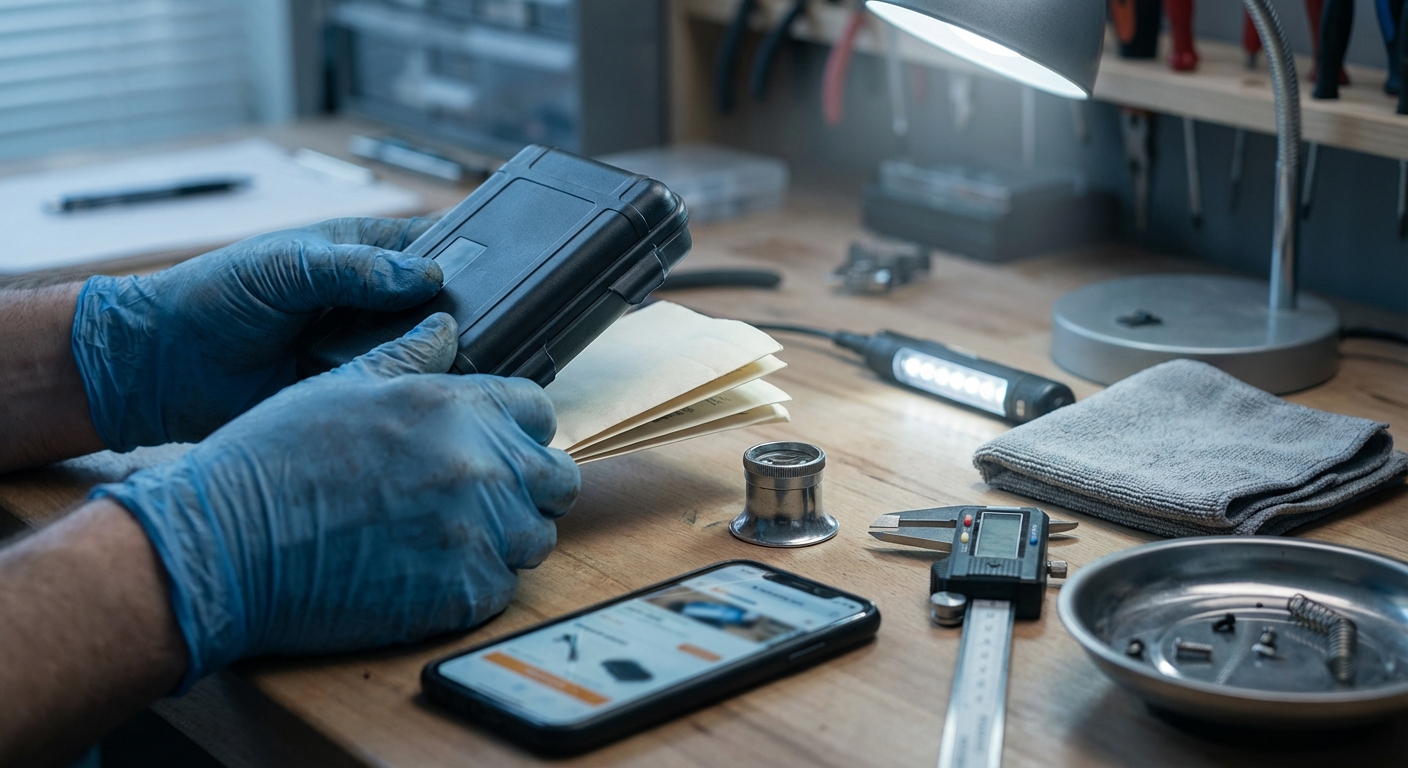
The fastest way to get to a realistic range is to focus on the same inputs appraisers use, not what you paid years ago.
- Local demand for your exact model and category:supply and demand can make a common carry pistol easier to move than a niche hunting rig, and that changes how aggressive buyers get.
- Condition as buyers perceive it: NRA/Blue Book-style condition grading treats condition like percentage bands tied to finish wear and bore quality, which is why “looks fine to me” can still land in a lower grade once the finish percentage and bore condition are judged. Bore condition is a major value input in these grading standards, bright rifling and no pitting prices differently than frosting or corrosion even with clean exterior metal.
- Originality vs aftermarket parts: upgrades help if your buyer pool wants a ready-to-run setup, but non-factory changes can hurt collector-leaning demand, especially on older or rarer guns.
- Matching numbers and documentation: where applicable, matching-number components and factory box, manuals, and provenance support higher value.
- Market data and timing: sold prices from dealer listings and auctions, plus seasonality and regional demand, keep you anchored to what’s actually moving.
Private sales often produce a higher gross price because there’s no middleman margin. Dealer offers price in overhead, resale risk, and the margin required to put that gun back on the shelf, which is why dealers commonly offer about 50%-60% of used retail in cash, or about 60%-70% as trade-in or store credit (USCCA guidance; NRA-family guidance broadly aligns with “roughly half” for outright purchase). The tradeoff is speed and simplicity, which is exactly why a dealer route feels “worth it” for a lot of sellers.
Most pricing searches cluster around familiar names: what a Glock 19 is worth and what a Glock 17 is worth, SIG SAUER P320 variants, S&W M&P pistols, classic 1911s, AR-15s, Ruger 10/22s, Remington 870s, Winchester Model 70s, and occasional collectibles like a Colt Python. Cash My Guns valuation factors include make and model, overall condition (finish and bore), matching numbers, aftermarket parts, market data (dealer listings and auctions), seasonality, and regional demand.
Sanity-check yourself by pulling real sold comps, grading your gun honestly (especially the bore), then deciding if the extra private-sale upside is worth the extra effort and uncertainty compared to a dealer’s faster, lower-but-cleaner number.
Time, Convenience, and Certainty
The money is only half the story; the other half is how much time and uncertainty you’re willing to absorb to get it.

The real cost of a private sale is often your time and uncertainty, not the listing fee.
You’re doing the whole job yourself: take clean photos, write the listing, answer messages, field low offers, negotiate, then coordinate a meetup that actually happens. The friction is human unpredictability, not mechanics, because a “serious buyer” can vanish, show up late, or try to re-trade the deal in the parking lot. Private sales can net more, but they also stall easily, and every extra day is more follow-up, more rescheduling, and more mental bandwidth.
A dealer or structured FFL process is built for closure: defined steps, fewer back-and-forths, and a predictable handoff, which is why it’s widely viewed as the hassle-free convenience play.
If you want that same “one clear path” feel without meeting strangers, services like Cash My Guns describe themselves as a nationwide online purchasing service that buys guns, ammunition, and accessories directly, positioned as “Safe • Legal • Hassle-Free.” and “Trusted Since 2013.”
Where consignment fits (sometimes). It sits in the middle: you hand the selling work to a shop, but you’re still waiting on a buyer, and you’re paying for that help (see selling a gun on consignment).
If you need speed and certainty, a dealer or structured direct-buy route tends to fit; if you can tolerate back-and-forth and delays to chase upside, a private sale can make sense.
Safety, Fraud, and Legal Risk
The biggest downside of a private sale usually isn’t price, it’s exposure: you’re taking on the personal safety, fraud, and liability risk of selling to a stranger yourself.
A private sale often means meeting a stranger, and the “normal” parts of the deal create risk: showing up with cash, handling a firearm, and dealing with someone you don’t actually know. Dealers and other FFL routes add a layer of separation because you’re conducting the handoff in a controlled business setting, instead of a parking lot or your driveway. Keep it simple: meet in public, in daylight, and if your area has a police-station safe exchange zone, use it. If anything feels off, walk away.
Legitimate transactions still go sideways because payment mechanics are easy to exploit. The FTC warns that in fake-check scams, funds can appear “available” before a check fully clears, and the seller can be on the hook when it bounces, especially in overpayment and refund setups. The FBI’s IC3 also documents online overpayment schemes where sellers lose money after reversals or fraudulent payments. The practical move is boring but effective: be cautious with unusual payment requests, pressure to move fast, or complicated “send money back” stories.
Private sales have less built-in buffering. A dealer sale generally comes with a more structured compliance process and a clearer paper trail, but you still need to follow your state’s rules and keep whatever records your state requires. You also need to pay attention to red flags that suggest you should not proceed.
Routing a private-party transfer through an FFL (and the usual 4473 and NICS check) can reduce risk when you want a neutral location, stronger documentation, and a cleaner compliance boundary between you and the buyer.
Cash My Guns positions its process as “Safe • Legal • Hassle-Free.” and publishes scam warnings, but no service can eliminate risk if you ignore warning signs.
Choose the route that keeps your risk within your comfort zone, and verify your local rules before you meet or transfer.
State Rules Change the Answer
That last point is where a lot of people get tripped up: the safety and compliance “feel” of a private sale can change completely once your state’s transfer rules kick in.
State rules can flip your “best choice” overnight, a private sale that’s routine in one state can be illegal or tightly regulated in another.
- Do private party transfers have to be processed through an FFL (dealer paperwork, background check)?
- Do you need a permit, buyer card, or an authorization number before transferring?
- Are background checks required for private sales, or only for dealer transfers (NICS check)?
- Do the rules change for handguns vs long guns, or for in state vs out of state transfers?
- Where to confirm: your state’s official website (state police, DOJ, AG), and a local FFL that processes transfers daily.
California: California generally requires firearm sales and transfers, including private party transfers, to be conducted through a California licensed dealer under CA Penal Code § 27545. For a deeper breakdown, see this guide to selling a gun in California. In practice, that means “meet in a parking lot and swap cash for a gun” is not the compliant path.
Texas: Texas does not have a state law requirement that private party sales run through an FFL or a state background check. For practical steps, review how to sell a gun in Texas. Texas still enforces unlawful transfer restrictions and prohibited person possession rules, including Tex. Penal Code §§ 46.06 and 46.04.
Pennsylvania: Pennsylvania private handgun transfers generally must go through an FFL or the county sheriff, with a background check and the SP4-113 form, under 18 Pa.C.S. § 6111 and Pennsylvania State Police guidance. Long gun rules are not identical, so firearm type matters.
Texas, Florida, California, Georgia, Pennsylvania, Ohio, Arizona, New York, North Carolina, and Illinois are common states people search for on this topic, but the only safe shortcut is verification. Before you pick private vs dealer, confirm your state’s required transfer path, then take the simplest compliant route.
Choose the Right Selling Route
Once you’ve confirmed what your state will actually allow, the choice comes back to your priorities: money, time, risk tolerance, and how much process you want built in.
The “right” route is the one that matches your priorities, money, time, risk tolerance, and whatever your state requires for a compliant transfer. The same gun can be worth different levels of effort depending on how fast you need it gone and how much exposure you’re willing to take on.
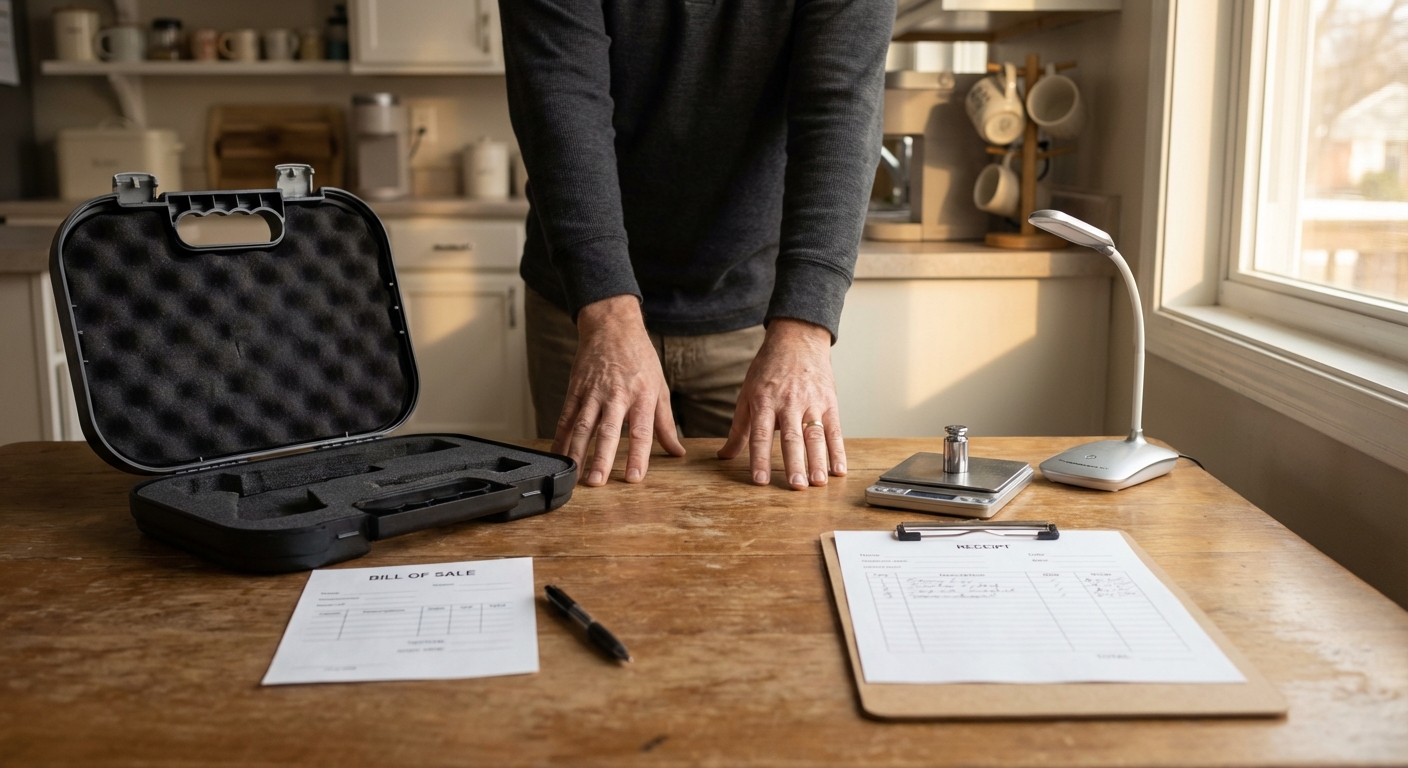
Choose a private sale when a higher price is worth extra coordination. You control the listing, the buyer conversation, and the meeting, which is where the work lives. For your paper trail, a simple bill of sale helps document what changed hands and when, but requirements vary by state. Include the firearm description and serial number, the date and location, and buyer and seller attestations.
Choose a dealer or other FFL route when you want the simplest, most predictable handoff. Dealer cash offers commonly land lower than private-party outcomes because the dealer prices in overhead, resale margin, and risk, which lines up with the general offer dynamics discussed earlier.
If you prefer an online option, Cash My Guns is an FFL-operated nationwide purchasing service.
Choose consignment when you want a stronger price than a straight buy offer, but you can wait and you’re fine paying a fee for the shop to market it and manage the buyer side.
A common handgun you want to move quickly usually points to a dealer sale. A collectible or rare model points to consignment or an appraisal-first approach, because accurate evaluation matters. A hunting long gun often sells best when local demand is active, so your timing matters as much as your route.
- Private sale: Clean photos, decide what accessories are included, and keep serial numbers off public listings. Sanity-check price against the same value drivers you used earlier. Have a transfer plan that stays compliant, including using an FFL if you want the extra buffer. Take only payment you’re comfortable verifying. Keep the bill of sale and your buyer communications.
- Dealer or FFL sale: Bring the firearm, mags, box, and any paperwork you have. Ask whether the offer changes for cash vs store credit. Confirm how they’ll handle the transfer on their end. Get a dated receipt or purchase document and keep it.
- Consignment: Agree on the consignment fee and the minimum you’ll accept before it goes on the wall. Confirm who sets markdowns and when. Make sure you can get your firearm back if you change your mind. Keep the signed consignment agreement and final settlement statement.
If you’ve got a collection or any uncommon pieces, an expert appraisal is money well spent before you commit to a route.
Conclusion
You’re really choosing between four practical factors: price, time and certainty, risk exposure, and whatever your state rules require.
Selling privately can put more money in your pocket, but you pay for it in scheduling, vetting buyers, and the uncertainty of deals that stall or fall apart. Selling through a dealer or other FFL route gives up some upside in exchange for a defined process and less exposure to scams and legal headaches.
If a dealer’s offer feels lower than your “market” number, that gap usually comes from real business costs, dealers build in margin and overhead so they can resell and stand behind the transaction.
Laws vary by state, and some rules effectively steer you toward an FFL, so confirm current requirements with official state resources or a local FFL before you decide.
If you want an FFL-run option, Cash My Guns is operated by Dunlap Gun Buyers (FFL) and is marketed as “Safe • Legal • Hassle-Free.” and it states “Trusted Since 2013.”