
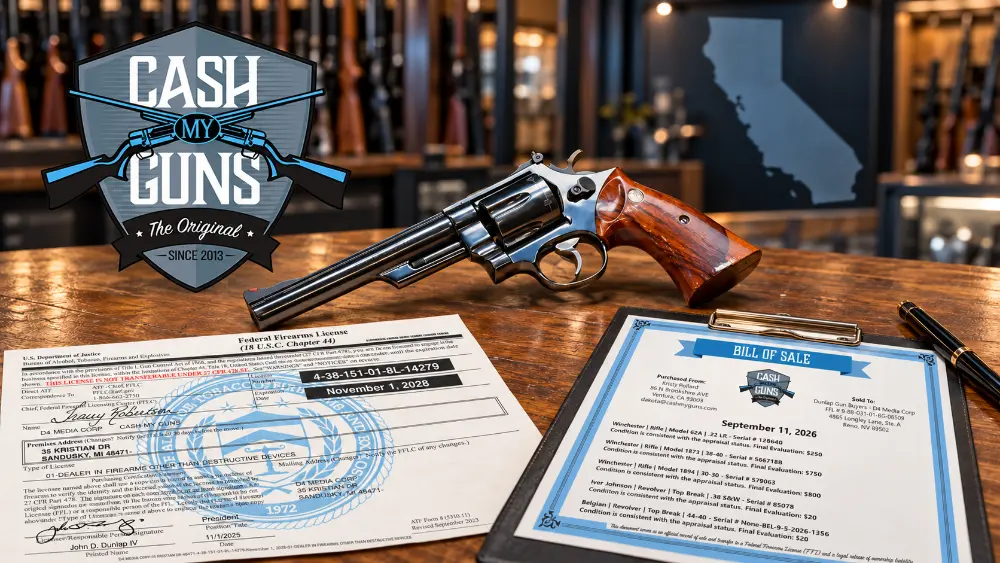
What Are the Legal Ways to Sell a Gun in California?
Where you can sell a firearm in California comes down to four routes: a direct sale to a licensed buyer, a sale to a local gun shop, a dealer-processed private sale, or consignment through a licensed business. California DOJ requires most private-party transfers between California residents to take place through a California firearms dealer, with both parties appearing in person. Finding someone willing to purchase the firearm does not replace that requirement.
For most California sellers, the practical choice is between selling directly to a business and finding an individual purchaser. Compare the work involved, the transfer arrangements, and the amount you would retain after applicable costs.
| Selling Route | Who Purchases the Firearm? | Transfer Arrangement | Main Advantage | Main Trade-Off |
|---|---|---|---|---|
| Online licensed buyer | The licensed business | Delivery to the buyer through an approved, lawful shipping process | No need to find a private purchaser | Shipping and inspection must be completed |
| Local gun shop | The dealer itself | Dealer acquisition at the shop | In-person discussion without shipping | The shop decides what inventory it will purchase |
| California private-party sale | Another individual | California dealer processes the transfer | You negotiate directly with the purchaser | You coordinate with the purchaser and the dealer |
| Consignment | An eventual purchaser | A licensed business handles the sale on your behalf | You can wait for a purchaser rather than accept a direct purchase offer | Payment depends on a sale, and consignment fees apply |
Dealer acquisitions and dealer-facilitated private transfers involve different records and responsibilities under guidance from the Bureau of Alcohol, Tobacco, Firearms and Explosives (ATF). Before leaving a firearm with a business, identify whether the business is buying it, accepting it on consignment, or only processing a transfer. Ask for the relevant purchase terms or consignment agreement in writing.
“California firearm owners should distinguish the buyer from the business handling the transfer. An outright dealer purchase, a dealer-processed private-party transfer, and a consignment are different arrangements, and that difference affects the paperwork, timing, costs, and when the seller is paid.” – John Dunlap, President, Cash My Guns
Not sure which route fits what you have? Identification and appraisal cost nothing and carry no obligation to sell. Start with a photo and get a free gun appraisal.
Do I Need an FFL to Sell a Gun in California?
You do not necessarily need your own dealer license to sell a firearm from your personal collection. California Penal Code section 26520 provides a state dealer-licensing exemption for qualifying infrequent sales and transfers. That exemption does not remove California’s separate requirement to use a dealer for most transfers between unlicensed people.
California Penal Code section 16730 defines an infrequent firearm sale or transfer using two conditions: fewer than six transactions per calendar year and no more than 50 firearms in total during that year. A transaction can involve more than one firearm. Those figures define a particular licensing exemption; they are not a blanket authorization to operate a firearms business or a complete explanation of every estate or collection exception.
Before arranging repeated sales or disposing of a substantial collection, have the applicable licensing and exemption rules assessed. Tell the dealer whether you are selling personal property, administering an estate, or acting for someone else. Dividing firearms into separate appointments does not by itself resolve a licensing question.
Can I Sell My Gun to a Gun Store or Licensed Firearms Buyer?
Yes. A licensed firearms dealer can purchase a firearm from a private owner, subject to the applicable laws and the dealer’s acceptance criteria. ATF’s dealer guidance requires licensed businesses to record firearm acquisitions, including acquisitions from unlicensed individuals. The dealer is the purchaser in this arrangement, not simply an intermediary between two private people.
For a local sale, contact the shop before traveling. Ask whether it purchases your firearm type, what identification it needs, and whether an appointment is required. Make clear that you are asking for an outright purchase rather than consignment or a private-party transfer.
Cash My Guns is a federally licensed firearms buyer that appraises and purchases firearms directly. Through its We Buy Guns service, you submit information and photographs for an appraisal before arranging shipment. You are dealing with the licensed business rather than creating a marketplace listing and waiting for another individual to respond.
“One of the biggest misconceptions is that selling to a gun store works like a private sale. When a licensed firearms buyer purchases your gun, the business is the buyer, so you don’t have to advertise it, meet strangers, or wait for an individual purchaser.” – Patrick A. Tarpey, General Manager, Cash My Guns
Can I Sell a Gun Online From California?
If you are moving out of California, deploying, or leaving the country, this is usually the route that applies. Arranging a sale online does not eliminate California or federal transfer requirements. California Penal Code section 27895 provides an exception to the state’s ordinary dealer-processing rule for a California resident’s transfer to an out-of-state federally licensed recipient when the transaction complies with federal law. Confirm the recipient’s license and the firearm’s eligibility before shipping.
ATF distinguishes a transfer to a licensee from a sale to an unlicensed person in another state. Under ATF guidance, an ordinary interstate sale to a private purchaser generally must pass through a firearms dealer in the purchaser’s state. Selling to an out-of-state licensed dealer is not the same as shipping directly to an out-of-state private purchaser.
Shipping eligibility also depends on the carrier. UPS, for example, limits firearm shipments to approved contractual arrangements involving specified licensed shippers. Federal permission to transfer a firearm does not mean every carrier, shipping counter, or label purchased online will accept the shipment. Obtain the receiving dealer’s instructions before packaging or tendering it.
For a Cash My Guns transaction, use the company’s firearm shipping instructions and confirm the approved handoff arrangements with its team. Do not substitute a different carrier or drop-off location without checking first. Keep your drop-off receipt.
Talk to an appraiser before you arrange any shipping, or call (775) 432-6006.
How Does a Private Party Transfer Work in California?
A California private party transfer (PPT) is a sale between private individuals that a California firearms dealer processes. California Penal Code section 28050 requires the dealer to receive the firearm and handle its delivery under the applicable transfer requirements. The seller does not simply hand the firearm to the purchaser after collecting payment.
An ordinary California PPT runs in this order.
- Confirm the dealer can process the transaction. Describe the firearm and confirm the appointment, document requirements, fees, and arrangements if the transfer cannot be completed.
- Appear at the California dealer with the purchaser. California DOJ describes PPTs between California residents as an in-person process involving both parties. Follow the dealer’s instructions for bringing the firearm into the premises.
- Complete the required transfer information. The dealer submits the Dealer Record of Sale (DROS), California’s firearm transaction record, and handles the required eligibility review. Review your information for accuracy before signing.
- Leave the firearm with the dealer.California DOJ’s guidance for dealers states that the ordinary waiting period is ten consecutive 24-hour periods after the DROS application is accepted. The dealer cannot deliver the firearm merely because the seller and purchaser have agreed on a price.
- Retain your transaction records. Request a receipt and the seller’s copy of the applicable transfer record. Keep the firearm description, transaction date, and dealer information with your records.
What documents should the seller bring?
If you are acting as an executor, personal representative, or administrator rather than selling your own firearm, bring the document establishing your authority along with your own identification. Ask the dealer for a seller-specific document list before the appointment. Have your identification and the firearm’s identifying information available, and explain any estate or ownership documentation involved. Distinguish your documents from those the purchaser needs: California DOJ’s Firearm Safety Certificate guidance generally concerns people purchasing or acquiring firearms, subject to exemptions. A purchaser’s certificate requirement is not a requirement for every seller to obtain the same certificate.
How should the firearm be transported to the dealer?
For handguns transported in a vehicle under California Penal Code section 25610, California DOJ’s transport guidance specifies that the handgun must be unloaded and secured in the vehicle’s trunk or a locked container. A glove compartment or utility compartment is not a qualifying locked container. Transporting an unloaded firearm to a dealer this way is lawful and routine, and it is how most sellers bring a firearm to an appointment. DOJ also identifies separate rules for other firearm types and circumstances, so confirm the applicable transport requirements before traveling.
If you are not familiar with a firearm, ask someone qualified for help before you handle, inspect, or move it.
How Much Is the California DROS Fee in 2026?
California DOJ lists $37.19 in combined state firearm transaction fees, checked on September 16, 2026. For an ordinary PPT, the dealer may add up to $10 for the first firearm, bringing that firearm’s listed state-and-PPT processing total to $47.19. The $31.19 DROS charge is only one component of the state total, and California DOJ publishes each component separately.
| Fee Component | Amount |
|---|---|
| Dealer Record of Sale fee | $31.19 |
| Firearms Safety Act fee | $1.00 |
| Safety and Enforcement fee | $5.00 |
| Combined state fees | $37.19 |
| Maximum additional PPT dealer fee for the first firearm | $10.00 |
| Combined state and PPT processing total for the first firearm | $47.19 |
How often each fee is charged matters more than the totals. California charges the state transaction fees once per transaction rather than once per firearm, while the dealer’s private-party fee is charged for each firearm.
- One Dealer Record of Sale covers every firearm transferred at the same time to the same person, handguns and long guns alike.
- The state fee is charged once. There is no additional state fee for a second or a tenth firearm.
Two examples show the difference. Selling one firearm through a California dealer costs $37.19 in state fees plus up to $10 for the dealer, so up to $47.19 in total. Selling five firearms in the same transaction costs the same $37.19 in state fees plus up to $10 for each firearm, so up to $87.19. If you are selling a collection, that is the difference worth knowing: the state fee does not repeat, so a larger collection does not multiply it.
California DOJ lists an additional dealer fee of up to $10 for each subsequent firearm in the same private-party transaction, so ask for an itemized explanation before the transfer, particularly when more than one firearm is involved. The $47.19 figure is not a universal fee for every firearm sale or shipment: it covers the specified California processing charges, not the firearm’s purchase price or every other transaction type. Agree with the purchaser about who will pay rather than assuming the costs fall on the seller.
These are California private-party transfer charges. A direct sale to a licensed buyer outside California is not a private-party transfer, so the DROS and PPT processing fees above do not apply to it. Cash My Guns covers shipping and the federal transfer fee on the firearms it buys.
Selling more than one firearm? Send us your firearm list, and we will look at them together.
Does California’s Handgun Roster Affect Selling a Gun?
California’s handgun roster affects which handguns dealers may ordinarily sell to the public, but California DOJ expressly identifies private-party transfers as exempt from the roster requirement. An off-roster handgun is not automatically unsellable simply because it is absent from that list. The transfer still has to qualify for the applicable exemption and comply with other laws.
California Penal Code section 32110 distinguishes qualifying dealer-processed private transfers from ordinary dealer retail sales. So selling a handgun privately through a dealer and selling that handgun to a shop for its inventory are not the same arrangement. Tell the dealer exactly which transaction you are proposing.
Roster status alone does not establish either legality or value. If you are selling from a collection, the specific variant and its configuration decide this rather than the model name. A firearm can raise separate questions about its configuration, acquisition history, or transfer restrictions. Have the exact model and proposed sale reviewed before advertising it as eligible for a particular transaction. California’s additional 2026 dealer restrictions also need consideration.
Are There Firearms That Require a Different Process in California?
Yes. California DOJ’s assault weapon guidance identifies separate transfer restrictions for registered assault weapons and .50 BMG rifles. An ordinary dealer license is not sufficient for every transaction involving those categories; the receiving California dealer may need the appropriate Dangerous Weapons Permit. A standard PPT appointment or an ordinary shipping arrangement may not be suitable.
Inherited firearms in these categories are treated separately again. California DOJ states that a person who obtains title to a registered assault weapon by bequest or intestate succession has 90 days, and 180 days for a registered .50 BMG rifle, to render it permanently inoperable, sell it to a licensed dealer holding the appropriate DOJ permit, obtain a DOJ permit to possess it, or lawfully remove it from the state, under California Penal Code sections 30915 and 30935.
If you inherited a registered assault weapon and you are selling it to a buyer outside California, the route that applies is lawfully removing it from the state. A licensed dealer in another state can purchase it once it has left California. Cash My Guns regularly completes this process for California sellers. California DOJ requires proof that the firearm has left the state so the registration in your name can be closed out. On every purchase, Cash My Guns issues a bill of sale that records each firearm by serial number, make, model, and caliber, alongside the seller’s details and its federal firearms license number. That document is the proof of transfer. Check the current form and deadline with California DOJ or an attorney when you reach that step, as the Department sets both and they can change.
California also added a distinct dealer restriction in 2026. Under Penal Code section 27595, beginning July 1, 2026, licensed dealers generally may not sell or transfer firearms within the statute’s defined category of semiautomatic machinegun-convertible pistols, subject to listed exceptions. The statute includes an exception for qualifying private-party-to-private-party transfers through a dealer. Roster status does not replace this separate analysis.
For an unusual or potentially restricted firearm, begin with identification and a review of the proposed transaction, not a promise to ship it. Describe the firearm accurately and provide existing records that may clarify its status. Do not modify a firearm in an attempt to make a sale possible based on a general online article.
For a contested estate, a court-ordered disposition, or uncertainty about lawful possession, obtain advice from an attorney qualified in California firearms law. Contact Cash My Guns about its transaction requirements, but do not treat a purchase inquiry as a substitute for legal advice.
Can I Sell Ammunition in California?
If you have ammunition alongside the firearms you are selling, you can include it. California regulates ammunition separately from firearms and more strictly than most states, and the strict part applies to sales inside California rather than to a sale out of state.
The rule is California Penal Code section 30312. A sale of ammunition has to be conducted by, or processed through, a licensed ammunition vendor. Where neither party holds that license, the seller hands the ammunition to a vendor, who processes the transaction and delivers it to the buyer. Passing ammunition straight to another California resident is not lawful just because you both may lawfully own it.
The same section sets out exemptions, and one of them covers selling out of state. Subdivision (c)(5) removes the vendor requirement for a sale, delivery or transfer of ammunition to someone whose licensed premises are outside California and who holds a federal firearms dealer or collector license. Cash My Guns is licensed outside California, so ammunition sold to it goes through that exemption rather than through a vendor.
Cash My Guns buys factory-sealed bulk ammunition, and ammunition that comes with a firearm collection. Loose or reloaded ammunition is not accepted. The process is the one you already know from the firearm: send details, get an offer, ship on the prepaid label. Tell the team what ammunition is in the sale before you pack anything.
How Do I Know What My Gun Is Worth Before Selling It?
A useful firearm valuation starts with the exact firearm, its condition, and evidence of comparable completed sales. Cash My Guns’ appraisal information identifies make, model, condition, originality, and market demand as relevant factors. Two firearms with the same broad model name can warrant different appraisals when their versions or condition differ.
Start by gathering clear photographs and the information already available to you. Cash My Guns requests photographs of both sides, visible markings, and identifying numbers, together with details such as the model and known history. There is no need to guess at a model designation, or to describe an unfamiliar firearm as rare. State what you know and let the appraiser identify what still needs confirmation.
Why do completed sales matter more than asking prices?
An asking price records what someone hopes to receive; a completed sale records what a purchaser actually paid. Compare recent completed sales of the same model and variant, not an active listing selected because its price is high. Cash My Guns’ published valuation guidance recommends matching identifiers, condition, and completeness when assessing comparable sales.
Keep the sale date with any comparison and distinguish a reported sale price from the amount a seller retained after fees. An older auction result or a firearm with different features is context, not an automatic price for yours. Without comparable evidence, a precise dollar estimate can suggest more certainty than the information supports.
Should I compare an offer with a retail asking price?
Compare the likely amount you would retain through each selling route, not only the largest advertised number. A direct purchase offer, a possible private sale, and consignment involve different work, costs, and uncertainty. Write down the expected proceeds after applicable charges and consider the effort required to complete each option. No route produces the highest net return in every case.
For help identifying and valuing a firearm, start with Free Gun Appraisal & Identification. The appraisal carries no obligation to sell. You can also speak with the team at (775) 432-6006 before deciding how to proceed.
How Does Selling to Cash My Guns From California Work?
Selling to Cash My Guns begins with photographs and identifying information, followed by appraisal, an offer, shipment, and inspection. Cash My Guns purchases directly rather than requiring you to find a separate private purchaser. Confirm that the company can accept your particular firearm and transaction before making shipping arrangements.
The steps run in this order.
- Submit information for a free appraisal. Provide photographs, identifying details, and an accurate condition description. For several firearms, use Sell Your Gun Collection and provide a list with each firearm’s make, model, and caliber.
- Review the offer and transaction terms. A first offer is based on the information you send. Cash My Guns’ Terms and Conditions state that an offer is not binding until the firearm has been received and examined. Review the terms before shipping, not only after receiving an offer.
- Use the approved shipping arrangements. Cash My Guns provides a prepaid label, covers shipping, and insures the firearm in transit at its appraised value. Its appraisal page also states that it covers federal transfer fees. Follow the company’s packing instructions and confirm the accepted carrier handoff procedure.
- Allow the firearm to be inspected. Cash My Guns checks the firearm against the submitted description. Its published process explains that a change in assessed value is communicated to the seller. Any difference is settled through the review process in those terms.
- Receive payment and the bill of sale. For a completed purchase, Cash My Guns offers a mailed business check or direct deposit. The company’s published process includes a bill of sale documenting the transaction. Keep that document with your other sales records.
Cash My Guns operates from Reno, Nevada, roughly two hours from Sacramento and under four from the Bay Area, so for parts of northern California an in-person handover can be a practical alternative to shipping. Drop-off is by appointment only. Some specially regulated firearms require additional review, so call (775) 432-6006 before you travel to confirm that an in-person handover is appropriate for your transaction.
A free appraisal is not the same as an unrestricted right to cancel after shipment. Cash My Guns’ Terms and Conditions address contractual acceptance, revised offers, and returns, including receiving-dealer transfer costs. Ask the team to explain those terms before sending a firearm.
The full Selling to Cash My Guns process provides additional context for the transaction.
Frequently Asked Questions About Selling a Gun in California
These answers cover what sellers ask most often. Each answer concerns the stated transaction, not every possible exemption or restricted-firearm situation.
Can I sell a gun directly to another person in California?
You can arrange a private sale, but California Penal Code section 27545 generally requires two unlicensed parties to complete the transfer through a licensed California firearms dealer. Payment, a private bill of sale, or a personal relationship with the purchaser does not replace the required dealer process. Confirm any claimed exemption before transferring possession.
Can I sell a gun to someone in another state?
Yes, when the applicable transfer requirements are satisfied. ATF states that an ordinary sale to an unlicensed out-of-state purchaser generally must be completed through an FFL in the purchaser’s state. A sale to an out-of-state licensed dealer is a different route, addressed for California residents by Penal Code section 27895. If you are moving, check the rules at your destination state as well.
Can I sell an inherited gun in California?
If firearms have come to you through a parent’s or a relative’s estate, you are allowed to sell them. An inherited firearm may be sold when the person arranging the sale has the necessary ownership or estate authority and the transaction meets applicable requirements. California Penal Code section 27875 sets conditions for certain intrafamily inheritance transfers; those exceptions do not automatically govern a later sale. Resolve ownership, reporting, or restricted-firearm questions before arranging delivery.
Where a firearm passes to you through an estate rather than as a lifetime gift, California Penal Code section 27920 treats it as a transfer by operation of law. California DOJ requires the person taking possession to report the transaction to the Department within 30 days, on the Report of Operation of Law or Intra-Familial Firearm Transaction (form BOF 4544A), filed through the California Firearms Application Reporting System or by mail, with a $19 processing fee. Receiving a firearm through an estate is not itself unlawful. That report is the step that records it, and it is separate from any later decision to sell. The form cannot be used for assault weapons.
If you do not know what the firearms are, identification and appraisal cost nothing and carry no obligation to sell. You can also call (775) 432-6006 and talk it through before deciding anything.
Can I sell an off-roster handgun in California?
California DOJ identifies qualifying private-party transfers as exempt from the handgun roster requirement. An off-roster handgun may therefore be eligible for a dealer-processed PPT, but roster exemption does not waive other firearm, purchaser, or transfer restrictions. Have the dealer confirm eligibility for the specific firearm and transaction.
What happens if the purchaser fails the background check?
The dealer cannot deliver the firearm to an ineligible purchaser. California Penal Code section 28050 addresses returning the firearm to the seller when lawful. If the dealer cannot lawfully return it, California DOJ’s failed-PPT guidance describes additional procedures, including a seller-requested holding period of up to 45 days in specified circumstances. Ask the dealer which procedure applies.
Do I need a Certificate of Eligibility to sell my personal firearm?
A Certificate of Eligibility (COE) is not a general permit that every private seller must obtain. California DOJ describes the COE as a background-eligibility credential used in particular firearms licensing, employment, and related contexts. For an ordinary private sale, confirm the dealer’s seller-document requirements. Specialized exemptions may involve additional credentials.
Does California limit how many guns I can sell in 30 days?
California’s purchase limit and its seller-licensing rules are different. California DOJ’s 2026 bulletin explains the three-firearm cumulative purchase limit within a 30-day period, effective April 1, 2026, subject to exceptions. Private-party transfers are not exempt from that limit. California Penal Code section 27535 counts them toward the same 30-day total, so someone acquiring several firearms through private transfers is subject to it in the same way as a retail purchaser. Separately, Penal Code sections 26520 and 16730 address qualifying infrequent sales using annual transaction and firearm totals. A buyer-side monthly limit is not a seller’s monthly allowance.
Can I give or sell a gun to a family member in California?
Some transfers between immediate family members are exempt from the dealer requirement. California Penal Code section 27875 covers a transfer by gift, bequest, intestate succession or other means between immediate family members, provided the transfer is infrequent and the person receiving the firearm is 18 or over and not prohibited from possessing one. California Penal Code section 16720 defines immediate family narrowly: parent and child, or grandparent and grandchild. Siblings are not included, so a transfer between a brother and a sister goes through a dealer like any other private-party transfer. California DOJ also treats a transfer between spouses or registered domestic partners as exempt from the dealer requirement. The person receiving the firearm files the same 30-day report described above.
Is my gun on record in California, and does it matter if it is not?
California does not require you to register a firearm you already lawfully own. What the state keeps is a record of transactions. California DOJ has retained records of handgun transactions for decades, and began retaining records of rifle and shotgun sales on January 1, 2014, so a long gun bought before that date usually does not appear in the system at all. An inherited firearm may not be recorded in your name either.
None of that prevents a sale. Neither a dealer-processed transfer nor a sale to a licensed buyer requires the firearm to be on record in your name first. If you want to know what is recorded, California DOJ publishes a free Automated Firearms System request form, and reporting ownership voluntarily is possible but not required.
How long does selling a gun in California take?
For a dealer-processed private-party transfer, the ordinary waiting period is ten consecutive 24-hour periods after the transaction record is accepted, and the buyer must take possession within 30 days of that record being submitted or the process starts again with a new record and new fees. A sale to a licensed buyer outside California runs on shipping and inspection instead of a state waiting period, so the timing depends on the carrier and the buyer rather than on a fixed statutory clock.
For an individual firearm, get a free appraisal using photographs and the information you have. For a collection, send your firearm list so the team can review the items together. To discuss the process before submitting a form, call (775) 432-6006.
This guide provides general information, not legal advice. Every transaction is subject to applicable federal, state, and local law. Confirm current requirements with the receiving dealer and obtain qualified legal advice for circumstances involving disputed ownership, court orders, or restricted firearms.