

You walk into a shop or grab a quick quote, and the number hits you like an insult. But you also don’t want to spend the next three weeks answering flaky messages, boxing up a firearm, or wondering if you’re stepping into a compliance mess.
That’s the real decision: speed and convenience vs maximizing what you actually walk away with. Quick offers feel “low” because they’re priced to remove your effort, your risk, and the dealer’s resale uncertainty in one shot.
On the trade-in side, the math usually starts with a haircut. Dealer rules of thumb commonly land around 50% to 60% of a firearm’s current used-retail value, adjusted for condition and demand, which is why trade-in numbers often feel disconnected from what you see on the shelf.
And the sticker offer still isn’t the story. Most shop trade-ins run through an FFL (Federal Firearms Licensee) because that license is the legal backbone behind dealer transactions, and the “trade-in credit” you’re offered is value applied toward another purchase rather than cash in hand, which can look generous on paper while shifting the real tradeoffs into taxes, pricing, and flexibility.
You’ll leave with a simple decision rule: pick the option that delivers the best net outcome for your time and comfort level, not the biggest headline number.
The simple math that decides it
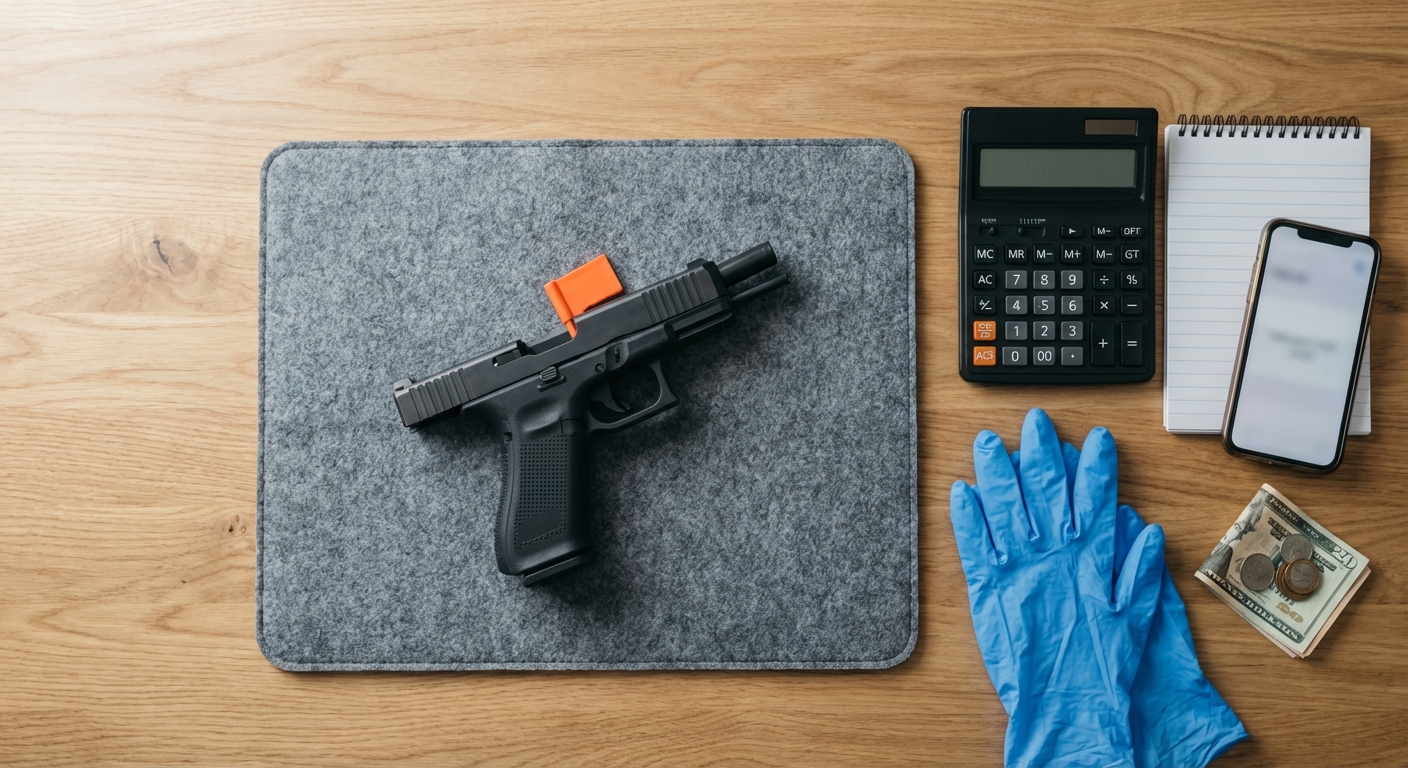
Two net numbers decide it. Put Net Sell next to Net Trade, and the “right” move usually stops being a debate and starts being a math problem.
You already saw how quick offers hide costs in the fine print. “Net” beats “offer price” because the headline number ignores the stuff that actually drains value, like platform fees and payment fees, plus the friction you absorb to get the deal across the finish line.
Net Sell is the cash you actually keep after subtracting all sale-related costs from your sale price, so a strong listing price can still disappoint once the real costs hit. Example input you can plug into your worksheet: GunBroker’s published firearms Final Value Fee is charged only if the item sells (no sale, no Final Value Fee), so the fee doesn’t matter until you actually have a buyer. The exact amount depends on the platform’s tiered schedule, plus whatever you spend on shipping, insurance, and transfer-related costs.
Net Trade is the effective value you get from trading after accounting for what you still pay on the replacement purchase, including how sales tax treats your trade credit and any store fees, so store credit is not automatically “free money.” Tax treatment is state-by-state: some states reduce the taxable amount when a qualifying trade allowance applies, while others tax the full purchase price, which can swing Net Trade by the full local tax rate. Verify your local rule, this is not legal advice.
- Sell inputs
- Expected sale price (private sale, marketplace, what gun stores typically pay for guns)
- Selling costs: marketplace commissions, payment processing (if applicable), shipping and packing, optional insurance or coverage
- Any transfer or FFL steps that create fees (FFL transfers are commonly cited around $20 to $50, with some outliers higher or lower)
- Trade inputs
- Trade-in credit offered
- Replacement purchase price you are applying it to, plus any store fees
- Tax treatment: does your state tax (price minus trade credit) or the full price?
- Time, effort, risk (optional but honest)
- Your hours x your hourly value (example: 3 hours x $25)
- A simple “risk buffer” you assign if you want one (example: $50 for hassle, no-shows, disputes)
If one input is fuzzy, especially taxes or transfer fees, run it as a range. If Net Sell beats Net Trade even in your worst-case, sell. If trade still wins in your best-case, trade. If they flip depending on the assumption, that’s your signal that convenience and risk tolerance should break the tie.
How to estimate your gun’s value
The net math is only as good as the value you feed into it. Get the value wrong and the math lies to you, because every “fee,” “discount,” or “store credit” gets applied to a number that was never real in the first place.
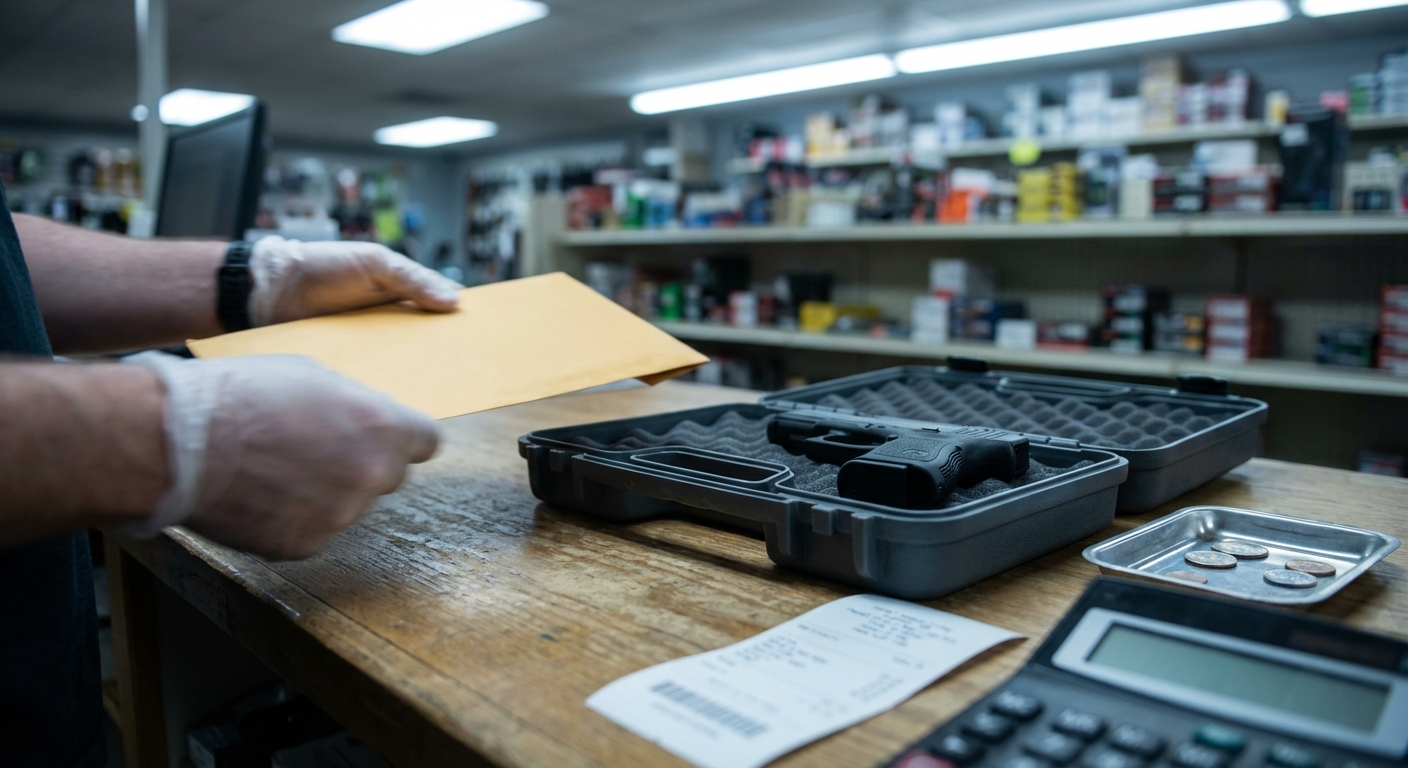
Value estimates usually go sideways for three boring reasons: the gun gets misidentified (wrong variant or generation), the “comp” is the wrong type (unsold asking prices), and completeness gets ignored (extra mags, box, optics, or a pile of aftermarket parts that doesn’t actually raise resale).
Use completed-sales comps, meaning recent sold listings or closed auctions that show what buyers actually paid for comparable items, because that data reflects real demand instead of optimistic price tags. GunBroker’s Completed Items view is useful here because it shows listings that ended with a sale and displays the final selling price.
Pull multiple recent sold comps, not just one “perfect” example. Then summarize them with a median (the middle sale) or a trimmed average (drop the highest and lowest) to reduce outliers like a bidding war or a weirdly beat-up example. Keep your comps recent, because for popular models, what sold last month can be more relevant than what sold last year when demand swings.
The fastest way to blow up your range is comparing the wrong configuration. Match exact identifiers: manufacturer, model, variant/generation/SKU, caliber, and finish. “Same brand, similar name” is not a match when one is optic-ready, threaded, or a different generation.
Then adjust for completeness. Factory box and paperwork, the number of included mags, and accessories like lights or optics change what a buyer is willing to pay today. Also separate original parts from aftermarket parts; aftermarket can be a plus, a minus, or neutral depending on what it is and whether the buyer trusts the install, so it belongs in your range logic, not as a guaranteed add-on.
Skip the grading rabbit hole. Focus on the high-impact signals: visible finish wear, rust or pitting, bore condition, and any functional issues. On collectible or older guns, mismatched numbered parts can materially change value, so document that clearly.
Unusual, collectible guns, and multi-gun collections benefit from more careful valuation because small configuration details and condition notes create big price gaps, and dealer offers vary based on how confident they are they can resell. For example, Cash My Guns describes valuing guns using a blend of make and model details, condition inputs (including finish, bore condition, matching numbers, aftermarket parts), and market data from dealer listings and auctions, with seasonality and regional demand in the mix.
Before you price it or request quotes…
- Photos to take: both sides, full top view, muzzle and crown, breech/feed area, serial number area (don’t post publicly), close-ups of wear, and clear shots of optics and accessories included.
- Details to write down: exact model/variant/gen or SKU, caliber, barrel length, finish, included mag count, optic model, lights/lasers, and every modification (trigger, barrel, springs, stippling, Cerakote).
- Honesty flags (prevents repricing later): finish wear, rust/pitting, bore issues, cracked grips or stock, missing factory parts, and mismatched numbered parts when applicable.
Trade-in, consignment, or direct sale
Once you know what the gun is really worth, the question becomes how you want to get paid-and how much hassle you’re willing to take on to do it. Your “best” selling route is really a constraint choice. If you need speed and certainty, you’ll trade dollars for a clean exit. If you want maximum net, you’ll do more coordination and carry more buyer risk. If you want less hassle than a direct sale but more upside than a trade-in, you’re usually looking at consignment or an FFL-facilitated online sale (see how to sell a gun: your options).
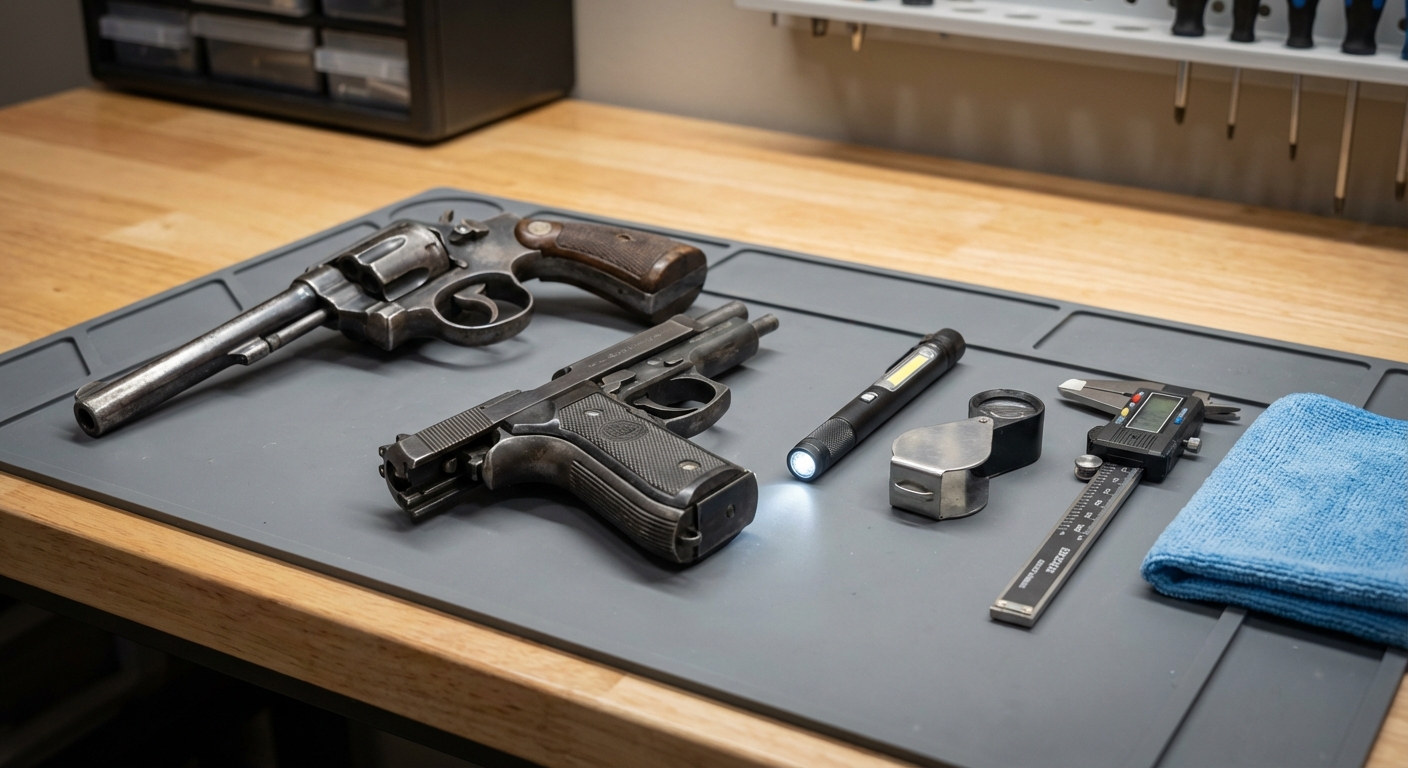
Trade-ins win on predictability. The upside for you is simple: once the dealer owns it, you’re not dealing with payment reversals, buyer claims, or return arguments.
That resale risk is real, shops often cannot predict how long a traded-in gun will sit in inventory before it sells.
A lawful private-party sale can produce a higher net because you’re not paying a dealer margin or commission. The friction is everything that makes the sale “yours” to manage, scheduling, verification, negotiation leverage (buyers push harder when they know you’re the only decision-maker), and the ugly category of payment risk.
Scams in direct or online-person-to-person deals usually show up as payment reversals and bait-and-switch tactics. An online gun sale through an FFL-facilitated process can reduce some of that risk, but you still need to watch for Venmo/PayPal reversals and “unrealistic offer” style scams.
Consignment is a sale arrangement where a dealer lists and sells your firearm and keeps an agreed commission, so you’re buying convenience with a cut of the proceeds. Commissions are commonly percentage-based, one example policy is about 20% under $2,000 and about 15% at or above $2,000, but terms vary by shop.
The tradeoff is timeline uncertainty and fee drag, in exchange for less direct handling of buyers and fewer disputes landing on you (more on selling a gun on consignment).
Compliance baseline: under federal law, a private (non-FFL) seller can generally transfer to another unlicensed resident of the same state without using an FFL unless state or local law adds requirements; interstate transfers generally have to route through an FFL process.
If two options come out close on net after fees and your time, pick the one with less stress and fewer ways to go wrong.
Worked examples for common models
This is where the earlier Net Sell vs Net Trade framework stops being abstract. The math changes once you include real costs. Plug realistic fees and your own time into your Net Sell and Net Trade worksheet, and the “obvious” choice flips fast, especially on lower-priced guns where fixed costs take a bigger bite. The numbers below are templates, not price predictions.

Example 1 (illustrative)
- Assumptions: you can trade today for $360 Net Trade, or list online for $500 sale price.
- GunBroker fee assumption: common categories generally have a $0 insertion fee, but you pay a Final Value Fee only when it sells. Using GunBroker’s published tiered schedule, that’s 6% of the first $250 plus 3.5% of $250.01 to $2,500, plus 1.5% above $2,500, capped at $499 per item. On $500, that’s about $23.75 in platform fee.
- Shipping assumption: plus shipping and packing; UPS requires Adult Signature Required for firearm shipments with an $8.35 surcharge per package.
- Example Net Sell: $500 minus $23.75 (GunBroker FVF), minus $30 shipping, minus $8.35 Adult Signature, minus $15 packing and insurance = about $423 Net Sell.
- Break-even: if your trade offer gets within roughly $60 of that Net Sell, the trade wins for a lot of people because you skip photos, messages, payment clearance, packing, and the “is this buyer legit?” cycle.
Example 2 (illustrative)
- Assumptions:$275 Net Trade vs $400 sale price.
- Example Net Sell: $400 minus about $20.25 (GunBroker FVF), minus $55 shipping, minus $8.35 Adult Signature, minus $10 packing, minus $8 insurance = about $298 Net Sell.
- FFL meeting friction: if you try a local non-shop sale and agree to meet at an FFL for paperwork, a round $35 transfer fee can easily wipe out what little spread is left.
- Break-even: for selling to beat trading here, you need either a meaningfully higher sale price or unusually cheap logistics. Otherwise you are doing extra work for $20 to $30.
- Realism check: long guns often mean bulkier boxes, more shipping hassle, and more back-and-forth with buyers about transfers.
Example 3 (illustrative)
- Assumptions:$3,200 Net Trade vs $4,000 sale price.
- Example Net Sell: $4,000 minus about $116.25 (GunBroker FVF under the same tiered schedule), minus $120 insured shipping and handling, including the $8.35 Adult Signature = about $3,764 Net Sell.
- Break-even: selling looks “worth it” on paper, but only if your condition story holds up. Blue Book condition language ties value tightly to the percent of original finish remaining, and refinished or restored guns are typically worth less. Auction condition reports also treat matching numbers as value-positive and mismatched as value-negative, which can dwarf any fee difference in either direction.
- Realism check: collectibles take longer because serious buyers want detailed photos, provenance, and zero surprises.
Rule of thumb: once fixed costs like platform fees, Adult Signature, shipping, and transfer friction are a big chunk of the sale price, the upside of selling shrinks fast. Use these templates to find your break-even point, then choose the route that still wins after you price your time.
State rules that change the equation
Sometimes the decision isn’t about dollars, it’s about friction. Your state’s transfer rules and basic shipping constraints can force extra steps, extra fees, and extra waiting, even when the offer looks clean on paper.
The compliance baseline matters here because it shapes what’s even possible (and what you’ll pay in fees to do it correctly). Start by confirming what path your deal actually has to take, including how to get rid of a gun legally in your state. In-state private party transfers can be straightforward in some places, but crossing state lines generally pushes you into an FFL (a licensed dealer) transfer process, which adds scheduling, paperwork, and transfer fees. Use state agency resources to confirm the current rule set, and treat social media advice as noise. For example, Texas DPS says Texas does not require a background check for private party transfers, has no FOID or permit-to-purchase requirement, and no state waiting period. Florida FDLE focuses its background check process on dealer sales, and Florida does not mandate universal background checks for private party transfers statewide. Rules vary fast, verify before you commit.
Confirm the receiving dealer is real and willing to accept your shipment or transfer. Use ATF FFL eZ Check to validate the license number and that the name and address match. If an FFL is transferring to another FFL, the receiving FFL provides a certified copy of the license, missing or mismatched info is a common cause of delays.
USPS generally prohibits non-FFLs from mailing handguns, with limited exceptions. USPS allows rifles and shotguns if unloaded and otherwise compliant, but it prohibits ammunition in the same mailpiece as a firearm and requires non-descriptive packaging with no firearm-identifying markings. UPS policy requires Adult Signature Required for firearm shipments, and carrier eligibility rules can limit what a consumer can ship directly.
- Confirm whether your transfer must go through an FFL based on buyer location and state rules.
- Verify the receiving FFL in ATF eZ Check, then confirm they will accept the firearm and their intake requirements.
- Match the carrier method to the firearm type, and confirm packaging, ammo separation, and signature requirements.
If all of this feels like a lot, picking an FFL-forward route that’s built to be “Safe • Legal • Hassle-Free” usually cuts the mistake rate and the back-and-forth.
A clear decision rule you can use
Pick the option that wins on net value after you price your time and reduce avoidable risk. The Net Sell vs Net Trade result can flip based on fees, taxes, and the real-world friction of doing it right.
- Pull completed-sales comps, then set a realistic value range.
- Compare Net Sell vs Net Trade using your actual fees, shipping, and transfers.
- Choose your channel: trade-in is fastest, private sale pays more but adds work and risk, consignment trades margin for convenience.
- Verify local requirements and shipping constraints before you commit to a path.
- Protect shipments with eyes open: carrier declared value is generally a liability limit with exclusions, not full insurance coverage, so don’t assume you’re fully covered.
If you’re moving high-value guns or a collection and want a Safe • Legal • Hassle-Free, FFL-run nationwide option, Cash My Guns is a straightforward way to get a firm offer without the usual exposure.