How to Sell a Gun in Alabama: A Comprehensive Guide
When buying or selling a firearm in the state of Alabama all parties involved should have knowledge of the state’s laws and regulations that govern…
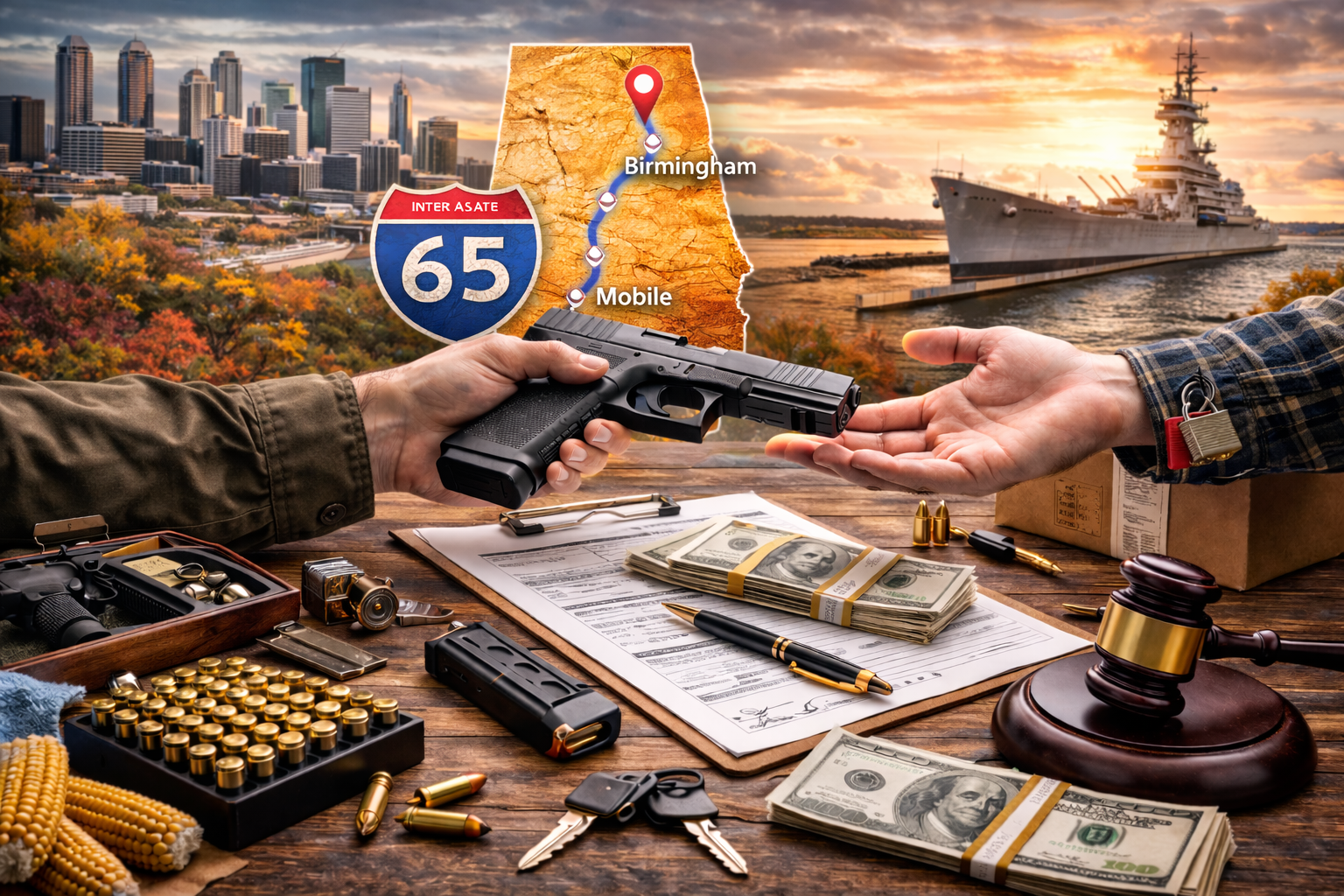
Whether you’re in downtown Birmingham, the Huntsville defense corridor, the Gulf Coast around Mobile, or a small town in the Black Belt, Alabama offers some of the most straightforward firearms selling options in the country. Local gun shops, pawn shops, gun shows, online FFL buyers, and private sales are all accessible statewide. The state’s permissive framework (no background check for private sales, no waiting period, no registration, permitless carry) keeps the process simple. These guides cover every selling option, local considerations, and legal requirement for Alabama gun owners.
Alabama defaults to federal law for most firearms regulations. There is no state requirement for a background check when selling a firearm in a private transaction between two individuals. The seller does not need a license, permit, or any state authorization to complete a private sale. Identification is not legally required for private transactions, although it is strongly recommended.
The seller's primary legal responsibility is ensuring the buyer is not a prohibited person under Alabama Code 1975, § 13A-11-72(b) or federal law. Selling to a known prohibited person, selling a defaced firearm, or selling a restricted weapon (such as a machine gun or explosive device) can result in criminal charges up to and including a felony. The 2025 passage of SB119 significantly expanded the categories of prohibited persons in Alabama, making seller diligence more important than ever.
For sales through a licensed FFL dealer, the buyer must complete ATF Form 4473 and pass a National Instant Criminal Background Check System (NICS) check. The dealer maintains the form. Federal law also requires that interstate firearms sales between private individuals must go through a licensed FFL in the buyer's home state.
Even in a permissive state like Alabama, sellers carry legal exposure. Federal law applies everywhere, and Alabama law adds its own prohibited persons categories. As a seller, you should confirm the buyer appears to be of legal age (18 for long guns, 21 for handguns from a dealer), is not obviously intoxicated or impaired, and does not disclose any disqualifying conditions.
While Alabama does not require identification for private sales, recording the buyer's driver's license information protects you if the firearm is later connected to a crime. A bill of sale should include: make, model, serial number, and caliber of the firearm, full names and addresses of both parties, the date and purchase price, and a written statement from the buyer confirming their legal eligibility to possess firearms.
Selling to a licensed FFL dealer like CashMyGuns.com eliminates all private sale risk. We verify eligibility through NICS, maintain ATF-required records, handle all federal compliance, and you receive competitive market-value pricing.
Alabama does not require background checks for private sales between individuals. FFL dealer sales require NICS check and ATF Form 4473.
No state-mandated waiting period. Transfers can be completed immediately upon passing a dealer background check, or at the time of a private sale.
Alabama does not require firearms registration. No state database tracks private firearm ownership.
No permit, license, or state ID is required to purchase or own a firearm in Alabama.
Alabama enacted permitless (constitutional) carry effective January 1, 2023 (HB272). Optional permits available for reciprocity.
18 to purchase long guns (rifles, shotguns, ammunition). 21 to purchase handguns from a dealer. Federal age minimums apply.
Alabama has no state assault weapons ban and no magazine capacity restrictions. SB116 specifically targets machine gun conversion devices.
Not legally required but strongly recommended. Document make, model, serial number, caliber, both parties' names, date, and price.
When buying or selling a firearm in the state of Alabama all parties involved should have knowledge of the state’s laws and regulations that govern…
Selling a firearm in Alabama involves specific legal requirements and procedures. Whether you’re downsizing your collection or selling a single…
No. Alabama does not require a background check for private firearms transactions. Only FFL dealer sales require a NICS check and Form 4473. Sellers are still responsible for ensuring the buyer is not a prohibited person under federal or Alabama state law (Ala. Code 1975, § 13A-11-72(b), as amended by SB119). Selling to a known prohibited person can result in felony charges.
No. Alabama has no state-mandated waiting period. Once a buyer passes a background check at a dealer, the transfer happens immediately. Private sales also have no waiting period.
SB116, signed March 19, 2025 and effective October 1, 2025, makes it a Class C felony to possess, sell, or use parts designed to convert a pistol into a machine gun. These devices are commonly known as Glock switches or auto sears. Exemptions exist for law enforcement, federally registered NFA items, and devices that do not enable more than two shots per trigger pull.
SB119, effective October 1, 2025, expanded Alabama's prohibited persons list. Anyone convicted of any felony (not just violent felonies) is now barred from possessing firearms. Individuals with a felony conviction in the last five years or three or more felony convictions are permanently banned. People charged (not yet convicted) with a violent crime or domestic violence and released pending trial face a Class C felony for firearm possession. This makes seller due diligence more important.
No permit is needed for occasional private sales. If you sell firearms regularly as a business activity, federal law requires an FFL. The ATF's Bipartisan Safer Communities Act guidance clarified that selling with a principal motive of profit may require a license regardless of volume.
Not legally required in Alabama, and identification is not mandated for private sales. However, a bill of sale is strongly recommended. Include the firearm's make, model, serial number, caliber, both parties' names and addresses, date, price, and a buyer eligibility statement. Both parties should keep signed copies.
Not directly. Federal law requires interstate private firearms sales to go through a licensed FFL in the buyer's home state. Selling to an FFL like CashMyGuns.com is the simplest way to sell across state lines legally from Alabama.
Yes. We hold active FFLs, buy from all 50 states, and have completed hundreds of Alabama transactions. Submit your firearm details, get a free appraisal, ship with our prepaid insured label, and get paid. We handle all federal compliance.
Alabama has historically been one of the most firearms-friendly states in the country, and that accessibility extends to the selling experience. From major metro areas like Birmingham, Huntsville, Montgomery, and Mobile to rural communities across the Tennessee Valley and Gulf Coast, gun owners have multiple paths to sell firearms legally. Local gun shops and pawn shops are common in every Alabama city, gun shows rotate through convention centers statewide, online FFL buyers ship from anywhere, and private sales are legal without a background check. The state imposes no waiting period, no registration system, and no permit to purchase or own. Concealed carry has been permitless since January 2023. Recent legislative sessions have introduced some updates sellers should be aware of, while maintaining Alabama's overall permissive framework.
Alabama law does not require a background check, permit, or government involvement for private firearms sales between two individuals. The state does not require identification to be presented during a private sale, does not require any paperwork to be filed with any state agency, and does not require a waiting period. This framework defaults almost entirely to federal law, which prohibits selling to anyone who is a prohibited person under 18 U.S.C. § 922(g) and requires interstate sales to go through a licensed dealer.
The absence of state requirements places a meaningful burden on the seller. If you sell to someone who turns out to be a prohibited person, you may face federal charges under 18 U.S.C. § 922(d), which makes it unlawful to sell or transfer a firearm to someone you know or have reasonable cause to believe falls into a prohibited category. While Alabama does not require you to run a background check, it does penalize selling to ineligible buyers, selling defaced firearms, or selling restricted weapons such as machine guns (now including conversion devices under SB116).
Before SB119, Alabama's prohibited persons list was relatively narrow: individuals convicted of crimes of violence, misdemeanor domestic violence offenses, violent offenses, or those subject to valid domestic abuse protection orders. SB119, effective October 1, 2025, expanded this list substantially. Anyone convicted of any felony is now prohibited from possessing firearms, even if the felony was non-violent. Individuals convicted of a felony within the previous five years face a prohibition, and anyone with three or more felony convictions is permanently banned. The most controversial provision makes it a Class C felony for a person to possess a firearm after being charged (not convicted) with a violent offense or domestic violence and released pending trial. This provision has drawn significant criticism from Second Amendment advocacy organizations, though it applies only if the person is ultimately convicted of the original charge or a lesser offense.
For sellers, SB119 means the pool of prohibited buyers in Alabama has grown. While the practical enforcement mechanism remains the same (sellers are not required to run checks), the legal consequences of selling to a now-prohibited person have increased.
SB116 created a new state-level felony for possessing, selling, or using parts designed to convert a pistol into a machine gun. These devices, commonly known as Glock switches or auto sears, were already illegal under federal NFA law, but SB116 gives Alabama law enforcement independent authority to prosecute. The legislation was prompted by the September 2024 mass shooting in Birmingham's Five Points South neighborhood. The Class C felony carries up to 10 years imprisonment. Sellers should ensure they are not transferring any firearm parts that could be classified as conversion devices under this law.
All sales through a Federal Firearms Licensee in Alabama follow the standard federal process: the buyer completes ATF Form 4473, the dealer contacts NICS for a background check, and the transfer is completed upon approval. Alabama does not run its own state-level background check system. The NICS check typically returns results within minutes, though delays can occur. If NICS does not return a result within three business days, the dealer may (but is not required to) proceed with the transfer under federal law. Alabama has no "point of contact" system; all checks go directly through the FBI's NICS database.
Alabama's 2022 passage of HB272, effective January 1, 2023, eliminated the requirement for a concealed carry permit. Any individual who is legally allowed to possess a firearm can now carry concealed without a permit. This does not change selling laws, but it does mean that the presence (or absence) of a carry permit is no longer a reliable indicator of a buyer's eligibility. Previously, some sellers used a valid Alabama concealed carry permit as informal proof of a buyer's legal eligibility. With permitless carry, that shortcut is less reliable. Alabama still issues optional concealed carry permits for reciprocity purposes (recognized by numerous other states), and sellers can still request to see one as a voluntary due diligence step.
Alabama has no assault weapons ban and no magazine capacity restrictions. The state has preemption that prevents local governments from enacting firearms ordinances that are more restrictive than state law (Ala. Code § 11-80-11), though Montgomery attempted a local ID-requirement ordinance in September 2024. SB281, signed by Governor Ivey in May 2024, established financial privacy protections for gun owners, preventing financial institutions from using firearms-specific merchant category codes to flag or restrict transactions. Firearms cannot be possessed on school premises (a Class C felony with intent to harm under SB119), in courthouses, or in police stations without express permission.
Whether you're in a Birmingham suburb, near Redstone Arsenal in Huntsville, on the Gulf Coast in Mobile, or anywhere across Alabama's 67 counties, selling to a licensed FFL like CashMyGuns.com is the fastest path with zero legal risk. We run NICS checks on all buyers, maintain ATF-required records, verify eligibility through the federal system, and handle all compliance. The process works the same from anywhere in the state: submit your firearm details online, receive a free expert appraisal (typically within hours), ship with our prepaid insured label at no cost, and receive payment. We've processed hundreds of Alabama firearms transactions since 2013 and consistently offer more than local pawn shops and gun stores. No driving to a shop, no meeting strangers at a parking lot, no paperwork to file.
When buying or selling a firearm in the state of Alabama all parties involved should have knowledge of the state’s laws and regulations that govern…
June was a big month for collectors, with some truly iconic firearms passing through our doors. For those who love history you can hold, these guns…
The Beretta 950BS Jetfire is a classic semi-automatic pocket pistol renowned for its compact design and unique tip-up barrel. As a discontinued model…
Why Do Gun Owners Like Shotguns of the World Wars? Shotguns utilized by soldiers during the World Wars occupy a unique place in the realm of…