
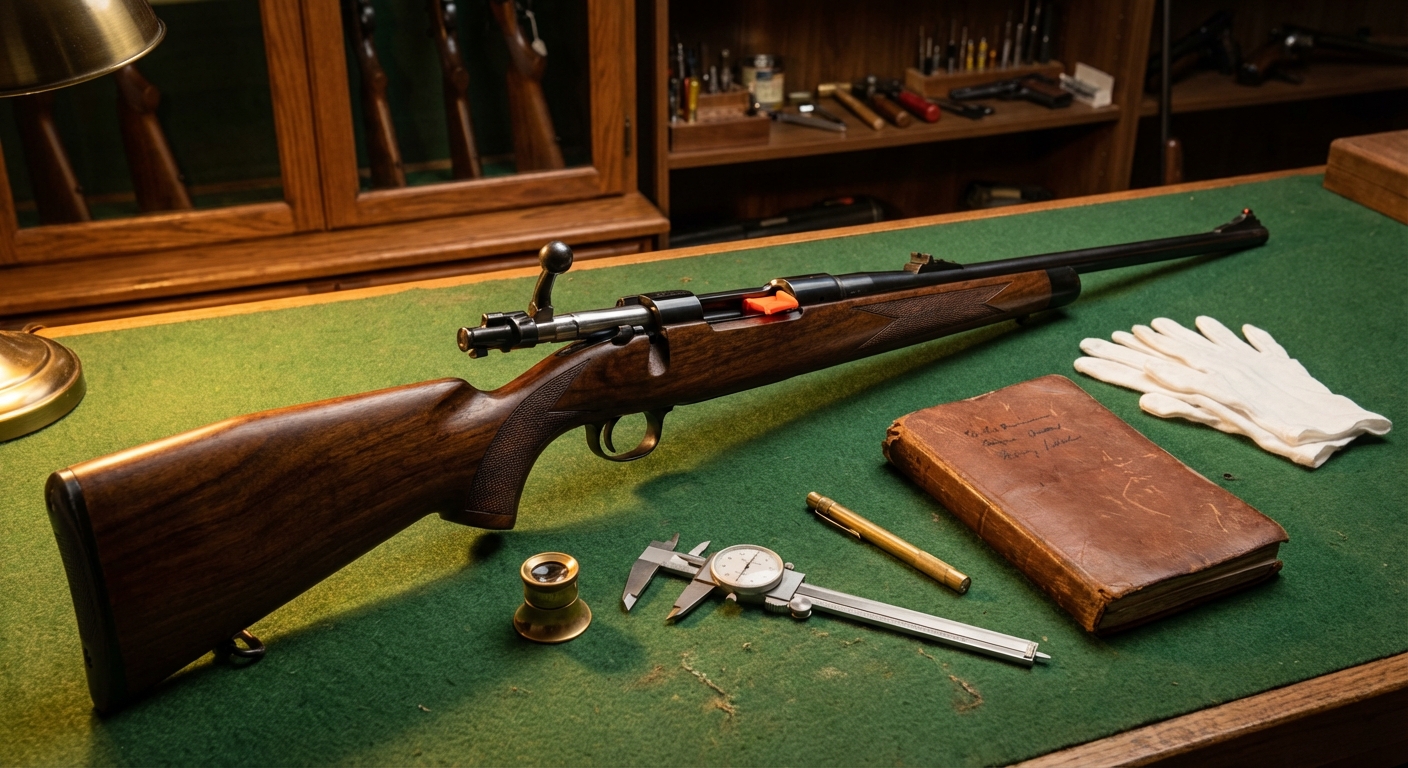

You’ve got a Model 70 and every price you see online contradicts the last one. You Google “Model 70 value,” and it feels like the internet can’t decide if your rifle is a basic used hunting gun or a serious collector piece.
Here’s the trap: “Model 70” isn’t one price, it’s a whole family of rifles. Value moves fast based on era, configuration, condition, and what’s actually with the gun, like original parts and paperwork. Then the number you care about changes again depending on how you sell, because “market value” and what you actually walk away with are rarely the same thing.
Collectors call rifles made before the 1964 redesign “pre-64,” meaning 1936 to 1963 production, and that one detail alone can put two “Model 70s” in totally different buyer categories. The commonly cited serial cutoff, often credited to Roger Rule’s reference work, is 1 through 581,471 for pre-64, with post-64 beginning at 581,472.
Timing and location matter too, since valuations hinge on condition plus market data from dealer listings and auctions, and they shift with seasonality and regional demand. The source material used here doesn’t include recent sold-price results or any quantified pre-64 premium, so the repeatable path is what wins: identify what you have, judge originality and condition, verify against real sales, then pick a selling path that matches your goal.
Identify your exact Model 70
Before you look up prices, lock down what you actually have. If you can’t describe your Model 70 precisely, your “value” research will be junk, matching the right variant is the whole game.
Start by putting your rifle in the big bucket buyers use: pre-64 (made before the 1964 changeover) or post-64. You’ll also see “Classic” in listings, which is a later, reintroduced controlled-round feed action from the early 1990s onward, not “pre-64,” but it gets talked about in the same breath.
Don’t try to solve edge-case serial numbers from memory. If your rifle seems “in between,” confirm using a reputable Model 70 reference or a qualified appraiser.
Pre-64 Model 70s use controlled-round feed (CRF), meaning the cartridge is captured by a full-length Mauser-style claw extractor as it feeds, and ejection is handled by a fixed blade ejector in the receiver, not a bolt-face plunger.
Most 1964 to 1991 Model 70s are push-feed (PF). They typically show a recessed bolt face with a spring-loaded plunger ejector and a smaller hook-style extractor. Quick checkpoint: open the bolt and look at the bolt face, a plunger button is the tell.
For basic “catalog language,” the two most common labels you’ll need are Standard vs Featherweight. A Standard rifle is commonly a 24-inch sporter-weight barrel with factory open sights. A Featherweight is commonly a lighter setup with a shorter, light-contour barrel, often 22 inches. If your rifle has a noticeably handier profile and shorter barrel, it usually gets searched as a Featherweight.
- Record the serial number exactly as stamped (typically on the receiver).
- Note the caliber marking (commonly on the barrel).
- Measure barrel length (muzzle to closed bolt face).
- Check for factory open sights (front ramp and rear sight).
- Describe stock material (walnut, synthetic, laminate).
- Photograph any obvious special-edition or “Classic” markings.
If you want a clean note that an appraiser can work from, use this template: “post-64 PF, Standard,.30-06, 24-inch barrel, open sights, walnut stock.” If you’re unsure on any of those fields, use a guide to identifying your gun to confirm the basics first.
Condition and originality multipliers
Once you know the era and configuration, condition and originality decide whether your rifle lands as a straightforward hunting gun or something buyers treat as collectible.
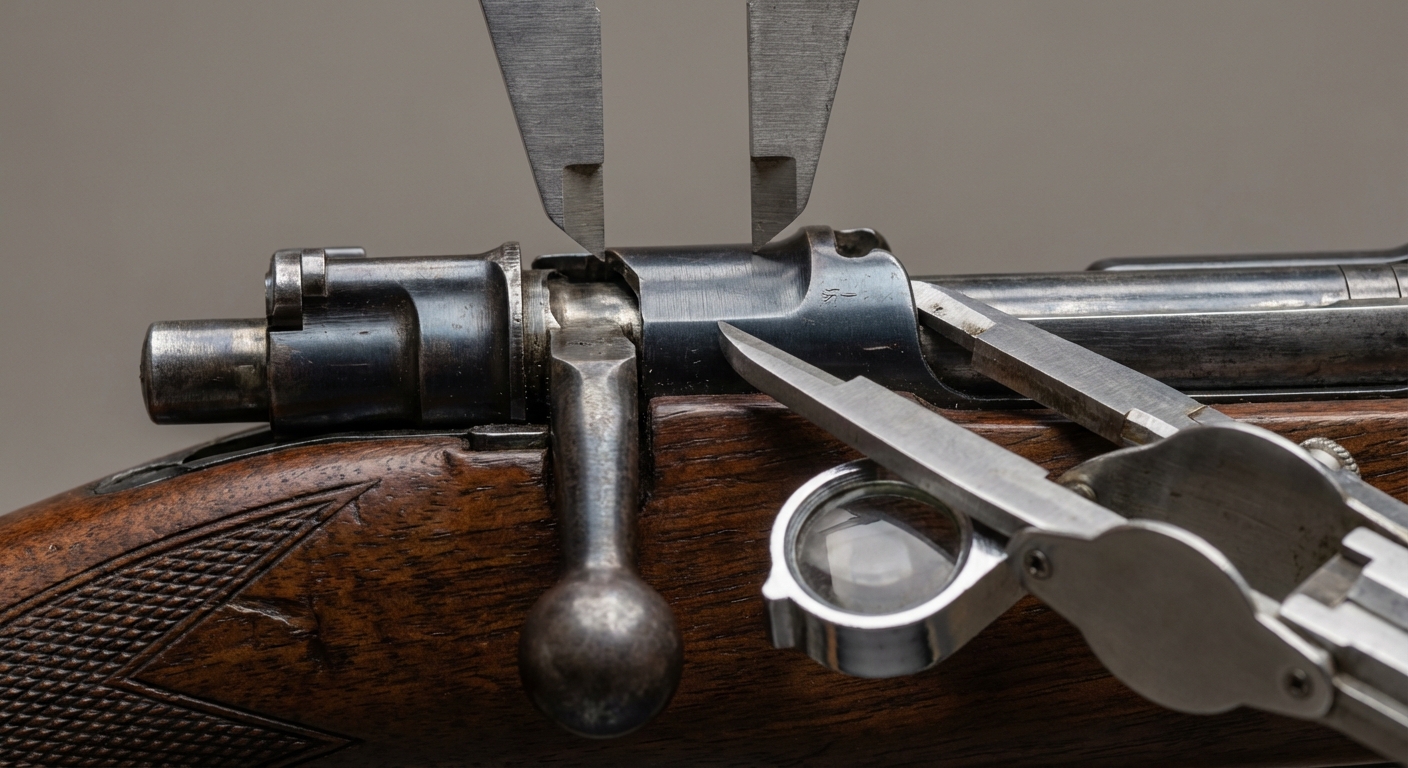
On a Winchester Model 70, condition and originality are the biggest multiplier or penalty, two rifles that look “the same” on paper can land in completely different price brackets once you see the finish, bore, and any altered parts.
Start by making it safe and clear, then inspect like a buyer who’s deciding if they’re paying “clean collector rifle” money or “honest hunting rifle” money. On the metal, you’re looking for finish wear at carry points (muzzle, floorplate, bolt handle), sharp edge wear, freckling, and any rust or pitting that’s more than surface-deep. In the bore and at the crown, bright and crisp lands win; dark fouling, pitting, and crown dings are where “looks fine” turns into “shoots frustrating.” On the stock, check the wrist for cracks, old repairs, and chips, and look for clues it’s been swapped (mismatched fit lines, odd finish, or hardware that doesn’t quite sit right). Finally, run the rifle through basic function, the bolt should cycle smoothly, the safety should click positively, and the trigger should feel consistent. You’re not diagnosing, you’re confirming it behaves like a sound rifle.
When buyers say “Very Good” or “Excellent,” they’re often leaning on NRA Modern Gun Condition Standards, which use six primary grades (New, Excellent, Very Good, Good, Fair, Poor) based on observable things like original finish remaining, mechanical function, and bore condition. As a quick anchor, “Excellent” is commonly around 98% to 100% original finish, and “Very Good” is commonly around 95% to 98%. If you can estimate finish percentage and describe the bore plainly, your condition description suddenly sounds like everyone else’s.
Collector logic is simple: changes to a highly collectible gun reduce collector value. On more common Model 70s, mods still often reduce value, but it depends on who’s buying, a “shooter” might like a practical upgrade, while a collector will pay for untouched—especially when what makes a gun collectible comes down to originality and scarcity.
High-signal value changers include refinishing or rebluing, recoil pad swaps (especially if the stock was cut), bedding work, rebarreling, extra drilling and tapping, and aftermarket triggers. A quick refinishing red-flag check:
- Proof marks that look partially filled or “soft”
- Blue that’s unusually bright and uniform compared to typical factory aging
This is also why professional buyers and appraisers, including federally licensed dealers that buy online, scrutinize originality details, because altered parts change what the rifle is in the market—and why original finish and natural patina can be worth more than a refinish.
- Estimate finish: “About ___% blue remaining, wear on ___, no rust/pitting”
- Describe bore and crown: “Bore is ___, crown is ___”
- Disclose changes: “Known mods: ___ (recoil pad, bedding, trigger, refinish, holes, barrel)”
- List what’s included: “Sling, scope/rings, box/papers, extra mags, etc.”
Find comps and read the market
Once you can describe the rifle the way a buyer would, you can finally compare it to sales that actually mean something.
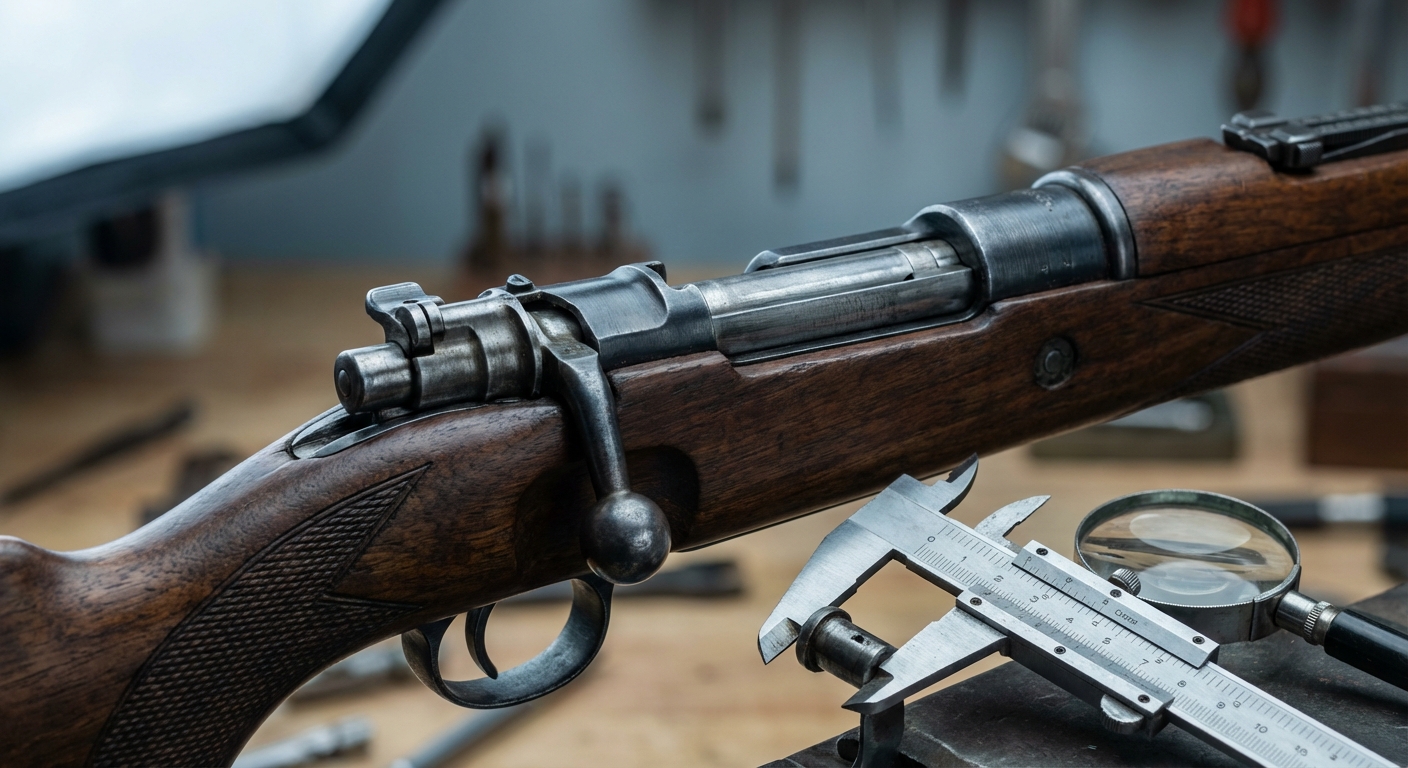
Asking prices lie, sold comps tell you what buyers actually paid.
A fair-market number comes from what a rifle actually cleared for on the open market, not what someone hopes to get for it. That’s why you want sold comps, comparable rifles with documented completed sale prices, because they reflect real bids and real money changing hands.
- Search completed sales on whatever marketplace you’re using, not active listings.
- Use the platform’s “completed” filter so you’re looking at closed results instead of unsold inventory.
For example on GunBroker, Quick Search only hits active listings. To see closed-auction results, you use Advanced Search and switch from “Current Items” to “Completed Items” before you run the search. Some users report the “Completed Items” view requires being registered and logged in. If you want a bigger-picture read, GunBroker Market Data publishes month-by-month realized sale metrics by category, which is useful for spotting seasonal swings without hand-counting auctions.
The trap is grabbing “Model 70” results that look close in photos but are fundamentally different rifles in the listing fields. Keep it simple and match the big levers that move clearing price fast: the same era bucket, the same feed system bucket (CRF vs PF, if that’s how the listing breaks it out), Standard vs Featherweight, the same caliber, and a similar condition grade.
If any of those are off, your comp stops being a comp. A Featherweight in.270 with honest hunting wear doesn’t anchor a clean Standard in.300 H&H, even if both say “Model 70” and both sold last week.
Even perfect comps skew if you ignore timing and how supply and demand affects firearm resale prices. NSSF “Adjusted NICS” shows recurring seasonality in U.S. firearms demand, with demand commonly peaking in late Q4, especially November and December. GunBroker’s own index and market commentary has also documented demand-shock periods, notably 2020 to 2021, where realized online-auction prices ran materially higher than pre-2020.
Regional demand matters too, which is why professional buyers like Cash My Guns don’t treat a single screenshot as “the market.”
Actionable rule: collect 5 to 10 sold comps, write down the sale month for each, then circle the 2 to 3 closest matches and let those anchor your range. If you need a baseline, a current Winchester Model 70 worth guide can help you sanity-check typical ranges and the value drivers you should match in your comps. Remember, “sold” is not the same as “net,” the headline sold number isn’t always what the seller took home.
Choose a selling path
Once you have a realistic sold-comp range, the decision shifts from “what is it worth?” to “what will I actually take home?” A Model 70 that “sells for $1,200” can be worth a lot less to you once fees, shipping and insurance, transfer costs, and the time and risk you absorbed are subtracted.
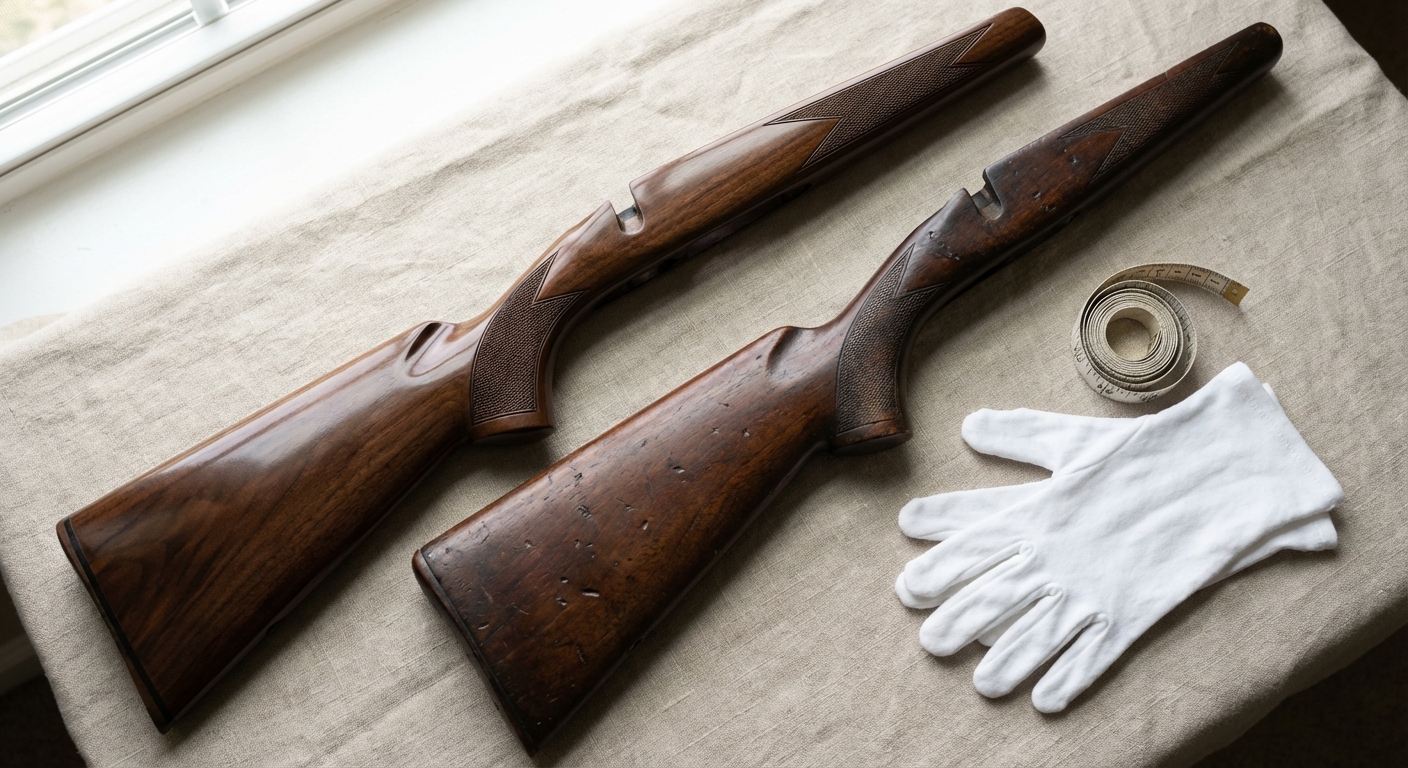
Friction matters too: every extra message thread, payment step, or compliance checkpoint is time you’re spending, and that time has a price even if it never shows up on a receipt.
Private sale (where legal) usually delivers the highest gross because there’s no middleman taking a cut. The catch is friction and compliance uncertainty. Confirm current laws before you advertise, and use an FFL where required so the transfer is handled through the right channel.
Consignment trades margin for access. A good shop can put your rifle in front of more walk-in buyers, but you’ll pay a percentage when it sells, and time-to-sale can be days or months depending on traffic and pricing.
Online listing or auction expands your buyer pool, but it also piles on platform fees, payment risk, and shipping logistics. GunBroker is a clean example of how costs get structured: there’s no recurring fee just to be a registered user, buyers are charged a 1% Marketplace Service Fee, and the seller’s Final Value Fee is assessed only if the item sells, when the listing closes.
Trade-in is the speed king, you walk in with a rifle and walk out with credit, but the net is usually the lowest because the dealer has to leave room for resale.
Direct-to-buyer offers are about predictability. For example, Cash My Guns operates as an FFL-based, nationwide online purchasing service where transactions route through licensed dealers, and it markets the process as “Safe • Legal • Hassle-Free.” If you want a broader breakdown of selling options and how each affects your net, compare the paths side by side before you commit.
The hard-cost reality check on shipped sales is the receiving dealer. Typical receiving FFL transfer fees are often cited in the ~$20 to $75 range, with many commonly ~$25 to $50, and those dollars come straight out of what you net. Add shipping and insurance on top, and your “winning” price can shrink fast.
- Pick two paths you’d actually use, like online listing vs consignment, or direct offer vs trade-in.
- Estimate net proceeds for each by subtracting the obvious costs, fees, transfer, shipping and insurance, plus the hassle you’re willing to tolerate, then choose the one that matches your priority: maximum net if you can wait, or speed and low friction if you can’t.
Maximize your Model 70 offer
However you sell, the fastest way to lose money is to make buyers guess.
Every Model 70 gets hit with an “uncertainty discount”, buyers pay less when they’re not 100% sure what they’re looking at.
A careful wipe-down and gentle cleaning raises confidence because it shows honest condition instead of hiding it. Keep it low-risk: remove dust, fingerprints, and surface grime, then stop. Don’t “improve” it with rebluing, refinishing, sanding, or aggressive polishing, those are permanent changes that trigger lowball suspicion fast.
Bring anything that proves what it is and where it’s been: the original box and end label, manuals, hang tags, receipts, old appraisals, prior email correspondence about the rifle, and a short list of included accessories. If you’re selling with no box or papers, these items don’t magically add value by themselves, they reduce questions about originality and history.
A labeled, systematic photo set makes remote evaluation cleaner: full-length left and right sides, clear shots of markings and the serial number, plus close-ups of wear, damage, and any notable areas. That’s the difference between “I think” and “I can price it,” whether you’re emailing a collector or requesting an online offer from a service like Cash My Guns.
If you’re handling an estate, a rare variant, a large collection, or comps are all over the place, pay for a pro appraisal to stop guessing. If the rifle smells like a collector piece, a factory letter (Cody letter) from the Cody Firearms Museum at the Buffalo Bill Center of the West is the primary source for Winchester factory letters when records exist, and it’s a signed document pulled from surviving original factory records (when available) that commonly documents originality and provenance. Those letters typically list recorded configuration details like model, serial, caliber, barrel length, finish, stock configuration, and sights, along with key dates (often ship date) and shipment destination or consignee when present.
Your prep checklist is simple: light clean only, gather paperwork and extras, shoot a consistent photo set with markings and honest close-ups, then write a straight description that discloses known changes and condition. Assemble the photos and notes first, then ask for offers so you’re answering questions before they cost you money.
Your value range and next step
The reason Model 70 prices look all over the map online is the same reason a clean, original pre-64 and a modified post-64 can share a name but not a buyer pool.
You can get to a defensible value range for your Model 70 without guessing if you follow the same repeatable sequence every time.
Start by nailing the exact variant (pre-64 vs later, CRF/PF, and whether it really matches a Standard or Featherweight-level configuration), then describe condition and originality in buyer language using the NRA Modern Gun Condition Standards while plainly disclosing any changes. From there, anchor your range on sold comps, completed sales, not asking prices, and choose a selling path based on net proceeds, meaning what you actually take home, plus your patience and risk tolerance.
If the stakes are high, think estate, insurance, or family disputes, pay for a written appraisal instead of relying on a free “current market valuation.” One published fee schedule lists fair market collection appraisals at about $50/hour, priced around what the guns would sell for on the open market, and one appraiser lists written appraisal examples around $50 per item for firearms valued up to $1,000 (pricing varies by scope and provider).
Next step: gather your notes and clear photos and price it yourself using the four steps above, or request a professional valuation or written appraisal, and if you want a fast, straightforward route, you can also cross-check what your Winchester Model 70 is worth.