
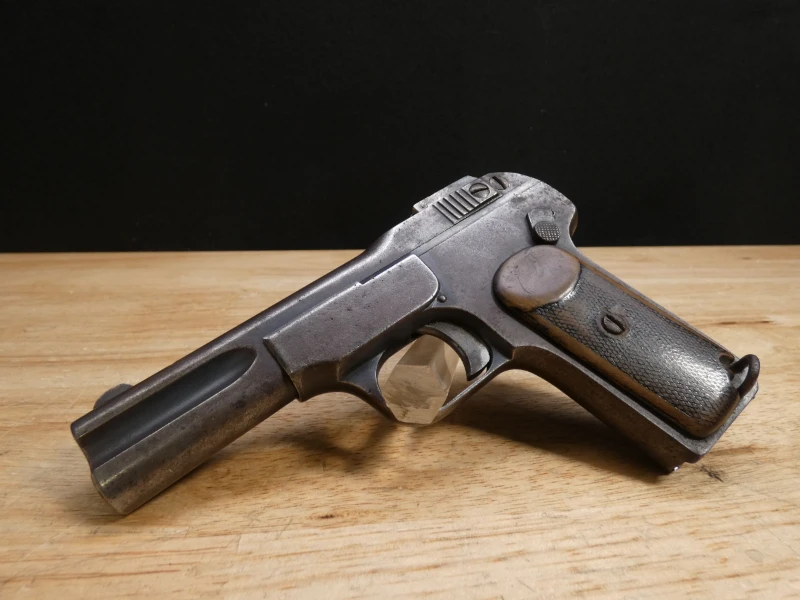
A landmark in firearms history, the FN M1900 was the first commercially successful, production semi-automatic pistol to utilize a slide. Designed by the legendary John Browning, its influence is seen in nearly every modern handgun. Today, it is a prized collector’s item, with its value determined not by modern performance metrics but by its historical significance, originality, and overall condition. Understanding these key factors is essential for any owner looking to accurately assess its worth in the current market.
What Determines Your FN M1900’s Worth
The value of a vintage firearm like the FN M1900 is primarily dictated by its condition, originality, and historical integrity rather than its functionality or round count. Collectors place the highest premium on examples that retain a large percentage of their original factory finish, have all-matching serial numbers, and show minimal wear. While a common model has an average price of around $715, specific examples can range from approximately $300 for a well-used piece to over $900 for one in pristine condition. Any documentation or historical provenance associated with a specific pistol can also significantly elevate its standing and, consequently, its market value.
2026 Price Breakdown by Generation
M1899 (Pre-Production)
The M1899 stands as the direct precursor to the more common M1900, representing the final developmental stage before full-scale production began. As a pre-production model, these pistols are considerably rarer and are highly sought after by serious collectors of early semi-automatic firearms. Their value is often significantly higher than that of the standard production models, driven by this scarcity and historical importance. Key characteristics that differentiate them from the M1900 can make them a centerpiece in a collection, and their value is assessed on a case-by-case basis, often exceeding the typical market range for their successors.
While specific market data providing a direct value comparison is scarce, it is an established principle in collectibles that rarity commands a premium. An M1899 in good, original condition would be expected to perform at the highest end of the valuation spectrum, likely surpassing the $900 mark. Its significance as a tangible piece of John Browning’s design evolution is a powerful value-adding factor. For sellers, documenting the pistol’s unique features and provenance is critical to realizing its full financial potential when presenting it to knowledgeable buyers who understand its place in firearms history.
M1900 (Primary Production)
The FN M1900 is the primary production variant and the model most collectors will encounter. As the first of its kind to achieve commercial success, even standard examples hold significant historical appeal. The general market value for a used FN 1900 pistol typically falls within a range of approximately $388 to $700, with the average price settling around $714. This variation is almost entirely dependent on the firearm’s state of preservation. Collectors scrutinize the percentage of original bluing, the condition of the original grips, and the crispness of the factory markings when determining a fair price.
For these models, originality is paramount. Any evidence of refinishing, re-bluing, or the installation of non-period-correct parts can severely diminish the pistol’s value. A well-preserved example with matching serial numbers and minimal cosmetic flaws will always command a price at the higher end of the spectrum. Conversely, a pistol that shows heavy use, pitting, or has mismatched components will fall to the lower end. Therefore, an honest and thorough assessment of the firearm’s condition is the most crucial step in establishing an accurate and defensible asking price for this historic handgun.
[Generation 3 Label]
While the FN M1900 did not have distinct “generations” in the modern sense, its long production run resulted in minor variations that are of interest to dedicated collectors. However, for general valuation purposes, these subtle changes do not typically create separate pricing tiers like those seen in contemporary firearms. The market does not formally recognize a third generation, instead continuing to group all standard production models together. The value of any M1900, regardless of its production date, remains overwhelmingly tied to its physical condition and degree of originality rather than specific manufacturing-era features or incremental design updates.
Therefore, a mid-to-late production M1900 is appraised using the same criteria as an early one: finish, originality, and overall wear. Its value will fall within the established market range of roughly $300 to over $900, aligning with the average price of approximately $715 if it is in typical, well-maintained condition for its age. Sellers should focus on documenting the tangible aspects of their specific pistol rather than searching for a generational premium that does not exist in the collector market for this particular model. The story the firearm’s condition tells is what ultimately determines its worth.
[Generation 4 Label]
Similar to the concept of a third generation, there is no recognized “Generation 4” for the FN M1900 pistol. The firearm’s design remained largely consistent throughout its manufacturing history, and the collector market does not categorize it into distinct generational blocks for valuation. Any attempt to market an M1900 as a later, more refined generation would be inaccurate and would not influence its price. The valuation principles remain constant across the entire production timeline: the closer the pistol is to its original factory state, the more valuable it will be to a potential buyer.
Prospective sellers and buyers should be aware that value is derived from tangible, physical attributes. A late-production M1900 in pristine condition will be worth substantially more than an early-production model that is heavily worn or has been altered. The focus must always be on a meticulous evaluation of the firearm itself. Factors like the quality of the bore, the integrity of the grips, and the percentage of original finish are the true determinants of its place within the established price range, not an assigned generational label that lacks historical or market precedent.
How Modifications Affect Value
For a historical artifact like the FN M1900, originality is the cornerstone of its value. The market consensus is clear: any non-factory, non-period modifications will almost invariably hurt its worth. Collectors seek examples that are as close as possible to the way they left the factory over a century ago. Modern enhancements such as custom grips, aftermarket sights, or any form of refinishing are considered significant detractions. These alterations erase the pistol’s historical integrity, which is its primary source of value, and will cause serious collectors to lose interest, significantly reducing the potential sale price.
Consequently, there is no market data available for “value-adding” modifications, because in this context, they do not exist. No modern update can improve upon the historical authenticity that a collector is paying for. The only additions that could potentially increase an M1900’s value are period-correct accessories that complete the package, such as an original holster, an authentic instruction manual, or a period box. These items enhance the firearm’s provenance and historical context rather than altering the firearm itself, making the entire set more desirable and valuable to a discerning buyer.
Regional Price Variations in 2026
The value and ease of selling an FN M1900 can be influenced by state and local firearm laws. In a highly regulated state like California, this pistol is not on the Roster of Handguns Certified for Sale, which prevents dealers from selling it as a new firearm. However, because it is over 50 years old, it qualifies as a Curio and Relic (C&R) firearm. This C&R status provides a legal pathway for it to be sold via a private party transfer conducted through a licensed dealer, thus maintaining a viable, albeit more complex, market among in-state collectors.
Similarly, New York requires a license for handgun possession, which can be a barrier for potential buyers. However, the state provides an exemption for “antique firearms,” a category for which the FN M1900 may qualify if it was manufactured before 1899 or uses ammunition that is no longer readily available in ordinary channels of commerce. If a specific M1900 meets these criteria, it could be exempt from licensing requirements for possession, potentially increasing its appeal to local collectors. Sellers must be aware of these regional legal nuances as they directly impact the size of the potential buyer pool.
Online vs Local Sales
When selling an FN M1900 locally as a private individual, it is imperative to adhere to all state and local regulations, which can vary significantly. Some jurisdictions mandate that all private firearm transactions be facilitated by a licensed dealer. Even where it is not legally required, the ATF strongly recommends documenting the transfer with a comprehensive bill of sale. This document should include the full details of both the buyer and seller, the firearm’s make, model, and serial number, and the date of sale to protect both parties and create a clear record of the ownership change.
Selling online to a buyer in a different state involves a strict, federally mandated process. The seller cannot ship the handgun directly to the buyer. Instead, the firearm must be sent from a Federal Firearms License (FFL) holder in the seller’s state to an FFL in the buyer’s state of residence. The buyer must then go to their chosen FFL, complete the ATF Form 4473, and pass a background check before they can legally take possession. This FFL-to-FFL transfer is required by law to ensure compliance with all applicable federal and state regulations governing interstate firearm sales.
Furthermore, navigating the logistics of shipping has become more complex due to corporate policies. Major carriers like UPS and FedEx now prohibit private individuals from shipping firearms. They require any package containing a firearm to be shipped by a Federal Firearms Licensee to another FFL. This means that a private seller is obligated to take their FN M1900 to a local gun dealer to have it legally packaged and shipped to the buyer’s designated FFL, making this a necessary step and an associated cost for virtually all non-local transactions.
The FFL Buying Advantage
Choosing to sell your FN M1900 to a Federal Firearms License (FFL) holder, such as a local gun shop, offers significant advantages in terms of convenience and legal security. The dealer handles all the necessary paperwork, officially logging the firearm out of your name and into their bound book. This transfer of ownership immediately absolves you of any future liability associated with the pistol. For many sellers, this peace of mind and the elimination of navigating the complexities of a private sale outweigh the potential for a slightly higher sale price on the private market.
In exchange for this convenience, a dealer’s cash offer will be less than the firearm’s full private market value. Typically, you can expect an offer between 50% and 65% of what the pistol might fetch in a private sale. This margin allows the dealer to cover their overhead costs, account for the time the item may sit in inventory, and generate a profit upon its resale. If your FN M1900 is in exceptionally high demand or pristine condition, the offer might increase to as much as 70%, but it will reflect the wholesale rather than retail value.
What Increases Your Offer
For a vintage firearm like the FN M1900, the most critical factor for maximizing an offer is its originality and condition. A premium is paid for pistols that retain a high percentage of their original factory finish, feature all-matching serial numbers, and exhibit minimal wear. Unlike modern firearms, where performance is key, the value of this historical piece is intrinsically linked to its state of preservation. Any deviation from its original configuration, such as replacement parts or refinishing, will negatively impact the offer. Presenting a well-preserved, authentic example is the best way to secure a top-tier valuation.
A thorough and proper pre-sale cleaning can also positively influence an offer, as it demonstrates meticulous care and maintenance. Before showing the pistol, ensure it is unloaded and perform a careful field strip. Clean the bore, chamber, and all moving parts using firearm-specific solvents and tools. It is crucial to avoid harsh, non-firearm cleaning agents or excessive force that could damage the delicate original finish or aged components. A clean, well-maintained appearance inspires confidence in the buyer and suggests the firearm has been well-cared-for throughout its life, justifying a higher price.
High-quality photography is essential for attracting the best offers, particularly in an online marketplace. Use ample, soft, and even lighting to prevent harsh shadows and accurately represent the firearm’s true condition. Capture multiple high-resolution images from every angle against a simple, non-distracting background. Be sure to include detailed close-ups of all markings, the serial number, the condition of the bore, and any areas of notable wear. A transparent and comprehensive visual presentation builds trust with potential buyers and gives them the confidence to make a strong offer.
When to Sell Your fn m1900
The market for collectible handguns like the FN M1900 is generally less susceptible to the seasonal trends that affect hunting rifles. Demand from collectors tends to be more consistent year-round, driven by historical interest rather than upcoming sporting seasons. However, sellers can still leverage broader economic patterns to their advantage. Certain times of the year see a general increase in consumer spending, which can translate into a more active and competitive market for firearms, including vintage pieces. Timing your sale to coincide with these periods can increase visibility and potentially lead to a faster sale.
One of the most opportune times to sell is during tax return season, which typically runs from February through April. During these months, many individuals have more disposable income and may be looking to invest in their hobbies or collections. Listing your FN M1900 during this period can capture the attention of buyers who are actively seeking to acquire a new piece. This influx of cash into the market often stimulates sales across various categories of goods, and collectible firearms are no exception, making it a strategic window for sellers.
Another strong sales period is the holiday season, from November through January. This time is characterized by a significant uptick in consumer spending and gift-giving. While a vintage pistol may be a niche gift, the overall heightened market activity can benefit sellers. Enthusiasts may be treating themselves to a new acquisition or receiving cash gifts they wish to put toward their collection. Capitalizing on this festive economic climate can expose your firearm to a larger audience of motivated buyers, potentially resulting in a more favorable and timely transaction.
Common Pricing Mistakes
One of the most frequent errors when pricing an FN M1900 is allowing sentimental value to cloud objective market analysis. An owner’s personal attachment to a firearm does not translate to monetary worth. It is essential to research recent, actual sales of models in comparable condition. With a wide value range from approximately $300 to over $900, and an average around $715, the market clearly demonstrates that condition is king. Pricing your pistol based on its real-world condition rather than personal history is crucial for attracting serious buyers and facilitating a successful sale.
Failing to accurately assess and transparently disclose the firearm’s condition is another major pitfall. For a historical piece, value is overwhelmingly determined by its originality and the percentage of original finish remaining, not its functionality or round count. Overlooking or hiding flaws like pitting, a non-original grip panel, or signs of refinishing will quickly erode buyer trust and can lead to a canceled sale or a significantly reduced offer. A detailed, honest description accompanied by high-quality photos of any imperfections is the best policy for achieving a fair price.
A third common mistake is neglecting to factor in the associated costs of selling, especially shipping. Current corporate policies from major carriers like UPS and FedEx mandate that private individuals must use a Federal Firearms License (FFL) holder to ship a handgun. This FFL-to-FFL transfer process involves fees for both the shipping service and the dealer’s handling. Not accounting for these expenses in your asking price can lead to a lower net profit than anticipated. Always calculate these costs beforehand to ensure your pricing is both competitive and profitable.
Market Outlook for 2026
The market outlook for a historically significant firearm like the FN M1900 is expected to remain stable and positive, driven primarily by the dedicated collector community. While specific future price predictions are unavailable, the value of well-preserved historical artifacts tends to appreciate over the long term. As the finite supply of original, high-condition examples naturally diminishes over time, their desirability and value are likely to increase. The pistol’s foundational role as the first production model to feature a slide ensures its permanent place in firearms history, underpinning its long-term appeal and investment potential.
Future value will also be influenced by broader economic conditions and the evolving interests of firearms collectors. A robust economy generally fuels the market for collectibles, as enthusiasts have more disposable income to invest in their hobby. As long as there remains a strong community of collectors who appreciate the innovation and craftsmanship of early 20th-century firearms, demand for the FN M1900 will persist. Its value will continue to be a direct reflection of its provenance, originality, and, most importantly, its exceptional condition, making well-cared-for examples a solid asset for the future.
Frequently Asked Questions
Does a high round count significantly lower the FN M1900’s value?
For a vintage collector’s piece like the FN M1900, the specific number of rounds fired is not a primary value driver. Instead, its worth is determined by factors directly related to its historical preservation. The overall physical condition, the percentage of the original finish that remains intact, and the originality of all its parts are far more significant. While a high round count can contribute to wear and tear, it is the visible wear itself, not the count, that impacts the appraisal. A low-round-count pistol in poor condition is worth less than a high-round-count one that was meticulously maintained.
Will having the original box or paperwork increase my pistol’s worth?
Yes, absolutely. While the provided data does not specify a consensus on original parts, for any collectible firearm, provenance and original accessories dramatically increase value. Finding an FN M1900 with its original box, sales receipt, or manual is exceptionally rare and would command a significant premium from serious collectors. These items help authenticate the firearm and place it in its historical context, making it far more desirable. Such a complete package would likely push its value to the very top of, or even beyond, the typical $300 to $900 price range.
How much does the dealer’s offer differ from a private sale price?
A gun dealer’s offer will typically be significantly lower than what you could achieve in a private sale. Dealers generally offer between 50% and 65% of a used firearm’s private market value. This margin covers their business overhead, the cost of holding the item in inventory, and their need to make a profit. In some cases, if the FN M1900 is in exceptional condition or is a highly sought-after variant, the offer might rise to 70%, but it will rarely match the full private sale potential, as you are trading potential profit for convenience and security.
Is my FN M1900 considered an NFA item?
No, the FN M1900 is not classified as an NFA (National Firearms Act) item. It is a conventional single-action, semi-automatic pistol. This is a positive factor for its value, as it does not require the additional taxes, extensive paperwork, and lengthy wait times associated with NFA-regulated items like machine guns or short-barreled rifles. Its standard handgun classification makes it much easier to buy, sell, and transfer legally, broadening its potential market to a wider range of collectors and enthusiasts without the regulatory burdens of NFA firearms.
Are there any states where my FN M1900 is more difficult to sell?
Yes, state laws can impact the value and ease of sale. In California, the FN M1900 is not on the state’s Roster of Handguns Certified for Sale, which restricts how dealers can sell it. However, its age qualifies it as a Curio & Relic (C&R) firearm, allowing for private party transfers through a licensed dealer. In New York, it may be exempt from standard handgun licensing if it qualifies as an “antique.” These legal hurdles can shrink the local buyer pool and complicate the sales process, potentially affecting its market value in those specific regions.
Get a Cash Offer Today
Ready to sell your FN M1900? We specialize in historical and collectible firearms, offering fair, market-based prices with a hassle-free process. Skip the uncertainties of private sales and the low offers from local pawn shops. Our expertise ensures you get a competitive cash offer for your vintage pistol today.
Simply submit your information and a few photos of your firearm, and our team of experts will provide you with a no-obligation quote. We handle all the necessary FFL paperwork and logistics, making the entire transaction safe, legal, and convenient. Turn your classic handgun into cash with confidence.