
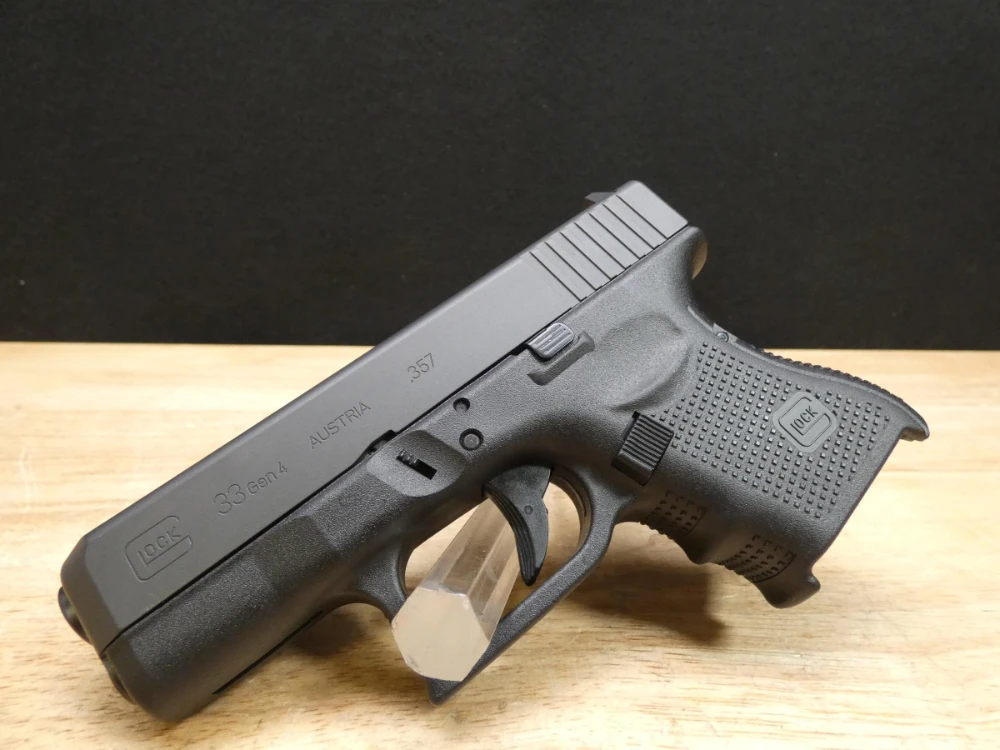
The Glock 33 is a subcompact, semi-automatic pistol renowned for its potent .357 SIG chambering in a concealable package. Designed for concealed carry, its value is influenced by its generation, condition, and the unique market dynamics of its ammunition. A new Glock 33 Gen 4 typically has an MSRP between $500 and $650, while used models are commonly found in the $300 to $500 range, making it an accessible yet powerful option for personal defense.
What Determines Your Glock 33’s Worth
The value of a used Glock 33 is primarily determined by its generation, physical condition, and any included accessories. In good condition, these pistols typically sell for between $300 and $500, with recent market data suggesting an average used price of around $410. Unlike many firearms, a high round count does not significantly lower the value of a Glock 33. These pistols are built for extreme durability. Instead, a more significant factor influencing its market position is the high cost and limited availability of its .357 SIG ammunition, which can affect buyer demand and, consequently, its resale price.
2026 Price Breakdown by Generation
Generation 1 (Gen1)
There is no market value for a Generation 1 Glock 33, as this model was never manufactured in the first generation of Glock pistols. The Glock 33 was introduced later in the company’s production history, well after the Gen1 design phase had concluded. Therefore, any search for a Gen1 variant will be fruitless, and it is not a factor for collectors or sellers when appraising the value of a Glock 33. Buyers and sellers should focus exclusively on the generations in which the model was actually produced to determine an accurate and fair market price for this subcompact firearm.
Because the Glock 33 was not part of the initial product lineup, its pricing and history begin with later iterations. The absence of a Gen1 model simplifies the valuation process, as there is no rare, early-production version to consider. The firearm’s value is instead tied directly to the features, condition, and market demand for the specific generations that were officially released to the public. This distinction is crucial for anyone looking to accurately assess the worth of their Glock 33, ensuring they are comparing it to relevant models on the used market and not searching for a non-existent collectible.
Generation 2 (Gen2)
Similar to the first generation, the Glock 33 was not produced during the Generation 2 production run. Glock introduced the .357 SIG chambering and the corresponding subcompact model later. Consequently, a Gen2 Glock 33 does not exist, and it holds no value on the used firearms market. Collectors and owners should be aware that the lineage of this specific model begins with Generation 3. Any valuation or price comparison must be made against existing Gen3 and Gen4 models, as these are the only versions available to buyers. This simplifies the process of determining a fair market price for the firearm.
When evaluating a Glock 33, it is essential to disregard any consideration for a Gen2 variant. The market for this pistol is confined to the generations in which it was manufactured, primarily Gen3 and Gen4. Focusing on these later models ensures an accurate assessment based on real-world availability and demand. The lack of a Gen2 version means that pricing is not influenced by the rarity or historical significance associated with earlier Glock generations, but rather by the tangible condition and features of the pistol as it was actually produced and sold to consumers in its later forms.
Generation 3 (Gen3)
The Glock 33 Gen3 is one of the most common versions found on the used market. A model in very good to excellent condition will typically fall within the established price range of $300 to $500. The specific price depends heavily on its cosmetic condition, the number of included magazines, and whether the original box and paperwork are present. The Gen3 introduced features like an accessory rail, thumb rests, and finger grooves on the grip, which are standard expectations for buyers looking at this generation. Its value is well-established, offering a solid and reliable platform for the potent .357 SIG cartridge.
Sellers of a Gen3 Glock 33 should expect offers to align with the average used price of approximately $385 to $412, depending on local market conditions. Because this generation is widely available, its value is stable and predictable. A firearm that shows minimal wear and has been well-maintained will command a price at the higher end of the spectrum. Conversely, visible holster wear, scratches, or a lack of original accessories will place its value closer to the $300 mark. The Gen3 remains a popular choice due to its proven reliability and widespread familiarity among firearm enthusiasts and concealed carry holders.
Generation 4 (Gen4)
The Glock 33 Gen4 introduced several key updates, including the modular backstrap system, a dual recoil spring assembly, and a new, more aggressive grip texture. These enhancements often allow the Gen4 to command a slightly higher price than its Gen3 predecessor on the used market, though it still generally falls within the $300 to $500 range. A new Gen4 model has an MSRP between $500 and $650, so a used price reflects a moderate depreciation. Buyers often prefer the Gen4 for its improved ergonomics and reduced felt recoil, making it a more desirable option for some shooters.
When selling a Glock 33 Gen4, its condition and completeness are paramount to achieving a top-tier price. A model with all its original backstraps, magazines, and case will be valued more highly. The average new price of around $578 sets the ceiling, with used prices adjusting downward based on wear and tear. Given its more modern features, a Gen4 in excellent condition is more likely to fetch a price closer to the $500 mark, especially in markets with strong demand for concealed carry pistols chambered in the powerful .357 SIG round, making it a prime asset for a seller.
How Modifications Affect Value
Modifications can have a significant and often negative impact on a Glock 33’s resale value, particularly when it comes to the trigger system. While aftermarket triggers may be installed to enhance performance for competition or personal preference, they can be a major deterrent for potential buyers. Many individuals prioritize the renowned factory reliability and safety of a Glock. A modified trigger introduces concerns about proper function and adherence to safety standards, potentially making the firearm less desirable and lowering its market value. Most buyers in the used market prefer an unmodified, factory-standard firearm, viewing it as a more trustworthy and predictable investment for personal defense.
Regarding modifications that might add value, a clear market consensus has not been established. While some shooters may appreciate upgraded sights or custom stippling, these changes are highly subjective and do not guarantee a return on investment. Often, the cost of the modification is not recovered during resale, as a new buyer may not share the same preferences. For this reason, firearms with their original factory parts tend to have a broader appeal and a more predictable resale value. Sellers will find that a clean, well-maintained, and factory-standard Glock 33 is typically the easiest to sell and will often fetch a better price than a heavily customized one.
Regional Price Variations in 2026
State and local laws create significant regional price variations for the Glock 33. In California, the pistol is currently on the Roster of Handguns Certified for Sale, making it legal to purchase from a dealer. However, a new law is set to ban the sale of new Glock pistols starting July 1, 2026. This impending ban could increase the value and demand for existing, legally owned Glock 33s within the state’s private party transfer market, as it will become a scarcer commodity. The standard 9-round magazine complies with the state’s 10-round capacity limit, further ensuring its legality and appeal in this restrictive market.
In contrast, New York’s laws present a different set of factors. While a license is required to own any handgun, the Glock 33 is compliant with the state’s 10-round magazine capacity restriction. This makes it a legal and viable option for residents with the proper permits. In states with fewer restrictions, the Glock 33 competes with a wider array of firearms, which can lead to more standard, market-driven pricing. However, in heavily regulated states like California and New York, its compliance with specific laws can make it a more sought-after item, potentially sustaining or even increasing its value compared to non-compliant firearms.
Online vs Local Sales
Selling a Glock 33 online to a buyer in another state involves strict legal protocols. Federal law mandates that the firearm must be transferred through a Federal Firearms Licensee (FFL). As a private seller, you are required to ship the handgun directly to an FFL dealer located in the buyer’s state of residence. The buyer cannot receive the firearm directly from you. They must visit their chosen FFL, complete the necessary ATF Form 4473, and successfully pass a NICS background check before they can legally take possession of the pistol. This process ensures a legal and documented transfer across state lines.
The logistics of shipping a handgun add another layer of complexity. Both UPS and FedEx have stringent policies requiring that handguns be shipped via their respective overnight air services, which is more costly than ground shipping. Furthermore, many carrier policies now restrict firearm shipments to be sent only from one FFL to another, making it difficult for a private individual to ship directly. The package must be properly secured, the firearm must be unloaded, and ammunition must be shipped separately. Crucially, the package cannot bear any markings that indicate it contains a firearm, ensuring it does not become a target for theft during transit.
When conducting a private sale, paperwork requirements are dictated more by state and local laws than federal ones. While federal law does not mandate a bill of sale for a private transfer, it is a highly recommended practice to create a document of the transaction for your own records. This document should include the full details of the buyer and seller, the firearm’s make, model, and serial number, and the date of sale. However, it is critical to remember that many states have their own laws, some of which require all private sales to be conducted through an FFL for a mandatory background check.
The FFL Buying Advantage
When you sell your Glock 33 to a gun dealer, you are trading maximum value for convenience and speed. Dealers typically offer between 50% and 65% of the firearm’s estimated used retail value. This margin allows them to cover their overhead costs—such as rent, insurance, and employee salaries—while still making a profit when they resell the pistol. The offer reflects the dealer’s need to account for the time the gun may sit in their inventory and the administrative work involved in acquiring and selling a firearm. For a seller, this means an immediate, hassle-free cash transaction without having to find a private buyer.
The specific offer you receive can fluctuate based on the dealer’s assessment of the firearm’s marketability. Some stores may offer as low as 30% to 40% if the gun is in poor condition or if they have low demand for that particular model. Conversely, if your Glock 33 is in high demand and excellent condition, a dealer might offer up to 70% of its resale value, knowing they can sell it quickly. This “buy vs. private sale ratio” is a fundamental aspect of the firearms industry, providing sellers with a quick exit strategy at a lower price point compared to a private sale.
What Increases Your Offer
While no definitive market consensus exists on the value of retaining all original parts, it is a widely accepted best practice that a firearm in its factory configuration is more desirable to a broader range of buyers. An unmodified Glock 33, complete with its original barrel, trigger, and sights, assures the next owner of its intended reliability and function. Deviating from this standard can narrow the pool of interested buyers, as many are wary of amateur gunsmithing or subjective upgrades. Therefore, presenting the pistol as it came from the manufacturer is the safest way to protect its value and appeal.
Similarly, there is no standardized financial penalty for an incomplete firearm package, but its absence will undoubtedly lower offers. A “complete” Glock 33 typically includes the original hard case, the owner’s manual, all factory-included magazines, and any accessories like a magazine loader or cleaning tools. Lacking these items suggests the firearm may not have been meticulously cared for and forces the buyer to purchase them separately. To maximize your offer, gathering all original components before the sale demonstrates a higher level of care and presents a more attractive, turnkey package to a potential new owner.
A thorough pre-sale cleaning is one of the most effective ways to increase the value of your Glock 33. You should field strip the pistol and meticulously clean the frame, slide, barrel, and magazines to remove all carbon buildup, residue, and debris. Pay close attention to the bore and the feed ramp, running patches through the barrel until they emerge clean. A critical mistake to avoid is over-lubrication. Glock recommends using a minimal amount of gun lube, as excessive oil can attract dirt and grime, which can be a major red flag and deterrent for a discerning buyer inspecting the firearm.
When to Sell Your Glock 33
Timing the sale of your Glock 33 can significantly impact the final price you receive. The most opportune time to sell a used handgun is widely considered to be during tax refund season, which typically runs from February through April. During this period, many potential buyers have more disposable income and are actively looking to make purchases they may have postponed. This surge in demand creates a seller’s market, allowing you to price your firearm more competitively and close a sale more quickly. Listing your pistol during this window maximizes your exposure to motivated buyers with cash in hand.
Conversely, the worst times to sell are generally during the summer months and the end-of-year holiday season. In the summer, potential buyers are often focused on vacations and outdoor activities, leading to a dip in firearm sales. Similarly, during the holidays in November and December, discretionary spending is heavily skewed towards gifts and travel, leaving less room in household budgets for firearm purchases. Demand typically wanes during these periods, which can force sellers to lower their prices or wait longer to find an interested party. Listing your Glock 33 outside of these slower seasons is advisable.
To capitalize on the peak selling season, preparation is key. Before tax season begins, take the time to thoroughly clean your Glock 33, gather all original accessories and paperwork, and take high-quality photographs. By having your listing ready to go before the rush, you can be one of the first sellers that early-bird shoppers see. This proactive approach ensures you are perfectly positioned to take advantage of the increased market activity, rather than trying to play catch-up when demand is already at its highest. Strategic timing combined with proper presentation will yield the best possible offer for your firearm.
Common Pricing Mistakes
One of the most frequent pricing errors is paying for a professional appraisal for a common, modern firearm like the Glock 33. The market value for these pistols is well-established and can be easily determined by researching online marketplaces, forums, and consulting with local gun dealers. Professional appraisals are best reserved for rare, antique, or historically significant firearms where value is not easily ascertained. For a Glock 33, the cost of the appraisal will likely eat into your profits without providing any information that isn’t already readily available, making it an unnecessary expense for the seller.
Another common mistake is assuming a high round count significantly devalues the pistol. Glocks are legendary for their durability and ability to function reliably even after tens of thousands of rounds with proper maintenance. Consequently, the market does not penalize them heavily for being used as intended. A far more relevant factor for the Glock 33 is the high cost and relative scarcity of .357 SIG ammunition. This can dampen buyer demand, and sellers should price the firearm realistically, acknowledging that the ongoing cost of shooting it is a greater concern for most buyers than its round count history.
Overpricing based on sentimental value or the cost of aftermarket additions is a classic pitfall. Your personal attachment to the firearm or the money you spent on custom grips or sights does not translate to a higher market value. The worth of a used Glock 33 is dictated by current market demand, its condition, and its generation. It is crucial to set a price based on what comparable models are actually selling for. An unrealistic price will cause potential buyers to overlook your listing, prolonging the sale process and ultimately forcing you to lower the price anyway.
Market Outlook for 2026
While a definitive, long-term price prediction for the Glock 33 is not available, current market trends and legislative changes offer valuable insight into its potential future value. As a firearm known for its robust construction and chambered in a powerful but less common caliber, its value is relatively stable. It appeals to a niche of shooters who specifically seek the performance of the .357 SIG cartridge. This dedicated following helps insulate its price from the dramatic fluctuations sometimes seen with more common calibers, suggesting a steady market outlook for the foreseeable future, especially for well-maintained models.
A significant factor influencing the Glock 33’s market in the near future is the changing legal landscape in states like California. A new law is set to ban the sale of new Glock pistols in the state beginning July 1, 2026. This will likely increase the demand and, consequently, the value of legally owned, used Glock 33s available through private party transfers within California. As the supply of new Glocks is cut off, existing ones will become more valuable commodities for residents of the state, potentially creating a strong regional market with prices that exceed the national average for this particular model.
Frequently Asked Questions
Does a high round count hurt my Glock 33’s value?
A high round count does not significantly lower the value of a Glock 33. Glocks are renowned for their exceptional durability and are engineered to withstand very high usage with routine maintenance. The market for these pistols understands and respects this reputation. Instead of round count, the value of a Glock 33 is more heavily influenced by the high cost and more limited availability of its .357 SIG ammunition. This factor can impact buyer demand more than the firearm’s usage history, as the ongoing expense of shooting the pistol is a greater consideration for many potential owners.
Is it worth getting a professional appraisal for my Glock 33?
For a standard used Glock 33, a professional appraisal is generally not worth the cost. The market value for common, modern firearms like this is well-established and transparent, typically ranging from $300 to $500. You can accurately determine a fair price by researching online gun forums, auction sites, or by consulting with a local gun dealer. Professional appraisals are more appropriate for firearms that are antique, rare, or have historical significance, where the value is not easily determined. For a Glock 33, the appraisal fee would likely reduce your net profit from the sale.
How much less will a dealer offer me compared to a private sale?
When selling to a gun dealer, you should expect to be offered between 50% and 65% of the firearm’s used retail value. This price difference accounts for the dealer’s business overhead and the need to make a profit upon resale. In some cases, the offer could be as low as 30% to 40% if the gun is in low demand, or as high as 70% if it is a highly sought-after model that the dealer is confident they can sell quickly. A private sale will almost always yield a higher price, but it comes at the cost of convenience.
Will an aftermarket trigger decrease the pistol’s resale price?
Yes, installing an aftermarket trigger can negatively impact a Glock’s resale value. While such modifications may enhance performance for a specific user, many potential buyers in the used market prioritize the firearm’s original factory reliability and safety features. A modified trigger can introduce concerns about proper function and safety, making the gun less desirable to a broader audience. To maximize resale value, it is almost always better to sell a Glock in its original, factory-standard configuration, as this is what the majority of buyers are looking for in a used defensive handgun.
How does the pistol’s generation affect its selling price?
The generation of a Glock 33 is a notable factor in its valuation, although most used models still fall within the general $300 to $500 price range. A Gen4 model, with its updated features like the modular backstrap system and dual recoil spring, may command a slightly higher price than a Gen3. However, the available data does not show a dramatic price difference between the generations. The value is more significantly influenced by the pistol’s overall condition and whether it comes with its original case and accessories. The generation is a point of preference but not a drastic price driver.
Get a Cash Offer Today
Ready to sell your Glock 33? We make the process fast, safe, and simple. Find out what your firearm is worth with our fair, market-based pricing. Click below to start your appraisal and receive a no-obligation cash offer today. We handle all the paperwork for a hassle-free experience.
Don’t let your firearm collect dust. Turn it into cash with a trusted, licensed dealer who values your time and security. Our streamlined process ensures you get paid quickly and legally. Get your free quote now and see how easy it is to sell your Glock 33 with us.