
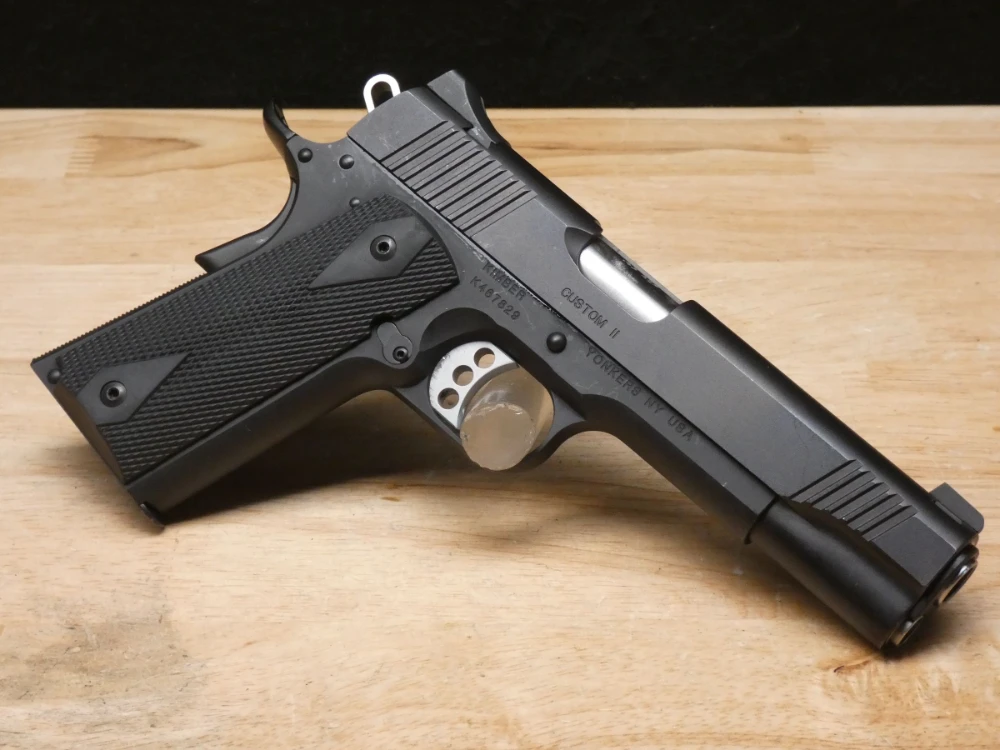
The Kimber Custom II is a cornerstone of the modern 1911 market, respected for its blend of classic design and contemporary manufacturing. As a semi-automatic pistol, this handgun is not classified as an NFA item. Understanding its market value is key for any owner looking to sell. This guide provides a detailed breakdown of the factors that influence its worth, from specific sub-models and modifications to market trends, ensuring you can accurately price your firearm for a successful sale.
What Determines Your Kimber Custom II 1911’s Worth
The primary drivers of a Kimber Custom II’s value are its overall condition, specific sub-model, and mechanical tightness, rather than its round count. While an extremely high number of rounds fired might serve as a minor negotiating point, many owners report firing thousands of rounds with no significant issues. Potential buyers are far more concerned with the firearm’s cosmetic appearance and functional reliability. Therefore, a well-maintained pistol with visible holster wear will often be valued lower than a pristine example with a higher round count. For standard models, a professional appraisal is generally not worth the cost, as their market value is well-established.
2026 Price Breakdown by Generation
Pre-Series II Models
While Kimber does not use formal generation designations, collectors and enthusiasts often distinguish between the early “Pre-II” models and the current “Series II” pistols. These older firearms lack the Swartz-style firing pin safety found on modern versions, a feature some 1911 purists prefer for what they consider a truer trigger pull. Their value, however, is not consistently higher or lower than their modern counterparts. There is no well-documented price variance based on this distinction alone, with individual condition and specific model features remaining the most critical factors in determining their final sale price in the used market.
The market for Pre-Series II models is driven more by individual buyer preference than a collective consensus on value. A seller might find a specific buyer willing to pay a slight premium for a clean, early example, but this is not a guaranteed outcome. Ultimately, these pistols fall within the same general used price range as other Custom II variants, typically from approximately $560 to $850. The final price depends heavily on cosmetic condition, mechanical integrity, and the inclusion of the original box and paperwork, which can enhance appeal for collectors seeking these earlier production guns.
Standard Custom II Models
The most common variant is the standard Kimber Custom II, which is part of the “Series II” family and includes the Swartz firing pin safety mechanism. This model serves as the baseline for the Kimber 1911 lineup and is widely available on both new and used markets. The manufacturer’s suggested retail price for a new Custom II is approximately $1,000, though new models are often found at retailers for between $700 and $816. This accessibility and popularity create a very active and predictable used market, making it a benchmark for pricing other variants in the family.
On the used market, the value of a standard Custom II is well-established. A recently sold example fetched a price of $699.99, which aligns with the typical range for these firearms. Depending on condition, accessories, and local market demand, a seller can expect to get between $560 and $850 for their pistol. Because this model is so prevalent, its value is highly sensitive to cosmetic condition and mechanical soundness. A pistol in excellent condition with its original case and materials will command a price at the higher end of this spectrum, while one with significant wear will fall to the lower end.
Enhanced & TLE Models
The value of a Kimber Custom II is significantly influenced by its specific sub-model, with enhanced versions like the TLE II (Tactical Law Enforcement) commanding higher prices than the standard base model. The TLE II was originally designed for the LAPD SWAT team and comes from the factory with desirable upgrades such as tritium night sights and front strap checkering for improved grip. These functional enhancements make it more sought-after by buyers looking for a duty-ready or defensive pistol out of the box, and its price reflects these added features, placing it in the upper portion of the used value range.
When selling a TLE II or a similar factory-enhanced model, it is crucial to highlight these specific features in your listing. Buyers specifically searching for these variants are willing to pay more for the factory-installed upgrades compared to a standard model with aftermarket parts. The perceived quality and reliability of factory components mean these pistols hold their value better over time. Consequently, a TLE II in very good condition will consistently fetch a higher price than a standard Custom II of the same age and cosmetic state, demonstrating that the sub-model designation is a more accurate value indicator than any generational label.
Specialty & Raptor Models
At the higher end of the Custom II family are the specialty models, such as the Raptor II. These firearms are distinguished by unique aesthetic and functional features, including proprietary scalloped slide and frame serrations, special grips, and often a two-tone finish. These distinctive elements set them apart from the more utilitarian models and appeal to buyers seeking a more stylized 1911. Because of their unique design and premium factory features, these specialty variants carry a higher MSRP and retain more of their value on the used market compared to the standard Custom II or even the TLE models.
The value proposition for a Raptor II or other specialty model is rooted in its distinctiveness. A seller with one of these pistols is targeting a more specific niche of the market. Pricing should reflect its premium status, but it’s also important to recognize that the pool of potential buyers may be smaller. The final sale price will be heavily dependent on finding the right buyer who appreciates the specific features of that model. As with all Kimber 1911s, condition is paramount, but for these specialty guns, the uniqueness of the sub-model is the most significant factor in achieving a top-tier resale price.
How Modifications Affect Value
When it comes to selling a Kimber Custom II, modifications can be a double-edged sword. Many potential buyers strongly prefer firearms in their original, factory-stock condition. Consequently, customizations such as the installation of aftermarket triggers, hammers, or elaborate grips generally do not increase and may even decrease the firearm’s resale value. Unless the work was performed by a well-known, high-end gunsmith whose name carries its own prestige, the pistol will likely be worth less than an unmodified counterpart. It is often more profitable to reinstall the original parts before selling and list the aftermarket components separately.
However, not all modifications are detrimental to value. Practical, high-quality upgrades are often seen as a benefit by buyers. Swapping the stock sights for premium tritium night sights from reputable brands like Trijicon or TRUGLO is a common value-adding modification. Similarly, professionally mounting a red dot optic from a respected manufacturer such as Holosun can also increase the pistol’s appeal and final sale price. These types of functional enhancements are widely recognized for improving the shooting experience and are often sought after by buyers, making them a worthwhile investment that can be recouped during resale.
Regional Price Variations in 2026
The value and ease of selling a Kimber Custom II can be significantly impacted by state and local laws. Certain states have stringent regulations that dictate which firearms can be sold. For example, a specific, California-compliant version of the Kimber Custom II in .45 ACP is available for sale in that state because it is listed on the official roster of approved handguns. This limited availability can sometimes create a pocket market where roster-approved firearms command a slightly higher price within the state. Similarly, some retailers list specific models as “New York Compliant,” indicating they meet that state’s unique legal requirements.
Beyond specific state compliance models, the rules governing private firearm sales create further regional price variations. Paperwork requirements vary dramatically across the country. Some states allow for private sales with no required paperwork, while others mandate that every transaction must be conducted through a licensed dealer, including a background check. These additional legal hurdles, fees, and logistical complexities in more restrictive states can influence a seller’s net profit and may affect the final negotiated price. A seller in a state with fewer restrictions may find it easier to achieve a higher price through a direct private sale.
Online vs Local Sales
Choosing between a private sale and selling to a dealer will dramatically affect your financial return. Gun dealers typically offer between 50% and 65% of a firearm’s true market value, as they need to account for overhead and profit margin. For instance, one owner reported being offered $600 by a dealer for their Kimber Custom II, only to see the dealer price the same pistol at $725 for resale. In contrast, a private sale allows the seller to capture a much larger portion of the firearm’s worth, often around 75% or more, making it the more lucrative option.
However, a private sale to an out-of-state buyer introduces legal complexities. Federal law mandates that when selling a handgun to a resident of another state, the firearm must be transferred through a Federal Firearms Licensee (FFL). This requires the seller to ship the handgun to an FFL in the buyer’s state of residence. The buyer then completes all necessary paperwork and a background check at their local FFL before taking possession. This multi-step process adds shipping costs and transfer fees, which can influence the final negotiated price between the buyer and seller.
Furthermore, shipping a handgun like the Kimber Custom II is highly regulated. Private sellers are generally prohibited from shipping handguns via common carriers such as UPS and FedEx. The shipment must typically be handled by an FFL, who will send it to the receiving FFL. When shipping is permitted, the firearm must be declared to the carrier, be completely unloaded with no ammunition included in the package, and the box must have no external markings that would indicate its contents. These strict regulations make online sales more logistically challenging than a simple, local face-to-face transaction.
The FFL Buying Advantage
Utilizing a Federal Firearms Licensee (FFL) for the sale of your Kimber Custom II offers a significant advantage in terms of legal security and peace of mind. When you sell or consign your firearm through an FFL, they assume the responsibility of ensuring the transaction is fully compliant with the law. The dealer will handle the mandatory background check on the potential buyer and manage all required state and federal paperwork. This process creates an official record of the transfer, protecting you from future liability should the firearm ever be used in a crime, a protection not always guaranteed in a private sale.
For any sale that crosses state lines, using an FFL is not merely an advantage—it is a federal legal requirement. You, as the seller, are required to ship the handgun to an FFL located in the buyer’s home state. This ensures that the buyer complies with their local and state laws before taking possession. While this adds steps like shipping and transfer fees to the process, it guarantees that the transfer of ownership is legal and properly documented. This federally mandated procedure is designed to prevent illegal firearm trafficking and provides a crucial layer of protection for both the buyer and the seller.
What Increases Your Offer
A thorough pre-sale cleaning is one of the most effective ways to maximize the value of your Kimber Custom II. Begin by field-stripping the pistol, taking care not to lose the recoil spring plug, which is under tension. Meticulously clean the bore, slide, frame, and barrel, focusing on removing all carbon buildup from contact points and hard-to-reach areas. A common mistake is over-lubrication; after cleaning, apply only a very light coat of high-quality oil to key wear points and then wipe off any excess. A clean, properly lubricated firearm not only looks better but also signals to the buyer that it has been well-maintained.
High-quality photographs are absolutely essential for attracting strong offers, especially in online listings. The firearm’s condition is a primary factor in its resale value, so your images must represent it accurately and professionally. Use a clean, neutral background and ensure your lighting is bright and even to eliminate harsh shadows that can obscure details. Capture multiple, high-resolution images from various angles. It is crucial to transparently document any specific features, modifications, or cosmetic imperfections like scratches or holster wear. Honest and detailed photography builds trust with potential buyers and leads to more serious inquiries.
While the market lacks a universal consensus on a specific monetary penalty for an incomplete package, providing the original box, owner’s manual, factory-supplied tools, and any included accessories will undoubtedly make your Kimber Custom II more appealing. Buyers, especially those with a collector’s mindset, place a premium on a complete set. Including these items can differentiate your listing from others, often resulting in a faster sale and stronger offers. A complete package conveys a sense of care and responsible ownership, which translates to higher perceived value and gives you more negotiating leverage.
When to Sell Your Kimber custom ii 1911
The market for handguns like the Kimber Custom II is typically less seasonal than that for hunting firearms. While rifles and shotguns see a surge in sales during the late summer and early fall leading up to hunting seasons, handgun sales are more consistently influenced by the political climate. News of potential new firearm regulations often drives a spike in demand, creating a seller’s market. Therefore, paying attention to current events can be more beneficial for timing your sale than watching the calendar. Selling during periods of heightened political discussion around gun control can often lead to a quicker sale at a higher price.
Despite the market’s primary driver being political, some general seasonal trends are still observed by sellers. Many find that sales activity picks up during tax return season, from roughly February to April, when potential buyers have more disposable income. Another active period can be the holiday shopping season, from mid-November through mid-January. Conversely, the summer months are often considered a slower period for firearm sales across the board. To maximize your chances, listing your Kimber Custom II during these peak consumer spending periods could increase its visibility and the number of potential offers you receive.
Ultimately, the ideal time to sell your Kimber Custom II is a combination of favorable market conditions and personal readiness. While there are minor seasonal peaks, the handgun market’s volatility means that a sudden political event can create an optimal selling window at any time of year. A strategic seller will have their firearm cleaned, photographed, and ready to list at a moment’s notice to capitalize on these unpredictable surges in demand. By preparing in advance, you can act quickly when the market is most active, ensuring you get the best possible return on your firearm regardless of the season.
Common Pricing Mistakes
One of the most frequent errors sellers make is overvaluing their personal modifications. Many owners mistakenly assume that the money they invested in an aftermarket trigger, custom grips, or other parts will translate directly to a higher resale price. In reality, the opposite is often true. The majority of buyers in the used market prefer firearms in their original factory configuration. Unless a customization was performed by a nationally recognized gunsmith, it is likely to decrease the pistol’s value. A seller will almost always get a better return by reinstalling the original parts and selling the aftermarket components separately.
Another common mistake is fixating on round count while ignoring cosmetic condition. A seller might believe that their pistol’s low round count automatically justifies a premium price, but potential buyers are far more critical of its physical appearance and mechanical feel. Scratches on the slide, significant holster wear on the frame’s finish, or signs of neglect will dramatically lower a firearm’s value, regardless of how few rounds have been fired through it. A pristine-looking, well-maintained pistol with a higher round count will almost always sell for more than a cosmetically damaged “safe queen.”
Paying for a professional appraisal on a standard production firearm like the Kimber Custom II is an unnecessary expense that cuts directly into your profit. The market value for these common models is very well-established and can be easily researched for free through online forums, auction sites, and gun community discussions. A paid appraisal is typically only worthwhile for firearms with unique historical significance, extreme rarity, or custom work from a world-renowned smith. For a standard Custom II, which usually falls in a predictable used value range of $400 to $700, the cost of the appraisal provides no tangible benefit.
Market Outlook for 2026
Predicting the future price of any firearm with certainty is nearly impossible, as the market is highly susceptible to sudden shifts based on political and economic events. For the Kimber Custom II, there is currently no market consensus or reliable data to forecast a specific value trajectory into 2026. Its price will likely continue to be influenced more by short-term factors, such as proposed legislation that can drive panic buying, rather than a predictable, linear trend. Therefore, owners should not expect a guaranteed appreciation in value as they might with a more collectible or rare firearm.
Despite the lack of a clear future price prediction, the Kimber Custom II’s position as a popular, mid-to-high-tier 1911 suggests its value will remain relatively stable. These pistols are known for their quality and performance, which creates consistent demand in the used market. While standard production models are unlikely to appreciate significantly, they are also not expected to suffer a major depreciation in value, barring any unforeseen market-wide collapse. It is a reliable firearm that tends to hold its value well compared to its original purchase price, making it a reasonably safe asset in the firearms world.
Frequently Asked Questions
Does a high round count hurt my Kimber Custom II’s value?
A high round count does not significantly lower the value of a Kimber Custom II. The market for these firearms places a much higher emphasis on the overall condition, both cosmetic and mechanical. A well-maintained pistol that shows minimal wear will command a higher price than a low-round-count gun with scratches and holster marks. While an exceptionally high round count might be used as a minor negotiating point, the functional reliability and appearance are the most critical factors for potential buyers, as these pistols are known for their durability over thousands of rounds.
Is it worth getting a professional appraisal for my pistol?
No, for a standard used Kimber Custom II, a professional appraisal is likely not worth the cost. The market value for these popular production firearms is well-established and can be accurately determined through free online resources, such as completed sales on auction sites and discussions in firearm communities. Values for models in very good to excellent condition typically range from $400 to $700. A paid appraisal is generally only necessary for firearms with unique features, historical significance, or high-end custom work, none of which apply to a standard Custom II model.
Will adding a custom trigger increase the resale price?
No, installing an aftermarket trigger or making similar modifications will generally not increase, and may actually decrease, the resale value of your Kimber Custom II. The vast majority of buyers on the used market prefer firearms to be in their original, factory-stock condition. Unless the customization was performed by a very famous, high-end gunsmith, the pistol will likely be worth less than its unmodified counterpart. It is almost always more profitable to reinstall the original factory parts before selling the firearm and then sell the aftermarket components separately.
How much less will a gun dealer offer me compared to a private sale?
You can expect a significantly lower offer from a gun dealer compared to what you could get in a private sale. Dealers typically offer between 50% and 65% of the firearm’s current market value to account for their overhead, profit margin, and the time the gun may sit in inventory. In contrast, a private seller can often expect to receive around 75% or more of the firearm’s value. For example, one owner was offered $600 by a dealer who then priced the same pistol at $725 for resale, illustrating the clear financial advantage of a private sale.
Does my pistol’s value change if it’s a California-compliant model?
The value of a California-compliant Kimber Custom II is primarily affected by geography. Within the state of California, its value may be higher or more stable due to the state’s roster of approved handguns, which severely limits the selection of new firearms available for purchase. This scarcity can increase demand for rostered models. However, outside of California, the specific compliance features do not typically add any value. To a buyer in another state, it is just another Kimber Custom II, and it will be valued based on its condition and features, not its California-compliant status.
Get a Cash Offer Today
Ready to sell your Kimber Custom II? We make the process simple, safe, and hassle-free. Avoid the uncertainty of private sales and the low offers from local dealers. Click here to submit your firearm’s information and our team of experts will get back to you with a fair, competitive cash offer.
Our streamlined process is fully compliant with all federal and state laws, providing you with complete peace of mind. We provide the shipping label and ensure a secure, legal transfer. Turn your used firearm into cash today with a trusted name in the industry. Get your no-obligation offer now!