
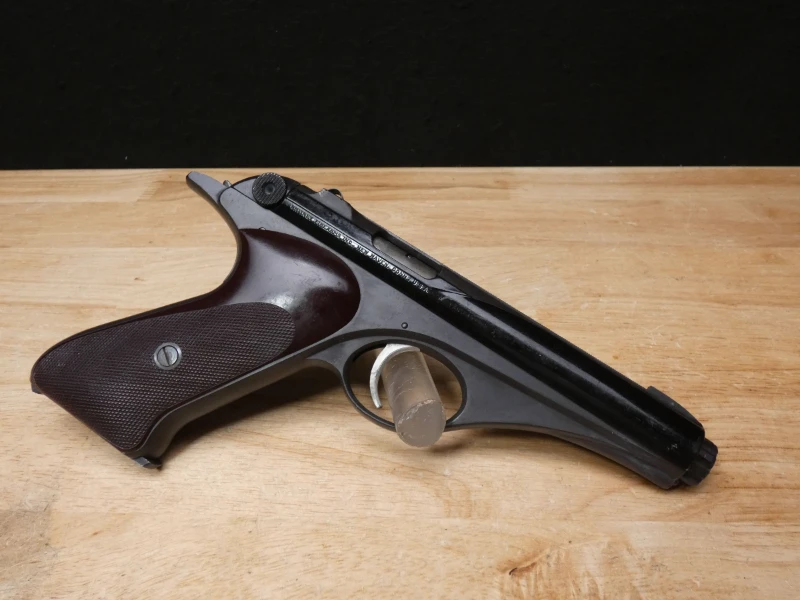
The Whitney Wolverine is a semi-automatic pistol renowned for its futuristic, “space-age” design that was far ahead of its time. Produced for only a few years in the 1950s, its unique aesthetic and limited production run have made it a coveted item for firearm collectors. Understanding the key factors that determine its value, from its production era and condition to the nuances of the collector market, is essential for anyone looking to accurately price this iconic handgun.
What Determines Your Whitney Wolverine’s Worth
The value of a Whitney Wolverine is primarily dictated by its originality, condition, and specific production model. The most significant factor is whether the pistol is an original from the 1950s or a later polymer-framed reproduction by Olympic Arms, with originals commanding substantially higher prices. Condition plays a critical role, as collectors pay a premium for well-preserved examples. For instance, a model with heavy cosmetic damage, often classified as ‘shooter grade,’ can see its value plummet by 40% to 60% compared to one in excellent condition. Any deviation from its factory configuration, such as aftermarket parts, will also negatively impact its worth in the collector market.
2026 Price Breakdown by Generation
Original Whitney (1950s)
The original Whitney Wolverine pistols, produced from 1956 to 1958, are the most valuable and sought-after models by collectors. These firearms are prized for their historical significance and unique aluminum-frame construction. In today’s market, a standard original model in good condition can command a price between $1,200 and $1,800. The average used price hovers around $1,174, but pristine examples can easily exceed this range, reflecting their rarity and appeal. These pistols represent the pinnacle of the Wolverine’s design legacy and are the benchmark against which all other versions are measured by collectors.
Among the original production models, the rare nickel-plated versions represent the highest tier of value. These pistols were produced in much smaller quantities than their standard blued or anodized counterparts, making them exceptionally desirable. Collectors will pay a significant premium for a factory-original nickel Wolverine, with prices often soaring well over $3,000 depending on the condition and provenance. The brilliant finish accentuates the pistol’s futuristic lines, and its scarcity makes it a centerpiece for any serious collection of mid-century firearms. Finding one of these in excellent condition is a rare opportunity that drives market prices to their peak.
Olympic Arms Reproduction
In the early 2000s, Olympic Arms revived the Wolverine design, creating a polymer-framed reproduction of the classic pistol. While visually similar, these modern versions are valued significantly lower than the 1950s originals. The typical market price for an Olympic Arms Whitney Wolverine falls between $600 and $750. These reproductions offer enthusiasts a chance to experience the iconic design and ergonomics without the high cost of a collector’s piece. They are considered functional firearms but lack the historical importance and material originality that drive the value of the first-generation models, placing them in a different market category entirely.
The primary reason for the lower value of the Olympic Arms reproduction is its modern construction and lack of historical rarity. Collectors of the Whitney Wolverine prize the original’s cast aluminum frame and its direct connection to designer Robert Hillberg and the post-war era of innovation. The switch to a polymer frame, while practical, removes the key element that makes the original a collectible artifact. Furthermore, the reproductions were made in larger numbers and are not yet old enough to have gained any significant collector status, positioning them as shooters rather than investments in the eyes of the market.
Excellent Condition Examples
A Whitney Wolverine in excellent or near-mint condition will always command the highest possible price within its category. For an original 1950s model, this means the finish is largely intact with minimal wear, the original grips are free of cracks, and the firearm is in perfect mechanical working order. All markings should be crisp and clear. The closer the pistol is to its factory-new appearance, the more a collector is willing to pay. While a standard used model might fetch around $1,200, a pristine example, especially a rare nickel variant, can easily double or triple that value, as collectors are paying for preservation and rarity.
While the provided data does not specify a value penalty for missing items, it is a universal rule in firearm collecting that completeness adds significant value. For a Whitney Wolverine, this would include the original factory box, owner’s manual, and any accompanying paperwork or tools. These items are often rarer than the pistol itself and provide important historical context and provenance. A Wolverine sold with its complete original package is far more desirable to serious collectors and will fetch a considerable premium over a standalone firearm, as it represents a more complete and authentic piece of history.
Shooter Grade Examples
A “shooter grade” Whitney Wolverine is one that is mechanically functional but exhibits significant cosmetic wear. This can include heavy finish loss, deep scratches, dings in the frame, or worn grips. While these issues make the firearm undesirable for serious collectors focused on condition, it remains appealing to enthusiasts who want to experience shooting the iconic pistol without risking a pristine example. Based on market analysis, a Wolverine in this condition will see its value reduced by approximately 40% to 60% compared to a model in excellent shape, placing its price point well below the average.
The value of a shooter grade model is based almost entirely on its functionality rather than its collectibility. Buyers for these pistols are not investors but rather hobbyists and shooters. Therefore, the primary consideration is whether the firearm operates safely and reliably. Any mechanical issues on top of the cosmetic flaws would further decrease its value, potentially rendering it a “parts gun.” For sellers, it is crucial to accurately represent the firearm’s condition, as the market for a shooter grade Wolverine is distinct from the high-end collector’s market and requires transparent pricing based on its utility.
How Modifications Affect Value
For a collectible firearm like the Whitney Wolverine, originality is the most crucial component of its value. The market for this pistol is driven by collectors who prize its unique, factory-original “space-age” design and its limited production history. Consequently, almost any aftermarket modification is viewed as a detriment and will decrease its resale value. Collectors are not looking for improved performance; they are seeking a historical artifact that remains true to its original form. Any alteration, no matter how well-intentioned, compromises the integrity and historical authenticity of the piece, making it less desirable to the target market.
Specific modifications, such as changing the trigger or sights, are particularly harmful to the Wolverine’s value. These changes permanently alter the firearm from its factory configuration. Even if the modification is reversible, the simple act of replacing an original part can be enough to deter a serious collector. The value is intrinsically linked to its identity as a mid-century design icon. Therefore, a Whitney Wolverine with a non-original trigger or other custom parts will almost certainly sell for less than an untouched example, as the pool of interested buyers shrinks to exclude the purist collectors who drive prices.
Regional Price Variations in 2026
The Whitney Wolverine enjoys a relatively stable national market value, thanks in part to its legal status in states with strict firearm laws. In California, its age allows it to be classified as a Curio & Relic (C&R) firearm, making it exempt from the state’s restrictive handgun roster for approved buyers. Similarly, in New York, the pistol is not classified as an “assault weapon” under the SAFE Act, and its standard 10-round magazine capacity is compliant with state law. This broad legality ensures that collectors in these major markets can acquire the pistol without facing prohibitive legal barriers.
Because the Whitney Wolverine is generally permissible for collectors across the country, its price is less susceptible to the regional variations that affect many modern firearms. The value is driven by national collector demand rather than being artificially inflated or deflated by local legislation. A rare, nickel-plated original will be just as valuable to a collector in New York as it is to one in Texas. As a result, sellers can expect pricing to be fairly consistent nationwide, with the primary value determinants being the firearm’s condition, originality, and specific model, not the buyer’s zip code.
Online vs Local Sales
Selling a Whitney Wolverine locally through a private sale offers a direct and often simpler transaction. Paperwork requirements are dictated by state and local laws, and a bill of sale is a common document used to record the transfer. This document typically includes buyer and seller information, firearm details like the make, model, and serial number, and the transaction date and price. However, it is crucial to be aware that some jurisdictions mandate that all private firearm sales be processed through a licensed dealer to facilitate a background check, adding a layer of regulation to an otherwise straightforward process.
When selling to a buyer in another state, federal law mandates a more structured process. A private individual cannot legally ship a handgun directly to another private individual across state lines. The transaction must be facilitated by Federal Firearms License (FFL) holders. The seller must take the Whitney Wolverine to a local FFL, who will then legally ship it to an FFL dealer in the buyer’s state. The buyer then completes the required federal and state paperwork, including a background check, at their local FFL before they can take possession of the pistol.
Choosing between an online and local sale involves a trade-off. An online sale on a reputable auction site can expose the Whitney Wolverine to a much larger pool of interested collectors nationwide, potentially leading to a higher final price. However, this method involves additional costs and logistics, including FFL transfer fees and shipping expenses. A local sale is simpler and avoids these extra costs, but the potential market is significantly smaller. For a niche collectible like the Wolverine, the wider reach of an online marketplace often proves to be the most effective way to achieve its true market value.
The FFL Buying Advantage
Selling your Whitney Wolverine to a Federal Firearms License (FFL) holder, such as a local gun store or a specialized online buyer, offers a distinct advantage in convenience and security. While a private sale may yield a higher price, a dealer provides a guaranteed cash offer. Typically, a dealer will offer between 50% and 65% of the firearm’s estimated used retail value. For a desirable and collectible piece like the Whitney Wolverine, the offer may be on the higher end of that spectrum, potentially reaching up to 70%, reflecting its strong demand in the secondary market.
The most significant benefit of selling to an FFL is the complete transfer of liability and the simplification of complex logistics. A private seller is prohibited from directly shipping a handgun via common carriers like UPS or FedEx. The process requires taking the firearm to an FFL, who then handles the legal shipping to another FFL. By selling directly to a dealer, you eliminate this entire process. The FFL takes legal ownership immediately, handles all required paperwork, and assumes all responsibility for the firearm, offering the seller a fast, straightforward, and legally compliant way to complete the sale.
What Increases Your Offer
To maximize the offer for your Whitney Wolverine, exceptional presentation is key, especially for an online sale. High-quality photographs are non-negotiable. Use a simple, neutral background that doesn’t distract from the firearm. Ensure the pistol is well-lit with diffused, daylight-temperature light from multiple sources to eliminate harsh shadows and accurately represent the finish. Avoid using an on-camera flash. Capture numerous images from all angles, including close-ups of the serial number, manufacturer markings, and any notable imperfections. More detailed photos build buyer trust and confidence, leading to higher offers and a faster sale.
Beyond photography, the physical condition and completeness of the firearm are paramount. A thorough but gentle cleaning to remove dust and oil can improve its appearance, but be careful not to use harsh chemicals that could damage the original finish. The ultimate value lies in its originality and preservation. A firearm that is free from aftermarket modifications and shows minimal wear will always attract the highest bids. The closer your Whitney Wolverine is to its factory state, the more a discerning collector will be willing to pay for it.
While the market consensus on the value added by original accessories is not formally defined, including them will undoubtedly increase your offer. If you possess the original box, owner’s manual, or any sales receipts, these items provide provenance and enhance the package’s appeal to serious collectors. These accessories are often rarer than the pistol itself and are highly sought after. Presenting the firearm as a complete, original set transforms it from just a pistol into a historical artifact, which can significantly elevate its final sale price by attracting top-tier buyers who are willing to pay a premium for completeness.
When to Sell Your whitney wolverine
The value of a collectible firearm like the Whitney Wolverine is not typically influenced by seasonal trends in the same way as hunting rifles or shotguns. While the market for hunting arms often peaks in the months leading up to hunting seasons, the demand for a rare, historic pistol is driven by collector interest, which remains relatively constant throughout the year. Therefore, there is no specific “best” season to sell a Wolverine; its value is tied to its rarity and condition rather than the calendar.
However, general economic cycles can influence when buyers have more disposable income, potentially leading to a more favorable selling environment. Periods such as the tax refund season, typically from February through April, often see an uptick in spending on luxury and collectible goods. Similarly, the holiday season can also be an opportune time, as buyers may be looking to acquire a unique gift or invest a year-end bonus. Selling during these times can increase the pool of active buyers, potentially leading to a quicker sale at a strong price.
Ultimately, the most critical factor for selling a niche collectible is market awareness, not the time of year. The best time to sell is when you can connect with the right buyer who understands and appreciates the Whitney Wolverine’s unique place in firearms history. For a pistol with such a dedicated following, a well-presented listing on a platform frequented by collectors will likely find an enthusiastic buyer regardless of the season. The key is to market it effectively to the audience that values its specific attributes.
Common Pricing Mistakes
One of the most frequent pricing errors is failing to differentiate between an original 1950s Whitney Wolverine and a modern Olympic Arms reproduction. The value gap between these two is immense, with originals commanding prices often two to three times higher than the polymer-framed successors. A seller who prices their Olympic Arms model like an original will find no buyers, while one who undervalues a true 1950s model will leave a significant amount of money on the table. Proper identification is the absolute first step to accurate pricing.
Another common mistake is underestimating the severe financial impact of cosmetic damage on a collectible firearm’s value. Sellers may incorrectly assume that because the pistol is functional, its wear is negligible. However, for a collector’s piece, aesthetics are paramount. A “shooter grade” Whitney Wolverine with heavy finish wear or scratches can be devalued by as much as 40% to 60%. It is crucial to honestly assess the pistol’s condition and price it accordingly, recognizing that the premium market value is reserved for well-preserved examples that retain their original appearance.
Finally, many sellers mistakenly believe that modifications or “upgrades” add value. For the Whitney Wolverine, the opposite is true. Originality is everything. A collector is buying a piece of history, and any deviation from the factory configuration, such as an aftermarket trigger or custom grips, detracts from its historical integrity and thus its value. To maximize its worth, a Wolverine should be as close to its original state as possible. Attempting to market a modified pistol as an improvement is a fundamental misunderstanding of the collector market and will lead to a lower sale price.
Market Outlook for 2026
While specific future price predictions for firearms are inherently difficult to establish, the market outlook for the Whitney Wolverine remains positive due to its unique status as a collectible. The pistol’s “space-age” design, limited production run, and historical significance give it an enduring appeal that transcends typical market fluctuations for used firearms. Unlike mass-produced modern handguns, the finite supply of original Wolverines ensures that they will remain a point of interest for collectors. This sustained demand from a niche market suggests that values will likely remain stable or continue to appreciate over time.
Looking toward 2026, the value of pristine, all-original examples is expected to be particularly strong. As the years pass, well-preserved artifacts from the 1950s become increasingly scarce, driving up their value among discerning collectors. The distinction between the original aluminum-framed models and the later polymer reproductions will become even more pronounced, with the originals solidifying their position as investment-grade firearms. The Wolverine’s iconic design ensures it will not be forgotten, and its place in firearms history should support a healthy market for the foreseeable future, especially for top-condition specimens.
Frequently Asked Questions
How much does heavy cosmetic damage affect a Whitney Wolverine’s price?
Heavy cosmetic damage has a substantial negative impact on a Whitney Wolverine’s value, as its price is largely driven by collectibility. A model with significant finish wear, scratches, or dings, often categorized as ‘shooter grade,’ can expect a price reduction of approximately 40% to 60% compared to a similar model in excellent condition. While mechanically sound, its appeal to purist collectors is greatly diminished, and its market value shifts from that of a historical artifact to that of a functional, but worn, firearm.
Is an original 1950s Whitney Wolverine worth more than a modern reproduction?
Yes, an original 1950s Whitney Wolverine is worth significantly more than a modern reproduction. Original models, prized for their historical significance and aluminum-frame construction, typically command values ranging from $1,000 to over $3,000. In contrast, the polymer-framed reproductions made by Olympic Arms are valued much lower, generally selling for between $600 and $750. The market clearly distinguishes between the rare, historical artifact and the more common, modern homage, with a vast price difference reflecting that distinction.
Will adding an aftermarket trigger increase my pistol’s value?
No, adding an aftermarket trigger or any other modification will almost certainly decrease the resale value of a Whitney Wolverine. This firearm is prized by collectors for its originality and unique mid-century design. Any deviation from its factory configuration is seen as a flaw that detracts from its historical integrity. Buyers in this market are not seeking enhanced performance; they are seeking an authentic piece of history. Therefore, keeping the pistol in its original, unmodified state is essential to preserving and maximizing its value.
Does the pistol’s legality in states like California and New York impact its value?
Yes, its legality in restrictive states positively impacts its value by ensuring a broad, national market. In California, its classification as a Curio & Relic (C&R) firearm exempts it from the handgun roster, while in New York, its design and 10-round magazine are compliant with the SAFE Act. This widespread legality means that collectors from two of the nation’s largest markets can purchase it, preventing the regional price suppression that affects many other firearms and helping to maintain a stable and consistent national value based on collector demand.
What percentage of my Wolverine’s value can I expect from a dealer?
When selling to a gun dealer or FFL, you can typically expect an offer between 50% and 65% of the firearm’s current retail market value. However, because the Whitney Wolverine is a more desirable and collectible firearm, a dealer may be willing to offer a higher percentage, potentially up to 70%. This trade-off provides the seller with a quick, secure, and legally simple transaction, avoiding the complexities and uncertainties of finding a private buyer, but it comes at the cost of not achieving the full retail price.
Get a Cash Offer Today
Ready to sell your Whitney Wolverine? We make the process safe, simple, and hassle-free. Our team of experts understands the true value of this iconic firearm and is ready to provide you with a fair, competitive cash offer. Skip the uncertainties of private sales and online auctions today.
Click here to begin the process. Just submit a few photos and some basic information about your pistol, and our team will get back to you with a no-obligation offer. We handle all the FFL paperwork and logistics, ensuring a secure and legally compliant transaction from start to finish.