
What Are the Legal Ways to Sell a Gun in New Hampshire?
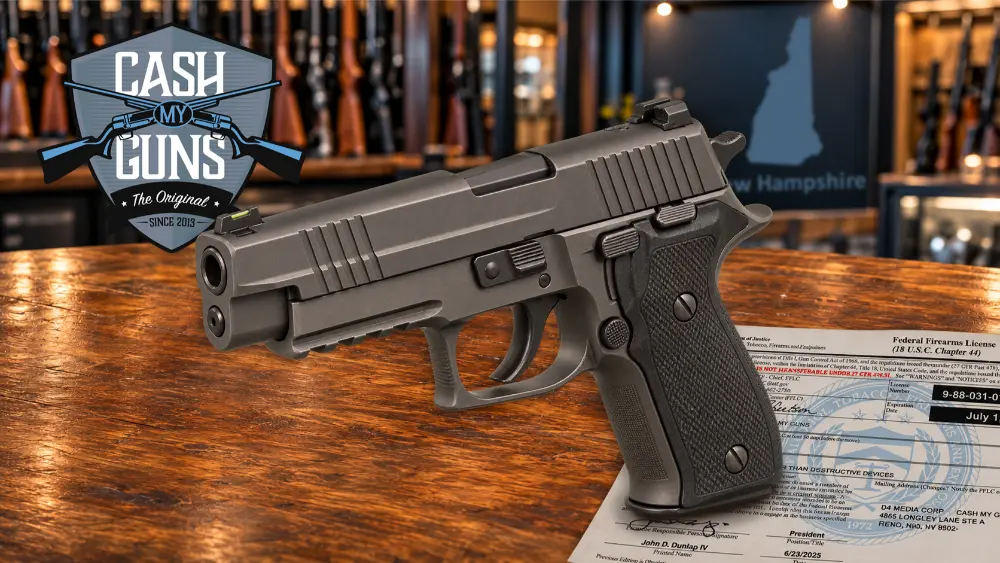
Where you can sell a gun in New Hampshire depends on whether you want a licensed buyer, a local shop, a private sale, or consignment. You can sell a gun in New Hampshire to a licensed firearms buyer, a local gun shop, another private person when the transaction satisfies state and federal law, or through consignment.
| Selling route | Who buys the firearm? | How the transfer is handled | Main advantage | Main trade-off |
|---|---|---|---|---|
| Licensed online buyer | The licensed business | Direct acquisition by the licensed buyer | No need to find a private buyer | Shipping and inspection occur before completion |
| Local gun shop | The shop | Direct dealer purchase | In-person transaction and no shipment to the buyer | Valuation depends on the shop and what it buys |
| Private-party sale | Another private person | New Hampshire and federal private-transfer rules | Seller negotiates directly | Seller must satisfy purchaser and transfer restrictions |
| Consignment | An end buyer through the consignee | Licensed consignment process | Seller can wait for a market sale | Takes longer and carries a fee |
The same statewide transfer rules apply whether you are in Manchester, Nashua, Concord, or elsewhere in New Hampshire. New Hampshire RSA 159:26 generally preempts local regulation of firearm sales, including in Manchester, Nashua, and Concord. (New Hampshire Government)
Do I Have to Go Through a Dealer to Sell a Gun in New Hampshire?
Generally, no. New Hampshire does not require every firearm sale between two unlicensed New Hampshire residents to be completed through a federally licensed firearms dealer. Federal law likewise does not require dealer participation in every same-state transfer between unlicensed residents. Federal law permits a same-state private transfer when the seller does not know or have reasonable cause to believe the buyer is prohibited from receiving or possessing firearms, according to the Bureau of Alcohol, Tobacco, Firearms and Explosives (ATF).
New Hampshire adds its own conditions. RSA 159:8 requires the purchaser to be personally known to the seller or to present clear evidence of identity. RSA 159:14 separately protects a handgun sale by an unlicensed individual who is not engaged in the business of selling pistols or revolvers when the buyer is licensed under Chapter 159 or personally known to the seller. New Hampshire RSA 159:7 also bars a firearm transfer to a person convicted of a felony. (New Hampshire Government)
A licensed dealer remains an available route when the seller wants a dealer to handle eligibility screening and transaction records.
Do I Need a License to Sell My Own Guns in New Hampshire?
No state dealer license is required simply because you sell firearms from your own personal collection in New Hampshire. New Hampshire repealed its former local license to sell pistols and revolvers effective May 23, 2025. Chapter 40, House Bill (HB) 551 replaced the former RSA 159:8 dealer-licensing provision with the current purchaser-identity rule. (New Hampshire Government)
Federal law still requires a dealer license when a person is engaged in the business of dealing in firearms. Section 921(a)(21)(C) of Title 18 of the United States Code (U.S.C.) defines that activity around repetitive purchase and resale of firearms as a regular course of business predominantly to earn a profit. The statute expressly excludes occasional transactions for a hobby or personal collection and the sale of all or part of a personal collection. (GovInfo)
The federal 2024 ATF rule that added regulatory presumptions to the dealer analysis was vacated by the U.S. District Court for the Northern District of Texas on June 12, 2026. (GovInfo)
How Many Guns Can I Sell in New Hampshire Before I Need a License?
Federal law sets no fixed number of firearms that a New Hampshire owner may sell before a dealer license is required. Under 18 U.S.C. § 921(a)(21)(C), the question is whether the person is selling from a personal collection or repeatedly buying and reselling firearms as a regular course of business predominantly to earn a profit. (GovInfo)
Selling several firearms, or even all or part of a personal collection, does not create a numerical licensing threshold. Buying firearms for repetitive resale can produce a different licensing analysis even when the number sold is relatively small.
Can I Sell My Gun to a Gun Store or Licensed Firearms Buyer?
Yes. A licensed gun store or firearms buyer can purchase a firearm directly from a New Hampshire owner. ATF states that an unlicensed person may transfer a firearm to a licensee in any state. (ATF)
When you sell directly to the dealer, you do not complete ATF Form 4473 simply because the dealer acquires your firearm. ATF Form 4473 applies when a licensed manufacturer, importer, or dealer transfers a firearm to the person receiving it.
Cash My Guns is a federally licensed firearms dealer and purchases firearms directly through its Sell Your Gun service.
You can request a free appraisal and identification before deciding whether to sell.
Can I Sell a Gun Online From New Hampshire?
Yes. A New Hampshire owner can start a firearm sale online, but the legal transfer rules apply when the firearm is delivered to the buyer. ATF permits a same-state private transfer subject to New Hampshire law, while an interstate transfer to an unlicensed buyer generally requires a federally licensed firearms dealer in the buyer’s state. (ATF)
An online licensed buyer can purchase the firearm itself. If an online sale leads to an unlicensed buyer in New Hampshire, the state purchaser-identity rule and federal recipient restrictions apply. An unlicensed buyer in another state generally receives the firearm through a licensed dealer in that state.
Can I Sell a Gun to Someone in Another State From New Hampshire?
Yes, but the transfer route depends on who the out-of-state buyer is. ATF states that a firearm sold to an unlicensed person in another state generally must be delivered to a Federal Firearms Licensee (FFL) in the buyer’s state so the buyer can receive it through the federal dealer process. A New Hampshire owner may transfer a firearm directly to a licensed dealer in another state. (ATF)
New Hampshire RSA 159:8-a also applies specifically to a pistol or revolver sold to a nonresident. The statute requires the nonresident to have authority under the laws of the person’s home state to purchase a pistol or revolver there, unless the New Hampshire State Police director has issued the permit described in that section. (New Hampshire Government)
Can I ship a gun out of New Hampshire?
Yes. ATF Publication 5300.21 confirms that an unlicensed person may transfer a firearm directly to a federally licensed firearms dealer (FFL) in any state. Shipments by common or contract carrier must comply with 27 C.F.R. § 478.31 and the carrier’s firearm-shipping policies.
Handguns generally cannot be mailed through the United States Postal Service (USPS) by an unlicensed individual and must instead be shipped through an eligible common or contract carrier. Under USPS Publication 52, § 432, a non-FFL owner may mail an unloaded rifle or shotgun domestically to a licensed dealer, manufacturer, or importer, subject to USPS mailing requirements.
For packing details, follow the Firearm Shipping Guide and the shipping instructions supplied for the transaction.
How Does a Private Party Sale Work in New Hampshire?
A same-state private firearm sale in New Hampshire can be completed without a dealer when the transaction satisfies New Hampshire and federal law. The federal Gun Control Act does not impose recordkeeping or dealer participation on every transfer between two unlicensed residents of the same state.
The New Hampshire rules add several boundaries. RSA 159:8 requires the purchaser to be personally known to the seller or to present clear evidence of identity. RSA 159:7 prohibits transferring a firearm to a person convicted of a felony. For a pistol or revolver, RSA 159:14 separately protects specified private sales to a person licensed under Chapter 159 or personally known to the seller. (New Hampshire Government)
Presentation of identification should not be treated as a substitute for checking every other condition that applies to the transaction.
What Does It Cost to Transfer a Gun in New Hampshire?
New Hampshire charges no state transfer-processing fee for a firearm sale. RSA 159:26 reserves regulation of firearm sales, taxation, licensing, and related matters to the state and preempts most local firearm regulation, and the current state firearm-sale framework imposes no per-firearm or per-transaction transfer charge. (New Hampshire Government)
A dealer that voluntarily processes a private transfer can set its own service price. Under 34 U.S.C. § 40913(f), the Federal Bureau of Investigation (FBI) does not charge a fee for National Instant Criminal Background Check System (NICS) checks.
| Cost | Amount | Who pays | Frequency |
|---|---|---|---|
| New Hampshire state firearm-transfer charge | $0 | No state charge | No per-firearm or per-transaction state charge |
| FBI NICS check | $0 from the FBI | No FBI fee | No federal charge per check |
| Voluntary dealer transfer service | Dealer-set | As arranged with the dealer | Dealer determines whether pricing is per firearm or transaction |
Is There a Waiting Period When Selling a Gun in New Hampshire?
New Hampshire has no state firearm-sale waiting period. A lawful same-state private transaction is not subject to a New Hampshire cooling-off period, and selling directly to a licensed dealer does not create a state waiting period for the seller. RSA 159:26 also prevents municipalities from creating their own firearm-sale waiting periods unless state law specifically authorizes them. (New Hampshire Government)
Federal dealer delivery rules can affect when an unlicensed buyer receives a firearm from a dealer. 18 U.S.C. § 922(t) contains the federal background-check timing framework, including the ordinary three-business-day provision and the extended investigation procedure for specified transactions involving a buyer under 21. Those rules govern dealer delivery to the buyer, not the owner’s direct sale to the dealer. (GovInfo)
How Do I Transport a Gun to a Dealer in New Hampshire?
A New Hampshire owner who may lawfully possess the firearm can lawfully transport it to a dealer. RSA 159:6, III states that the availability of a carry license does not prohibit otherwise lawful unlicensed transport or carry of a firearm in a vehicle, whether openly or concealed, loaded or unloaded. (New Hampshire Government)
Rifles and shotguns have an additional vehicle rule. RSA 207:7 prohibits carrying a loaded rifle or shotgun in or on a moving motor vehicle, subject to the section’s specific exceptions. RSA 207:1 defines “loaded” for that title as a round or projectile in the chamber that can be discharged by pulling the trigger. (New Hampshire Government)
The New Hampshire statutes do not impose a general trunk-only rule for this dealer trip. A dealer may still have its own handling procedure for bringing a firearm onto its premises.
Is My Gun Registered With New Hampshire, and Does It Matter?
New Hampshire does not maintain a general firearm-transaction registry through its state background-check records. RSA 159-D:2 requires the Department of Safety to destroy specified approved-buyer background-check records within one day and prohibits the department from maintaining firearm-transaction records or names of buyers and transferees under that system. (New Hampshire Government)
A firearm can still appear in other records. Federally licensed dealers have federal acquisition and disposition recordkeeping obligations, and certain National Firearms Act firearms are subject to federal registration rules or current federal enforcement policies.
How Do I Sell an Inherited Gun in New Hampshire?
If you have inherited a firearm in New Hampshire, receiving a handgun, rifle, or shotgun through an estate does not create a firearm-specific New Hampshire registration form, filing deadline, or firearm-registration fee. The person selling an inherited firearm must have authority to do so under the New Hampshire estate rules that apply to that property.
For a full estate administration, RSA 554:1 requires the administrator to file an inventory within 90 days after appointment. The inventory covers the estate’s real and personal property and its date-of-death fair market value. The New Hampshire Judicial Branch provides the Inventory of Fiduciary form, NHJB-2125-P, for that purpose. (New Hampshire Government)
Some estates use waiver of administration. RSA 553:32 lists circumstances in which an estate has no inventory requirement. (New Hampshire Government)
An administrator may account for estate goods sold at auction or private sale under RSA 554:7. RSA 554:9 provides that personal property specifically left to a beneficiary in a will is not to be sold when it is not needed to pay debts. If an heir later sells an inherited firearm in New Hampshire, the state’s purchaser-identity restrictions and federal recipient rules apply to that sale. (New Hampshire Government)
If you are handling several inherited firearms, you can use Sell Your Gun Collection to send Cash My Guns your collection list and photos. For a first-time or uncertain seller, Cash My Guns is also available at (775) 432-6006.
Are There Firearms That Require a Different Process in New Hampshire?
Yes. Some firearms and transactions require different treatment under New Hampshire or federal law. New Hampshire RSA 159:13 prohibits altering or removing identifying marks on a pistol or revolver, and RSA 159:7 prohibits transferring a firearm to a person convicted of a felony. (New Hampshire Government)
Treatment under the federal National Firearms Act (NFA) changed in 2026. Effective October 9, 2026, ATF adopted a policy of not enforcing specified NFA making, registration, tax-stamp, and transfer-approval provisions for short-barreled rifles, short-barreled shotguns, silencers, and “any other weapons.” The $200 NFA tax and full NFA framework remain in place for machine guns and destructive devices. Gun Control Act requirements continue to apply. (ATF)
The injunction in Silencer Shop Foundation v. ATF applied to the plaintiffs and specified related persons. ATF’s nationwide treatment comes from the Department of Justice (DOJ) enforcement policy rather than from a universal injunction.
For estate firearms still within the active NFA transfer framework, Section 479.90a of Title 27 of the Code of Federal Regulations (C.F.R.) addresses possession and transfer by an executor or other person authorized to dispose of estate property. (eRegulations)
Cash My Guns does not buy National Firearms Act (NFA) items, including within a collection. If an inherited or personally owned firearm may be an NFA item, ask a qualified attorney about the current federal requirements before transferring it. If a situation is court-ordered, contested, or involves a person legally prohibited from possessing firearms, contact Cash My Guns at (775) 432-6006 before arranging a transfer.
Can I Sell Ammunition in New Hampshire?
Yes. New Hampshire does not require a private ammunition sale to go through a state-licensed ammunition vendor or a state ammunition background-check process. RSA 159:26 gives New Hampshire statewide authority over ammunition-sale regulation and preempts most local ammunition regulation. (New Hampshire Government)
Federal restrictions on who may receive ammunition still apply. ATF also states that an unlicensed person may obtain ammunition from an out-of-state source if that person is not prohibited from possessing or receiving ammunition. (ATF)
Cash My Guns purchases factory-sealed bulk ammunition, or ammunition included with a firearm collection. Ammunition can be sold in the same transaction as a firearm and ships in a separate box.
For ammunition that fits that scope, you can submit an ammunition inquiry.
Where Can I Sell a Gun Collection in New Hampshire?
A New Hampshire owner can sell a personal firearm collection directly to a licensed buyer, sell individual firearms through lawful private transactions, use a local gun shop, or consider consignment. Federal law does not set a collection-size threshold that turns a personal collection sale into licensed dealing. The federal test remains whether the seller is engaging in repetitive purchase and resale as a regular business predominantly to earn a profit. (GovInfo)
An estate collection also carries the administrator and specific-bequest rules in New Hampshire probate law.
For collections too large to box, Cash My Guns arranges freight and shipping-container pickup, and direct pickup may be arranged case by case for a large or high-value collection. You can sell part of a collection, with no obligation to sell the rest.
You can send your collection list and photos for review.
How Do I Know What My Gun Is Worth Before Selling It?
A firearm’s value depends on its exact make, model, variant, condition, finish, markings, provenance, and evidence from completed sales. An asking price shows what a seller wants; a completed sale shows what a buyer actually paid.
Small identification details can move value materially. Proof marks, matching serial-numbered components, configuration, condition, and a particular variant can matter more than the model name alone.
Cash My Guns appraises against its own record of completed transactions, together with recent market activity and comparable sales. Identification and appraisal are free and carry no obligation to sell.
You can find out what the firearm is and what it may be worth at no cost.
How Does Selling to Cash My Guns From New Hampshire Work?
Cash My Guns is a federally licensed firearms dealer that appraises and purchases firearms directly through its Sell Your Gun service. The transaction runs through a licensed dealer and is subject to federal, state, and local law.
- Send details and photos. Cash My Guns identifies the firearm and provides a free, no-obligation appraisal.
- Review the offer. An offer is held open for 72 hours. No offer is binding until the firearm is received and examined.
- Ship with the prepaid insured label. Cash My Guns covers incoming shipping and the federal transfer fee, and the firearm is insured in transit at Cash My Guns’ appraised value. Ship within seven days of receiving the label; a longer delay may change the offer terms. If an oversized box is used instead of the standard dimensions in the shipping instructions, the difference in the carrier surcharge is deducted from the payout.
- Inspection and acceptance. Cash My Guns examines the firearm, and the seller decides whether to accept. If the seller declines after inspection, the seller pays return shipping to a federally licensed firearms dealer of their choice, plus that dealer’s transfer fee.
- Payment and documentation. Payment is submitted for processing the same business day the firearm is inspected, and the seller accepts. Cash My Guns pays by direct deposit or mailed business check. Direct deposits typically arrive within one to three business days, and checks are processed the same day. Acceptances after the daily cut-off, or on weekends and holidays, are processed the next business day. Cash My Guns issues a bill of sale on purchase.
Cash My Guns also offers Firearm Consignment for owners who would rather wait for a market sale. It is available for single firearms valued at $500 or more; within a larger collection, a lower-value firearm may be consigned case by case. The standard fee is 25% of the selling price, with a reduced rate possible on higher-value firearms, and it covers incoming shipping and transfer, FFL paperwork, appraisal, photography, marketing, payment processing, and normal preparation. The owner is paid when the firearm sells.
The transaction is subject to the Cash My Guns Terms and Conditions.
You can start with a photo and a free appraisal, or call (775) 432-6006 if you would rather speak with someone first.
Frequently Asked Questions About Selling a Gun in New Hampshire
Can I sell a handgun to someone I do not personally know?
New Hampshire law places specific conditions on an unfamiliar purchaser. RSA 159:8 permits delivery only when the purchaser is personally known to the seller or presents clear evidence of identity. RSA 159:14 separately protects specified handgun sales by an unlicensed person who is not engaged in the business when the buyer is licensed under Chapter 159 or personally known to the seller. A seller should not treat identification alone as resolving every other legal condition on an unfamiliar private handgun sale. (gc.nh.gov, gc.nh.gov)
Do I need a bill of sale for a private firearm sale in New Hampshire?
New Hampshire does not impose a general state bill-of-sale form for a private firearm sale between two unlicensed residents. ATF states that the federal Gun Control Act does not require recordkeeping for a same-state transaction between two unlicensed people. A licensed dealer has separate federal recordkeeping duties. (ATF)
Can I give or sell a gun to a family member in New Hampshire?
Yes, an adult family member can receive a firearm when the transfer satisfies the same New Hampshire and federal restrictions that apply to the transaction. Family status alone does not replace purchaser-identity or recipient restrictions.
New Hampshire has a specific rule for minors. RSA 159:12 generally prohibits selling, bartering, hiring, lending, or giving a pistol or revolver to a minor, but it expressly permits specified gifts by parents, grandparents, guardians, administrators, and executors to children, wards, or estate heirs. The statutory exception is for the listed gift situations and should not be converted into a general permission to sell a handgun to a minor. (New Hampshire Government)
How long does it take to sell a gun in New Hampshire?
A private same-state sale in New Hampshire has no state waiting period; its timing depends on when the parties satisfy the purchaser-identity and recipient requirements. A sale directly to Cash My Guns also involves shipping and inspection. After inspection and acceptance, Cash My Guns submits payment for processing the same business day. (New Hampshire Government)
Do New Hampshire’s January 2027 carry-license changes affect selling a gun?
No. The changes to RSA 159:6 that take effect January 1, 2027 concern the information and forms used for New Hampshire carry-license applications. They do not create a permit or license requirement for a private owner selling personal firearms. (New Hampshire Government)
Did any important federal firearm-sale rules change in 2026?
Yes. Several federal developments can affect seller guidance. The Supreme Court decided United States v. Hemani on June 18, 2026, holding the prosecution under 18 U.S.C. § 922(g)(3) unconstitutional as applied to the defendant before the Court. DOJ’s Office of Legal Counsel concluded on September 17, 2026 that the federal licensed-dealer handgun restrictions are unconstitutional as applied to otherwise lawful adults ages 18 through 20. (United States v. Hemani; DOJ Office of Legal Counsel)
The Hemani decision and DOJ handgun-age opinion do not resolve every individual’s firearm eligibility or every restricted-firearm transfer.
If you want to identify or appraise a firearm before choosing a selling route, you can start with a free appraisal and identification or call (775) 432-6006. For guidance on another jurisdiction, see How to Sell a Gun by State.
This article provides general information about New Hampshire and federal firearm-selling rules, not legal advice. If your situation is court-ordered, contested, or involves a person legally prohibited from possessing firearms, contact Cash My Guns at (775) 432-6006 before arranging a sale.
Sources
These external sources support the article’s inline links.
- New Hampshire RSA 159:8, Purchase of Firearm; Identity of Purchaser. Purchaser identity and felony restriction. Amended effective May 23, 2025; checked November 5, 2026.
- New Hampshire RSA 159:14, Exemption. Private handgun-sale exemption language. Current statute; checked November 5, 2026.
- New Hampshire RSA 159:7, Sales to Felons. State recipient restriction. Current statute; checked November 5, 2026.
- New Hampshire RSA 159:8-a, Sales to Nonresidents. Nonresident pistol and revolver sales. Amended effective May 23, 2025; checked November 5, 2026.
- New Hampshire RSA 159:26, Firearms, Ammunition, and Knives; Authority of the State. State preemption, transfer fees, waiting-period and ammunition framework; checked November 5, 2026.
- New Hampshire RSA 159:6, License to Carry. Vehicle transport and January 1, 2027 changes; checked November 5, 2026.
- New Hampshire RSA 207:1, Definitions and RSA 207:7, Hunting from Motor Vehicle. Loaded long-gun definition and moving-vehicle rule; checked November 5, 2026.
- New Hampshire RSA 159-D:2, Confidentiality. State background-check records and transaction-record restrictions; checked November 5, 2026.
- New Hampshire RSA 159:12, Sale to Minors. Minor handgun transfers and specified gift exceptions; checked November 5, 2026.
- New Hampshire RSA 159:13, Changing Marks. Firearm identification-mark restrictions; checked November 5, 2026.
- New Hampshire Chapter 40, HB 551. Repeal of local pistol and revolver seller licensing and amendment of RSA 159:8. Effective May 23, 2025; checked November 5, 2026.
- New Hampshire RSA 554:1, Inventory; RSA 553:32, Waiver of Administration; RSA 554:7, Accountability for Chattels; and RSA 554:9, Property Not to be Sold. Estate inventory, waiver, sale authority, and specific bequests; checked November 5, 2026.
- New Hampshire Judicial Branch Inventory of Fiduciary instructions. Form NHJB-2125-P and estate inventory contents. Current published form materials; checked November 5, 2026.
- ATF Publication 5300.21, Best Practices: Transfers of Firearms by Private Sellers. Same-state sales, interstate transfers through a licensee in the buyer’s state, direct transfers to licensees, and federal recordkeeping; January 2013 edition; checked November 17, 2026.
- 27 C.F.R. § 478.124, Firearms transaction record. Form 4473 requirements for licensed dispositions; current regulation; checked November 17, 2026.
- United States Code, 2024 Edition, 18 U.S.C. § 921. Federal “engaged in the business” definition and personal-collection exception; checked November 5, 2026.
- 18 U.S.C. § 922, Office of the Law Revision Counsel. Interstate firearm transfers, prohibited recipients, dealer background-check timing, and federal restrictions affecting out-of-state ammunition purchases, including § 922(g) and (n). Current U.S. Code; checked November 17, 2026.
- 27 C.F.R. § 478.31, Delivery by common or contract carrier, and USPS Publication 52, § 432. Shipping to licensees, common-carrier requirements, and firearm mailability; current regulation and postal policy; checked November 17, 2026.
- Texas v. ATF final judgment. Vacatur of the 2024 “engaged in the business” rule, June 12, 2026; checked November 5, 2026.
- ATF October 2026 NFA guidance and Silencer Shop Foundation v. ATF. Current NFA enforcement policy and underlying injunction; checked November 5, 2026.
- 27 C.F.R. § 479.90a, Estates. Estate handling of registered NFA firearms; checked November 5, 2026.
- United States v. Hemani. Supreme Court decision issued June 18, 2026; checked November 5, 2026.
- DOJ Office of Legal Counsel opinion on handgun sales to adults ages 18 through 20. Issued September 17, 2026; checked November 5, 2026.
- 34 U.S.C. § 40913(f), Office of the Law Revision Counsel. Federal prohibition on FBI user fees for NICS background checks under 18 U.S.C. § 922(t); current U.S. Code; checked November 17, 2026.