

You’re ready to sell a gun, then you realize the serial number is missing, rubbed almost smooth, or you can’t confirm what you’re seeing. That’s the moment the stakes feel real, because the wrong move can turn a simple sale into a legal mess or a gun that gets held up.
I hear the frustration: you’re not trying to do anything shady, you inherited it, found it in an old safe, or the markings are just confusing. And “no serial number” isn’t automatically illegal. Before 1968, there was no general federal requirement that all commercially made firearms have serial numbers, and plenty were only marked voluntarily. The Gun Control Act of 1968, often called the GCA, is where modern “this should be serialized” expectations largely start, requiring licensed manufacturers and importers to mark firearms.
This comes down to why it’s missing plus where the sale happens, especially since an antique firearm, including guns made in or before 1898 (and certain replicas or muzzleloaders under specific conditions), can sit in a different legal bucket. You’ll leave knowing how to sort what you have and what the safest next move looks like, usually through an FFL or a firearms attorney.
What “No Serial Number” Really Means
Here’s the big misunderstanding: “no serial number” isn’t one situation, it’s three broad categories, and mixing them up is where sellers get burned. One gun genuinely left the factory before routine serializing, another was privately made and never marked, and a third has markings that are removed, altered, or simply unreadable. Those are three totally different realities, so you want to sort the bucket first.
Some older, pre-marking-era firearms legitimately don’t have a serial number. The friction is that people assume “old” automatically means “unserialized,” but plenty of older guns were marked. Your job is to confirm you’re not overlooking a faint stamp in the correct place.
A privately made firearm (PMF) can be unmarked because it didn’t come from a licensed manufacturer or importer. Buyers and FFLs lean on the serial number because federal regs define it as the number or alphanumeric designation placed on a firearm by the manufacturer or importer to identify that specific firearm (27 C.F.R. §§ 478.11, 479.11).
This is the high-risk bucket: markings exist, but they’re defaced, ground, painted over, or corroded to illegibility. Treat this as its own lane and stop guessing.
- Check the frame or receiver first. That’s the regulated core component, and for GCA firearms, licensed makers and importers must put the serial number on the firearm’s frame or receiver (27 C.F.R. § 478.92(a)(1)).
- Look for duplicate locations. On Glock 17/19 pistols, the same serial typically appears in three places: the frame (metal serial plate), the slide, and the barrel, with the barrel number commonly visible on the barrel hood through the ejection port.
- Use light, not tools. Wipe gently, use a flashlight, and change angles to catch shallow stamps.
- Stop if it looks altered or unreadable. Don’t scrape or “clean it up,” get a qualified gunsmith or an FFL to look it over.
Federal Law Rules You Must Know
That bucket sorting matters because federal law treats these situations very differently, especially when a marking looks altered on the controlled part. Before you worry about buyers or listings, you want the legal selling steps straight.
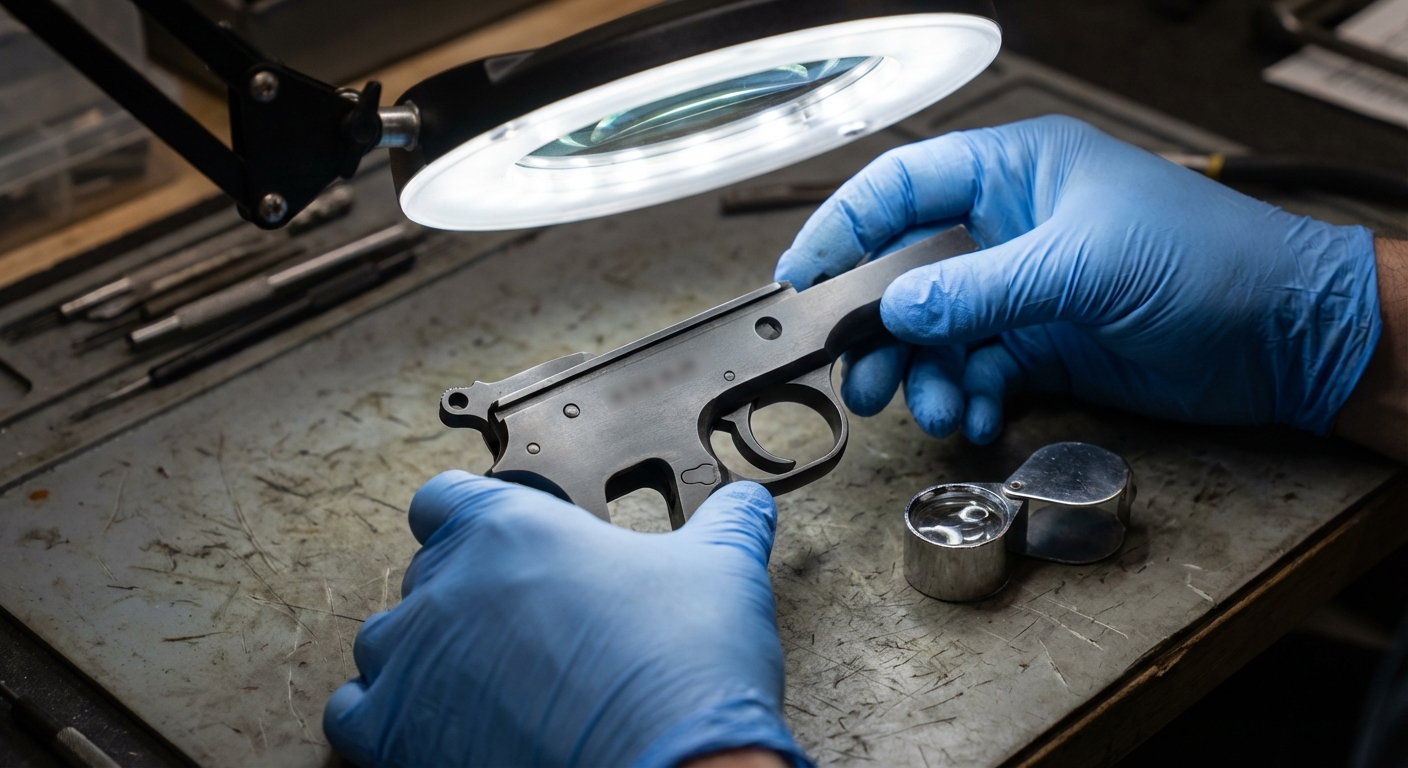
Federal law sets the floor, and the biggest federal “do not touch this” category is a firearm with an obliterated or altered serial number. If the number on the controlled part is gone or tampered with, selling and shipping gets functionally unsellable fast, and the legal risk spikes. Federal rules are the baseline only, states can stack stricter rules on top, but you need the federal bottom line right first.
18 U.S.C. § 922(k) makes it unlawful to knowingly transport, ship, or receive in interstate or foreign commerce a firearm that has had the importer’s or manufacturer’s serial number removed, obliterated, or altered. That interstate or foreign commerce connection is the jurisdictional hook in the statute, and it’s a big reason private sales without a background check can still trigger federal compliance issues.
Penalty-wise, violations are generally punished under 18 U.S.C. § 924(a)(1)(B), a fine and/or up to 5 years in prison. In plain terms, a defaced serial number is both a legality problem and a transfer problem, most legitimate buyers and dealers will not touch it.
For most modern guns, the frame or receiver is the regulated “gun” for identification and transfer purposes, which is why that’s where the serial number is supposed to be. Federal firearms licensees, FFLs, rely on that marking to log the firearm correctly and run a lawful transfer.
If an FFL can’t verify a lawful serial on the controlled part, they typically can’t accept it for shipment, consignment, or transfer without creating compliance exposure.
Privately made firearms, PMFs, can exist legally in private hands, but the moment one enters an FFL’s inventory, federal marking and recordkeeping expectations kick in. Under ATF Final Rule 2021R-05F (effective Aug. 24, 2022), an FFL who takes a PMF into inventory must ensure it is marked with a serial number and required identifying info in accordance with 27 CFR 478.92, or 479.102 for NFA items.
Practically, that means an FFL has to get the PMF marked with a unique serial number within seven days or before disposition, whichever occurs first.
If you’re not 100% sure which federal bucket you’re in, treat that uncertainty as a stop sign, loop in a reputable FFL or a firearms attorney before you try to sell or ship anything.
State Laws That Change the Answer
Once you have the federal baseline, the real swing factor is often your state. State law can flip the answer from “maybe” to “no,” even when federal law feels ambiguous.

Two people can be looking at the same “no serial number” situation and land in totally different legal territory depending on where they live, especially when a state treats defacement and home-built guns as separate problems.
- Defaced-serial bans: Many states criminalize possession or transfer if a manufacturer’s serial number was removed, altered, or obliterated, even if the gun is otherwise legal.
- Unserialized and PMF rules: Some states add their own limits on unserialized guns and PMFs (privately made firearms), including marking requirements or outright possession bans.
- Transfer constraints: State transfer rules, waiting periods, and who must run the transfer through an FFL (licensed gun dealer) can block private-party sales even when federal law doesn’t.
Example: Texas. Texas makes it an offense to intentionally or knowingly possess, manufacture, transport, repair, or sell a firearm on which the serial number has been removed, altered, or obliterated (Tex. Penal Code § 46.06(a)(1), (a-1)).
Example: Florida. Florida makes it a crime to knowingly possess or sell a firearm with the manufacturer’s serial number removed, altered, or obliterated (Fla. Stat. § 790.27(1)).
At the federal level, a PMF made for personal use is not required by the GCA to have a serial number, unless it later enters an FFL’s inventory where marking rules can apply.
Before you try to transfer, ship, or list the firearm, verify your exact state rules using current statutes or official state resources (and compare how to sell a gun by state), since the details change.
Three Scenarios and What To Do
Once you know which “no serial” bucket you’re in, the next move becomes much clearer, and in one bucket, your move is to stop. The tricky part is that “antique” and “privately made” get mislabeled all the time, and genuinely worn markings can look suspicious even when you did nothing wrong. Use this quick decision tree, and consider an FFL (licensed dealer) instead of a private-party sale anytime you feel uncertainty.
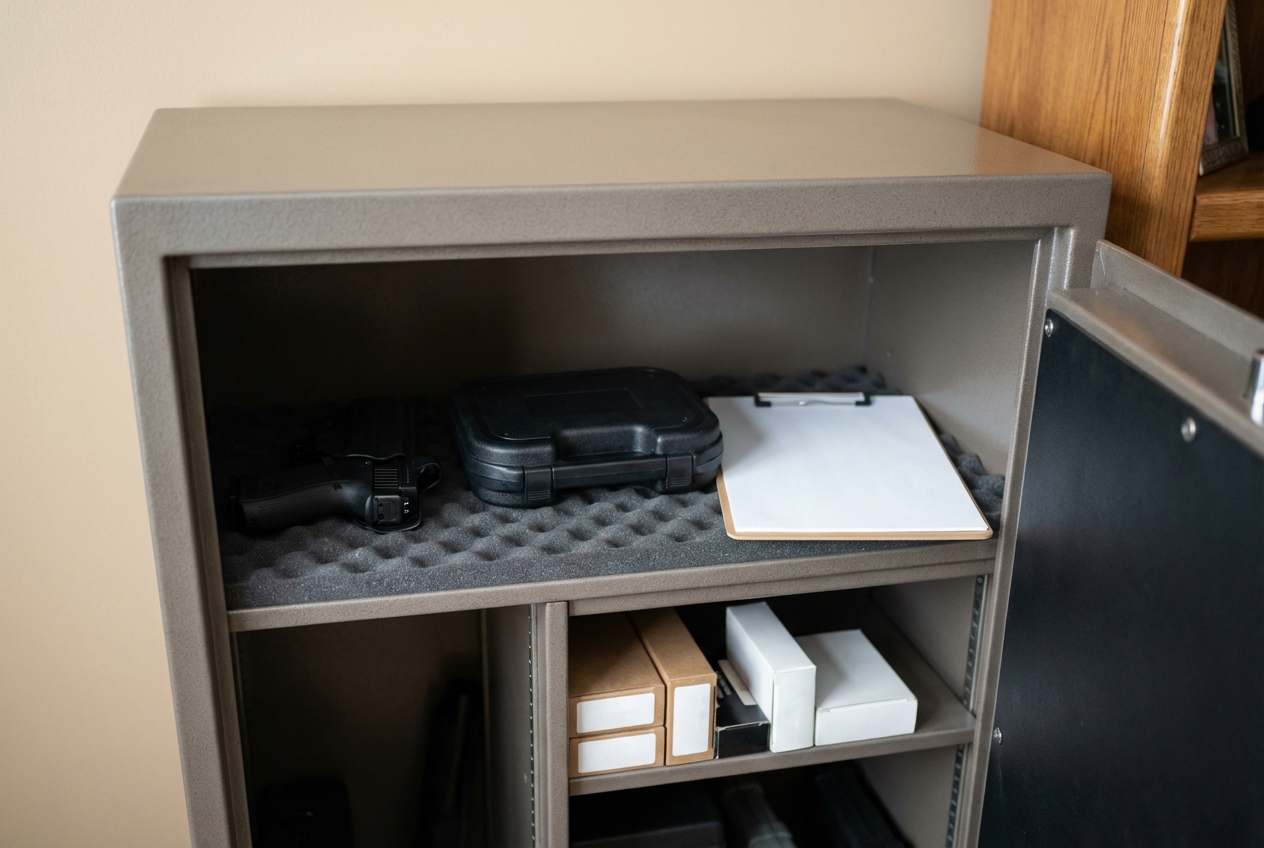
Under 18 U.S.C. § 921(a)(16), an “antique firearm” includes firearms manufactured in or before 1898. “Manufactured in or before 1898” means the gun’s actual build date, not when the model was first designed, so an 1890s-style gun made in 1901 is not an antique under that definition. A gun that uses fixed ammunition can still qualify as an antique if it was manufactured in or before 1898, replica and ammo-design issues are a separate question, so verify with maker records, known serial ranges, or a credible collector reference before you sell.
If it’s a PMF (home-built), plan on fewer willing buyers and more “house rules” from shops and platforms. The clean pathway is usually an FFL transfer or an FFL-run buyer that can document intake and keep you inside their process.
If you can’t confidently place the firearm in Branch 1 or Branch 2, treat it like Branch 3 until an FFL or attorney tells you otherwise—and review legal ways to get rid of a gun if selling is too risky.
Value, Pricing, and Selling Options
Once legality is sorted, the practical question is whether the market will even treat the gun like a normal sale. Even when a sale is legally possible, missing or questionable serial numbers change the market as much as they change the law.
A lot of buyers and dealers hesitate because they do not want the extra paperwork risk, an uncomfortable transfer, or a gun with unclear provenance. That hesitation shrinks your buyer pool, and fewer confident buyers almost always means softer pricing and longer time to sell.
What usually moves the needle is trust you can document. A legitimately older firearm that was never marked the way modern guns are, and a gun that looks suspiciously unmarked, get treated very differently at the counter. Bring any documentation you have, old receipts, a prior bill of sale, an estate inventory, even clear photos that show consistent condition over time. Collectible context matters too: condition, originality, and details like matching numbers can support value, while refinishing and aftermarket parts often do the opposite—and expert appraisals can help document that context.
If you want safer, lower-friction routes, you have options: sell directly to an FFL (a licensed dealer) who will control the intake and transfer; use consignment at a gun shop so they handle the buyer questions; lean on estate liquidation support if the gun is part of a larger cleanout; or find specialized buyers who focus on older and collectible pieces. Cash My Guns is operated by Dunlap Gun Buyers, a federally licensed firearms dealer (FFL); it states valuations consider make and model, condition (finish, bore, matching numbers, aftermarket parts), market data (dealer listings and auctions), seasonality, and regional demand, and in its workflow all firearms must ship to a Federal Firearms License (FFL) dealer.
Takeaway: pick the channel that reduces legal and transaction friction, not just the one that feels fastest, and show up with the best documentation you can.
Safe Next Steps Before You Sell
Your safest sale happens before you list anything-when you confirm what you have, document it, and check your rules.
That upfront work sounds small, but it’s where most sellers get tripped up, a fuzzy marking, missing paperwork, or the wrong assumption about what your state requires can create a big problem halfway through a transaction.
- Verify markings and make sure what’s on the firearm matches what you plan to describe.
- Gather documents that support lawful origin, age, and ownership (receipts, estate paperwork, prior transfer records).
- Confirm your state’s current requirements using official state sites, not forum summaries.
- Use an FFL (licensed gun dealer) any time you’re unsure about legality or transfer steps.
- Leave markings alone; never alter, “touch up,” or try to fix them yourself.
If anything looks tampered with or unreadable on the controlled part, treat it as a stop-and-verify situation and route it through professional help.
Conclusion
Rule of thumb: whether you can sell depends on why the serial number is missing and where you are.
“No serial” can mean a legitimately old or unmarked firearm, a PMF that was never marked, or a serial number that was defaced, removed, or altered.
Defaced, removed, or altered serial numbers are consistently treated as the highest-risk category in both federal and many state frameworks, stop and get help before you do anything else.
If the gun came from an inheritance or an old safe and the markings are simply unclear, the safest move is still the same: slow down, confirm what you have, and use an FFL when you’re not sure.
For compliance-forward next steps, Cash My Guns is a nationwide online purchasing service that buys guns, ammunition, and accessories, Safe • Legal • Hassle-Free.