
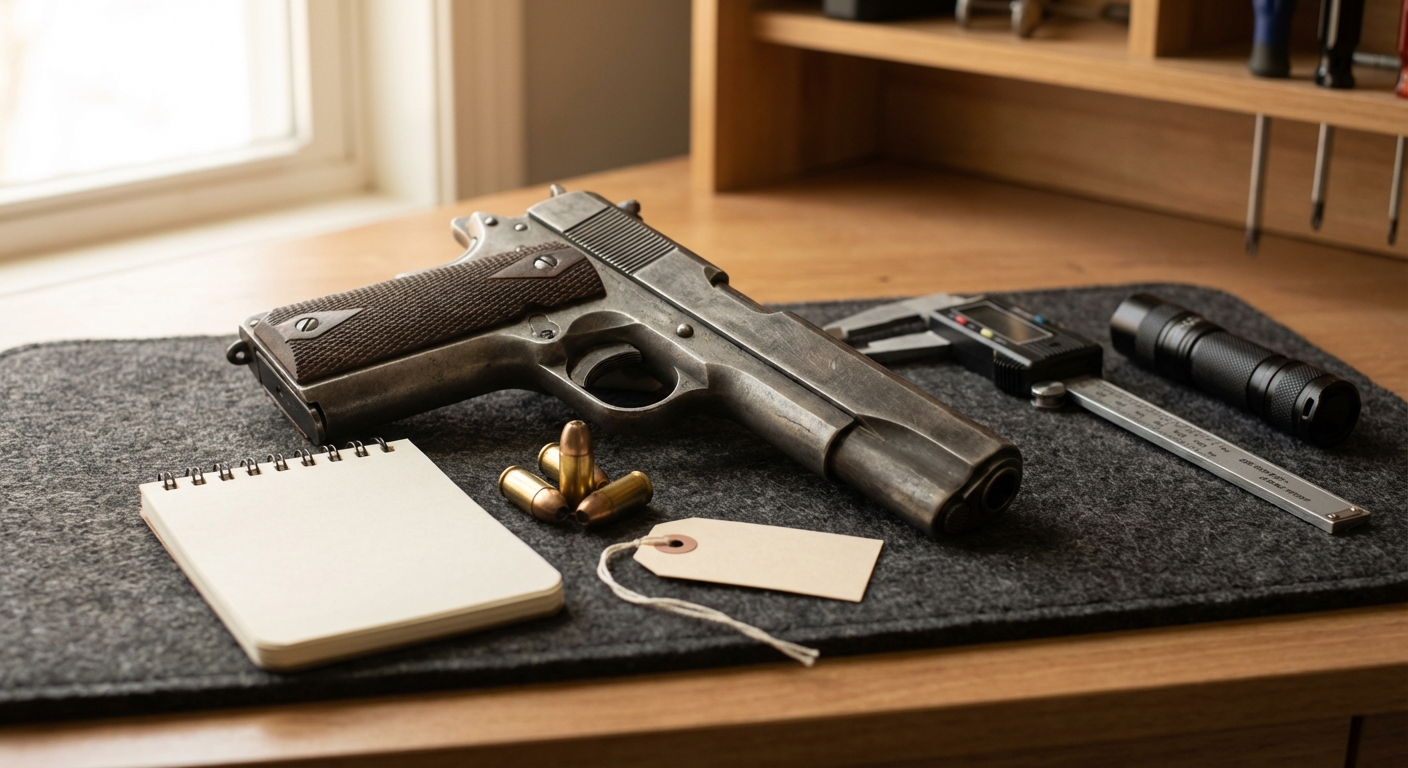

Your Springfield 1911 doesn’t have one “worth.” It has a few, and the number you should care about depends on how you plan to sell and how fast you need it gone. That’s why you keep bouncing between what you paid, what it would cost to replace, and what someone will hand you for it today. All three are real reference points, but they’re not the same question.
Here’s why the numbers don’t match: different buyers are pricing different risks. Major price guides, including the Blue Book of Gun Values, publish values by condition grade and split them into “retail” and “wholesale” for the same gun. A dealer’s trade-in value (cash offer), what they’ll pay now so they can resell it, is lower than private-party pricing because they’re baking in overhead, risk, compliance costs, and profit margin, and they’re anchoring the offer to expected resale, not original MSRP. Meanwhile, it’s easy to see wildly different numbers online and feel like someone’s trying to lowball you.
By the end, you’ll have a price range you can defend and a clear selling-path decision, based on which “worth” lens you’re actually chasing: private-party fair market value, consignment (retail asking price) that has to leave room for a commission, and auction hammer price, the number bidding stops at. Sentimental value is real, but it isn’t what the market pays.
What Actually Drives Springfield 1911 Value
Get the exact variant right and you eliminate most pricing mistakes. 1911 pricing swings hardest when you can name the exact series and configuration, then back it up with clear condition and originality signals buyers trust.
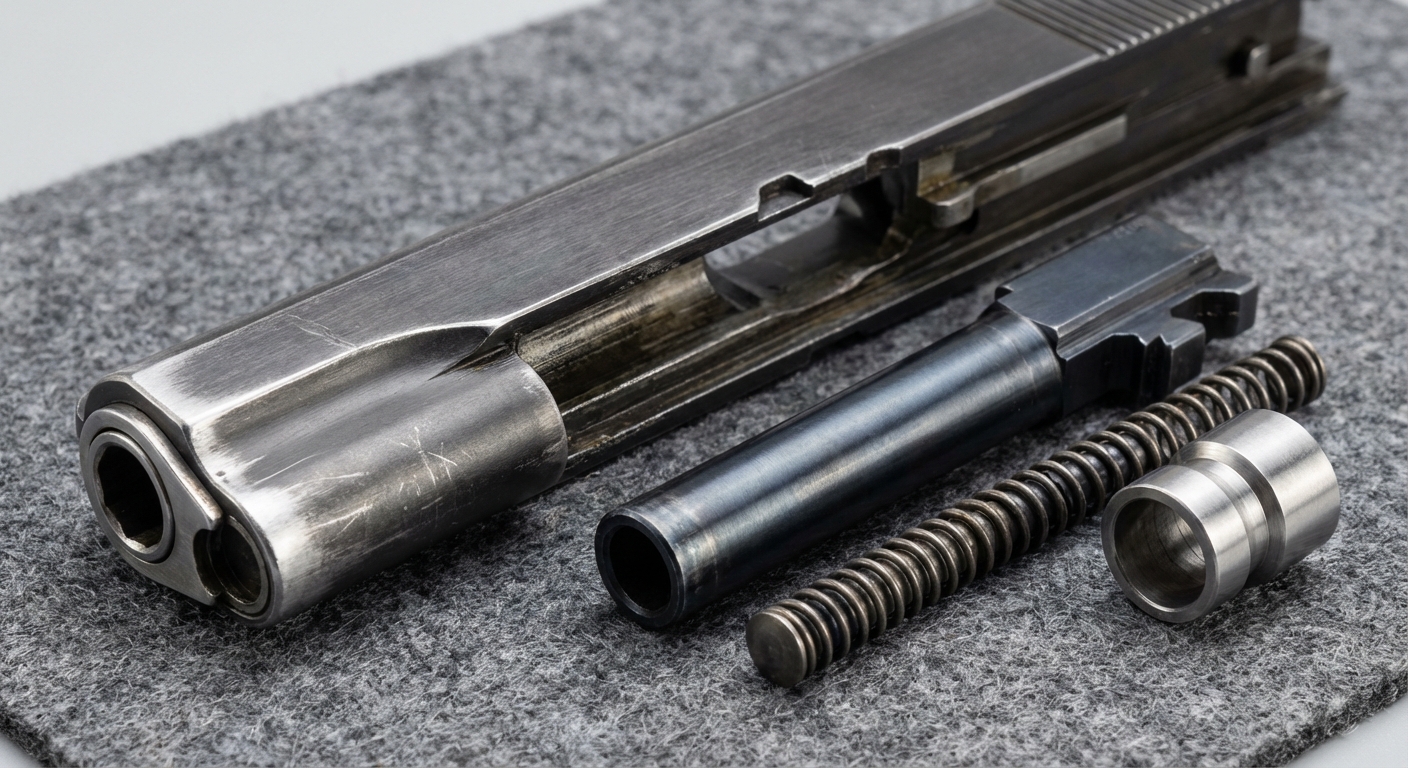
If you’re not sure what you have, don’t start with “1911” and a guess. Start with what’s observable. Springfield uses serial-number prefixes “N” and “NM” to designate 1911-A1 type pistols, and their serial-number records are described as very accurate and available online for lookup.
- Read the slide and frame rollmarks, then write them down verbatim.
- Check the serial prefix first, especially “N” or “NM,” before assuming a model family.
- Confirm maker clues, a “VP” proofmark inside a triangle at the left front of the trigger guard is a commonly referenced tell.
Here’s the quick way to sanity-check it: caliber and “major shape” decide which bucket your comps belong in. Full-size vs shorter models, and railed vs non-railed frames, pull in different buyers and different budgets. As a baseline example, 1911 GI models are typically full-size Government-pattern pistols with a 5-inch barrel and a non-railed dust cover.
Most offers move on what a buyer can see fast: edge wear, finish uniformity, and whether the bore looks sharp and clean. GI-style fixed sights generally trade for less than modern sight cuts, so a clean pistol with tiny GI sights still lives in a different value lane than the same gun cut for modern sights. Also, Parkerized finishes are common on GI models, and they can show holster wear differently than stainless; that “honest wear” look often turns into a pricing conversation.
Original box, papers, and factory accessories don’t magically change the gun, but they change buyer confidence. A complete package signals “this wasn’t a parts-bin project,” which tightens the range buyers feel good offering.
Two identical pistols move differently depending on your area. A 1911-heavy buyer pool rewards classic configurations, while markets packed with accessory-focused buyers lean toward railed, modern-sight setups because they fit lights and holsters people already own.
Write this down before you look up prices: exact model/series name from markings, serial prefix, caliber, barrel length, rail or no rail, finish and visible wear, bore appearance, and what’s included (box, papers, mags). Those notes are also why a GI, Mil-Spec, Loaded, Range Officer, TRP, Operator, and EMP never land in the same price neighborhood.
Once you can describe your pistol in that level of detail, pricing gets much less emotional. You’re no longer comparing “a 1911,” you’re comparing your specific configuration against recent 1911 pistol value benchmarks for the same kind of gun.
A Simple 3-Number Price Range
A 3-number range is the fastest way to stop guessing and start pricing like the market. You do not need a perfect single number; you need a simple, defensible fast-realistic-top range tied to how you might actually sell, because different channels reward patience differently and punish you with different fees.
Your anchor dataset is completed sales, meaning transaction records showing what similar guns actually sold for, not what sellers hoped to get. That one filter fixes the biggest pricing mistake I see: copying an ambitious asking price that never moved.
Pull a small stack, then make it usable:
- Filter to completed sales for your closest matches.
- Circle the three closest matches based on your condition bucket and the obvious configuration basics (caliber, size, major features).
- Trim out the weird outliers, like parts guns, custom one-offs, and listings with unclear descriptions or blurry photos.
You are building a defensible range, not winning a debate on the single highest sale you can find.
Turn those comps into three prices you can actually use in a conversation:
- Set the quick-sale number by starting at the low end of your closest completed sales, then nudging down for speed. This aligns with your trade-in value (cash offer) mindset: you are paying for certainty and convenience.
- Set the realistic private-party number by using the middle of your closest matches after basic adjustments. Condition moves the needle first, then accessories. Spare mags and a factory box help, but they rarely add dollar-for-dollar value like the seller hopes.
- Set the top-end “patient seller” number by using the high end of your closest matches, only if your gun truly matches that tier. This aligns with a consignment-style retail asking price, where you are trading time for a higher headline number.
Keep your adjustments high-level and obvious: if a comp includes a red dot, a threaded barrel, or a different variant, treat it as a mismatch and lean less on it. If your gun has aftermarket parts, price it against similar modified guns when possible, because “upgrades” do not automatically translate to higher sale prices.
One useful reference point: how expert appraisers determine firearm value (using market data plus make/model and condition details), along with seasonality and regional demand.
Your gross price is not your take-home. Handgun shipping is commonly described as averaging about $40 in real-world transactions, so use that as a planning baseline when you are netting proceeds. Consignment also bites harder than people expect; an example fee stack shows an FFL consignment fee of $79.35 on a $541.14 transaction total, and that is before you factor in how long it takes to sell.
If your top-end number only beats your realistic number by “a couple of fees,” it is not a top-end win, it is just extra waiting.
Write your three numbers down-quick-sale, realistic private-party, patient-seller top end-then use them as your script. When a buyer pushes, you can point back to completed sales and say, “Here’s the range the market is actually paying,” and you will sound like the person who did the homework, because you did.
Condition, Mods, and Collector Signals
Your comps only work if you’re honest about what you’re matching. Condition and buyer confidence are the biggest silent discounts on a used 1911, and mods can either build that confidence fast or set off alarm bells. Two Springfield 1911s that look “about the same” in a quick photo can feel worlds apart to a buyer once wear patterns, bore cues, and the quality of any work come into focus.

The NRA Modern Gun Condition Standards are widely cited because they grade modern firearms by what buyers can actually observe, finish wear, mechanical function, and overall integrity, using familiar buckets like New, Excellent, Very Good, Good, Fair, and Poor. Use that shared language in your description so you do not overprice the gun for its real-world wear.
Under those standards, “New” generally means as it left the factory with no wear or corrosion and no evidence of use or modifications. “Excellent” commonly implies minimal use, about 98%+ original finish remaining, mechanically excellent condition, and a sharp, clean bore.
On Springfield 1911s, finish tells the story first. Holster wear at the muzzle and slide flats, plus sharp edge wear on the dust cover and controls, reads as “carried a lot” even if the gun was not shot much, and buyers price that perception in immediately.
Bore and function are the next gut-check. A sharp, clean bore and normal lockup builds confidence. A dull, dirty, or questionable bore, or anything that hints at inconsistent function, pushes buyers toward “parts budget” thinking.
Finally, look for evidence of amateur work, chewed screws, punch marks, uneven fitting, or odd gaps. Clean tool marks and consistent fitting reads like professional work.
Mods usually help when they are reputable and documented, quality sights, or clearly explained reliability work with receipts and who did it. Mods usually hurt when they look home-done, involve permanent alterations, or include mismatched or unknown parts. Reversible changes and kept original parts do the most to protect value and trust.
- Excellent vs Good condition: About +15% to +35%
- Honest holster wear, otherwise solid: About -5% to -15%
- Tasteful, reversible upgrade with documentation: About 0% to +10%
- Permanent alteration or obvious home gunsmithing: About -10% to -30%
Your best move is simple: pick the most defensible grade, photograph wear honestly, list every mod, and include originals, receipts, and box/papers details. That presentation prevents renegotiation because you are selling trust, not just a pistol.
Market Trends and Comparable Gun Values
Once your model ID and condition call are solid, the next thing that shifts your number is timing. Your Springfield 1911’s price is not frozen in time. Timing and regional demand can shift what buyers will actually pay, even if your pistol hasn’t changed. The market, not your memory, sets today’s price, which is why supply and demand beats MSRP and nostalgia every time.
Big demand waves change how people shop and what they tolerate on price. FBI NICS data shows major spikes, including 39,695,315 background checks in calendar year 2020, and industry reporting widely links those surges to pricing pressure and volatility. NSSF’s “adjusted NICS” is widely used as a proxy for retail sales volume, and it also shows major surges in 2020 to 2021 versus many prior years. The practical takeaway is simple: in hot periods, buyers pay faster and argue less; in cooler periods, they negotiate harder and wait you out.
Even within the 1911 category, “recent” matters. One dataset reports the used value of a 1911 pistol increased by $72.57 over the past 12 months to $953.65, while another reports a used 1911 pistol increase of $206.29 over the past 12 months to $803.73. Those are big enough swings to punish anyone pricing off old screenshots.
Lots of buyers aren’t shopping “a 1911,” they’re shopping “a solid handgun around my budget.” That means your listing competes with searches like Glock 19, Glock 17, Sig P320, Beretta 92, and CZ 75, and that cross-pressure can cap what they’ll pay or raise it if your 1911 looks like the better value.
Refresh your comps any time they’re more than a few weeks old in active markets, or a couple months old in slower ones (check a recent gun market report to sanity-check conditions). If the last-sales you’re anchoring to don’t match today’s tempo, your price will be wrong, even if your pistol is perfect.
Best Ways to Sell for Your Goal
Those market swings show up differently depending on where you sell, because each selling option has its own fees, timelines, and buyer expectations. Your selling route determines what “worth” turns into in your pocket. If you want fast cash, you’ll land near the low end of your 3-number range. If you want the highest price, you’ll usually earn it with more time, more coordination, and more chances for something to go sideways.
Fast: You’ll probably prefer a gun store trade-in or a direct buyer. You trade dollars for speed and a clean exit.
Max price: You’ll probably prefer a local private sale (where legal) or consignment. Both can hit the top end, but you “pay” with time.
Least hassle: You’ll probably prefer a trade-in or a direct buyer. Fewer messages, fewer meetups, fewer moving parts.
Safest process: You’ll probably prefer any route that runs the handoff through an FFL (Federal Firearms Licensee), because interstate transfers typically must be completed by an FFL in the recipient’s state. Under federal law (18 U.S.C. § 922(a)(5)), a nonlicensee generally may not transfer a firearm to a nonresident except through an FFL.
- Local private sale (where legal)
- Payout: Higher net potential
- Effort and timeline: Days to weeks, you screen and coordinate
- Common friction: No-shows, renegotiation, your responsibility to avoid sketchy buyers
- Gun store trade-in
- Payout: Typically lowest
- Effort and timeline: Same day, minimal effort
- Common friction: You accept the store’s margin
- Consignment
- Payout: Higher gross, fees reduce net
- Effort and timeline: Weeks to months
- Common friction: Fees and delays, examples vary: 17% in-store and 20% online at one store, and some consignment arrangements require a 90-day minimum
- Online marketplaces via an FFL
- Payout: Often strong
- Effort and timeline: More steps, usually slower
- Common friction: FFL coordination, buyer questions, shipping and transfer timing
- Direct buyers
- Payout: Convenient, priced for resale margin
- Effort and timeline: Fast and simple
- Common friction: Lower than top-end private or consignment (example: Cash My Guns)
Shipping and compliance can be the deciding constraint: USPS prohibits non-FFLs from mailing handguns, and handguns are generally mailable only by FFLs, manufacturers, or government agencies under USPS rules. UPS policy requires handguns ship by an air service level (commonly Next Day Air) and not through The UPS Store, shipments must be tendered through authorized UPS channels.
Pick your top priority first, then choose the route that naturally matches it. That’s how you turn your range into the result you actually want.
State Rules, Quick Checklist, Next Steps
Once you’ve got a route in mind, sanity-check what “simple” means where you live. State and local rules can quietly change what a “simple sale” looks like, so your smartest move is building a quick verification habit, not guessing. This isn’t legal advice, it’s a practical reminder that requirements swing widely between states, and sometimes between counties or cities inside the same state.
Here’s how different the same private handgun sale can look: Texas (as of Aug 2025) does not require private-party handgun transfers between Texas residents to go through an FFL or include a background check, federal prohibitions still apply. Florida (as of Aug 2025) has no statewide universal background check law for private-party handgun transfers, federal prohibitions still apply. Virginia’s Act 45 (2023) imposes a 72-hour waiting period for certain transfers.
- Confirm the basic rule set where you live (state, county, city).
- Pick an honest condition bucket before you talk numbers.
- Re-check that your comps are current, not last year’s market.
- Choose a selling route that matches your goal (speed, net, simplicity).
- Double-check current local requirements, ideally by calling an FFL (licensed dealer) and reviewing an essential guide to legal and safe firearms sales.
If you want a fast baseline, Cash My Guns, operated by Dunlap Gun Buyers (FFL), offers a nationwide online buying service in all 50 U.S. states, and it starts with getting a remote quote online, then verify any local transfer details through an FFL.
Conclusion
You can defend your number once you treat “worth” as a range, built from correct variant ID, an honest condition call, and real comps. Serial-prefix and feature differences drive comps, and finish and bore condition, mods, and originality drive the spread. When you line that up with your selling goal, the three lenses from the start-private-party fair market value, consignment-style retail asking price, and auction hammer price-stop competing with each other and start making sense.
Get a baseline quote from Cash My Guns, an FFL-operated nationwide purchasing service in all 50 states, or list with that range.