
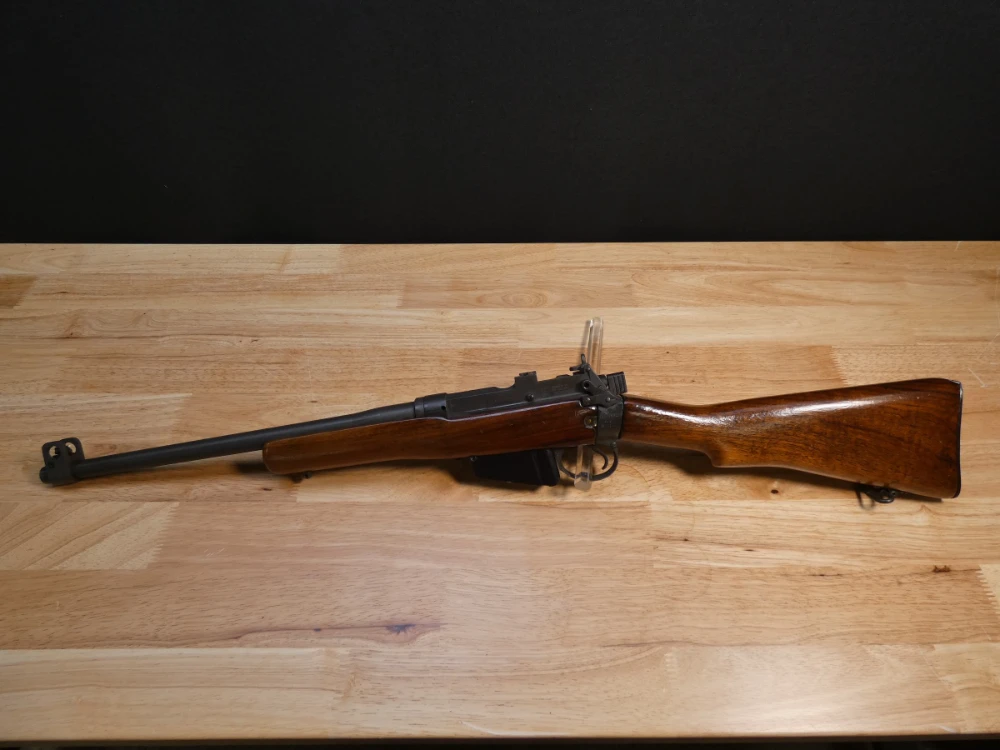
The RSAF Lee-Enfield No. 4 Mk I is a legendary bolt-action, magazine-fed repeating rifle that served as the standard for British forces for decades. Classified as a long gun, this piece of military history is highly sought after by collectors and shooting enthusiasts for its robust design, smooth action, and historical significance. Understanding its specific manufacturing history, condition, and originality is key to accurately determining its market value in today’s competitive collector’s market.
What Determines Your RSAF Lee-Enfield No. 4 Mk I’s Worth
The value of a Lee-Enfield No. 4 Mk I is primarily dictated by its originality, condition, and specific manufacturing variant. Collectors prioritize rifles with all-matching serial numbers and original components. The average used price is approximately $511, but examples can range from $500 to over $1,251 depending on these factors. While a formal appraisal is generally not cost-effective for standard models, which often sell for between $450 and $800, it can be essential for rare variations like sniper models that command thousands. Researching recent sales and consulting online forums is a practical way to gauge the worth of a common-issue rifle.
2026 Price Breakdown by Generation
Pre-Production ‘Trials’ Rifles
The earliest versions of the No. 4 rifle, known as ‘Trials’ rifles, represent the pre-production and developmental stage of the firearm. These models are considerably rarer than their mass-produced wartime counterparts and are highly prized by serious collectors. Their scarcity means they command a significant premium on the market. Identifying a genuine Trials rifle requires expert knowledge, as they possess unique markings and features not found on the standard No. 4 Mk I. Due to their rarity, establishing a standard price is difficult, as value is often determined on a case-by-case basis at auction or through private sales among specialized collectors.
Because of their limited production numbers and historical importance in the development of the iconic Lee-Enfield series, these rifles hold a distinct position in the market. A collector who discovers a Trials rifle will likely see its value far exceed the typical range for a standard wartime model. The provenance, condition, and degree of originality are paramount, with well-documented examples fetching the highest prices. For sellers, confirming the authenticity of a Trials rifle is the most critical step, as its unique status is the primary driver of its elevated value compared to the more common variants that followed.
Wartime Production (No. 4 Mk I & Mk I*)
The standard No. 4 Mk I and the simplified No. 4 Mk I* represent the bulk of wartime production, manufactured in the UK, Canada, and the United States to meet immense military demand. The value of these rifles is heavily influenced by the manufacturer, condition, and whether they retain their original, numbers-matching parts. The No. 4 Mk I* was an expediency model, primarily made by Savage in the US and Long Branch in Canada, featuring simplified components like a two-piece bolt head release to speed up manufacturing. While functionally identical, some collectors have preferences that can slightly influence prices between these variants.
A typical wartime production rifle in fair to good condition forms the baseline for Lee-Enfield values, often falling within the $500 to $800 range. Rifles that have been refurbished or have mismatched parts will fall on the lower end, while pristine, all-original examples command a premium. The presence of desirable original features, such as the click-adjustable micrometer rear sight versus the simple L-shaped battle sight, can also significantly increase a rifle’s appeal and market value. These models are the most common on the market, making condition and originality the key differentiators for determining a fair price.
Post-War Upgrades (No. 4 Mk I/2)
After World War II, many existing No. 4 Mk I rifles were upgraded to a new standard, becoming the No. 4 Mk I/2. This conversion, primarily performed in the late 1940s and 1950s, involved modifying the trigger mechanism to be hung from the receiver body rather than the trigger guard, resulting in a more consistent and improved trigger pull. These factory-converted rifles are identifiable by their updated markings and are considered a distinct and desirable variant. They represent an official evolution of the design, blending wartime history with post-war refinements that appeal to both collectors and shooters.
The market value for a No. 4 Mk I/2 is often solid, with examples in good condition typically valued in the $700 to $800 range. This places them slightly above many standard wartime production models, as the improved trigger is a functional benefit that shooters appreciate. For collectors, the official nature of the conversion maintains the rifle’s military provenance, making it more valuable than a rifle with aftermarket modifications. The combination of historical significance and enhanced performance makes the Mk I/2 a sought-after model that commands a respectable price among Lee-Enfield enthusiasts.
Late/Final Production (No. 4 Mk 2)
The Lee-Enfield No. 4 Mk 2 is the final iteration of the No. 4 series, featuring newly manufactured receivers with the improved trigger mechanism integrated from the start, rather than being a post-war conversion. These rifles, produced after WWII, are often considered the pinnacle of the No. 4 design, boasting superior fit, finish, and the refined trigger system. Because they were made during peacetime, production quality was typically higher than on hurried wartime models. Collectors and shooters value the Mk 2 for its craftsmanship and performance, often viewing it as the best shooter of the entire series.
Due to their refined features and excellent build quality, No. 4 Mk 2 rifles generally hold a higher value than many of their wartime predecessors. Their market price is influenced by their often-excellent condition, as many saw little to no combat use. A clean, all-original No. 4 Mk 2 can easily fetch a price at the higher end of the Lee-Enfield spectrum, sometimes surpassing the value of post-war converted models. The combination of historical lineage and peak manufacturing quality makes the Mk 2 a top-tier choice for any collector looking for the most refined example of the Lee-Enfield rifle.
How Modifications Affect Value
Modifications can significantly impact the resale value of a Lee-Enfield No. 4 Mk I, particularly for collectors who prioritize originality. Installing an aftermarket trigger, for example, is a common modification that can hurt its value. The issue is often compounded if the modification is irreversible, such as those requiring permanent alteration to the bolt. This makes it impossible to restore the rifle to its original factory configuration, which is a major deterrent for buyers seeking a historically authentic piece. Any change that deviates from the rifle’s military-issue state will typically lower its appeal and price within the collector community.
Conversely, not all non-standard features are detrimental. The most desirable sights for a No. 4 Mk I are not aftermarket but rather the original flip-up, click-adjustable micrometer sights. Many rifles were originally issued with simpler, non-adjustable ‘battle sights’ for expediency. Rifles that were later upgraded in service to the superior micrometer sights are more valuable to both collectors and shooters seeking precision. In this case, the “modification” was a period-correct upgrade that enhanced the rifle’s capability, thereby increasing its desirability and resale value compared to a version with the more basic sight.
Regional Price Variations in 2026
Determining specific regional price variations for the RSAF Lee-Enfield No. 4 Mk I is challenging, as the market for military surplus firearms is more national than local, driven largely by online auctions and forums. No clear consensus exists to suggest that these rifles are consistently more or less expensive in one state versus another. Pricing tends to be set by the firearm’s intrinsic qualities—such as manufacturer, condition, and originality—rather than the buyer’s geographic location. The widespread availability of online sales platforms has largely homogenized prices, connecting sellers and buyers across the country and minimizing regional market fluctuations.
While a definitive regional price map is unavailable, certain factors could theoretically create minor local variations. Areas with a higher concentration of military history enthusiasts or collectors may see slightly increased local demand, which could nudge prices up at gun shows or in local shops. Conversely, local laws regarding firearm transfers or the prevalence of certain competing surplus rifles could subtly influence the market. However, these effects are generally minimal, and a seller’s best strategy is to price their Lee-Enfield based on national market trends and recent sale prices from major online marketplaces.
Online vs Local Sales
Selling a Lee-Enfield No. 4 Mk I through a local, private sale offers a direct and often simpler transaction. While federal law does not mandate specific paperwork for a private sale between residents of the same state, using a Bill of Sale is highly recommended. This document protects both parties by creating a legal record of the transfer, including the firearm’s details, the buyer’s and seller’s information, and the date. The primary responsibility for the seller in a local transaction is to ensure, to the best of their ability, that the buyer is legally permitted to own a firearm.
Opting for an online sale significantly broadens the potential customer base but introduces specific legal and logistical requirements. A private seller cannot lawfully ship a rifle directly to an unlicensed individual in another state; the firearm must be sent to a Federal Firearms Licensee (FFL) near the buyer for a legal transfer. Furthermore, both UPS and FedEx have policies that typically require the shipper to be an FFL holder. Federal law also mandates that the carrier must be informed that the package contains a firearm, and the exterior of the box must not have any markings indicating its contents.
Comparing the two methods reveals a trade-off between reach and simplicity. A local sale is faster and avoids shipping costs and FFL transfer fees, but your market is limited to your immediate area. An online sale can potentially yield a higher price by reaching a national audience of collectors specifically looking for a Lee-Enfield. However, it requires navigating the complexities of interstate shipping regulations and finding a carrier that will accept the shipment from a non-licensee, which can be a significant hurdle. The best choice depends on the seller’s priority: convenience versus maximizing potential profit.
The FFL Buying Advantage
Selling your RSAF Lee-Enfield No. 4 Mk I to a Federal Firearms Licensee (FFL) offers a fast, secure, and straightforward alternative to the private market. While you can expect a lower cash offer, the convenience is often worth the trade-off. Gun dealers typically offer between 60% to 70% of the private party market value for a used firearm. For example, one source indicates a trade-in value of approximately 65% of its private sale price. This immediate cash offer eliminates the time and effort required to list the rifle, communicate with potential buyers, and arrange a meeting or shipment.
The primary advantage of selling to an FFL is the complete transfer of legal liability. Once the dealer takes possession of the rifle, they assume all responsibility for the firearm and its subsequent sale. This absolves you of any concern about the firearm’s future use and ensures the entire transaction is compliant with federal, state, and local laws. The dealer handles all necessary paperwork, background checks for the next buyer, and logistical complexities, providing the seller with unparalleled peace of mind. For those who prioritize a hassle-free and legally sound transaction, selling to an FFL is the most prudent choice.
What Increases Your Offer
High-quality presentation is crucial for maximizing the value of your Lee-Enfield No. 4 Mk I, and it begins with excellent photography. To attract the best offers, photograph the rifle in diffused natural light, such as on an overcast day, to avoid harsh glare and shadows. Place it against a simple, neutral background that doesn’t distract the viewer. Capture clear, high-resolution images of the entire rifle from both sides, ensuring the camera is perpendicular to the firearm to prevent distortion. Detailed close-ups of all markings, the bore, the bolt face, and any imperfections provide transparency and build buyer confidence.
A proper pre-sale cleaning also significantly enhances the rifle’s appeal. Focus on the bore and external surfaces without performing a full disassembly. Use a .30 caliber brush and solvent to clean the bore, but avoid excessive scrubbing; it’s not necessary for patches to come out perfectly white. A common mistake is separating the action from the stock, which can damage the wood and negatively affect the rifle’s bedding and accuracy. Instead, a simple wipe-down of all external metal parts and the bolt with a lightly oiled rag is sufficient to present a well-maintained firearm.
Finally, originality and desirable features are key value drivers. A rifle with all-matching serial numbers on the receiver, bolt, and magazine will always command a higher price. While collectors generally prefer unaltered rifles, the presence of certain period-correct features can add value. The most desirable of these are the original flip-up, click-adjustable micrometer sights. Rifles equipped with these are more sought-after by shooters and collectors alike compared to those with the more common and less precise ‘battle sights,’ and this feature should be prominently highlighted in your sale listing to justify a higher asking price.
When to Sell Your rsaf lee enfield no 4 mk i
While the market for historic military rifles is less volatile than for modern firearms, certain periods can offer a seller’s advantage. The consensus suggests that the best time to sell is during tax return season, from February through April. During these months, many potential buyers have more disposable income, leading to increased purchasing activity across the firearms market. Additionally, the pre-summer months of March through June are considered a favorable period, as enthusiasts and shooters are gearing up for the primary shooting season and are more likely to be acquiring new pieces for their collections.
Beyond seasonal trends, the political climate is often a more significant driver of demand for all firearms, including historical rifles like the Lee-Enfield. Demand tends to increase during election years or periods of political uncertainty when discussions around potential new firearm regulations become more prominent. This can motivate both new and existing gun owners to make purchases, creating a seller’s market with higher demand and potentially higher prices. Monitoring the political landscape can be just as important as tracking the seasons when deciding on the optimal time to list your rifle for sale.
Ultimately, the market for classic military surplus rifles like the No. 4 Mk I is also influenced by long-term supply and demand. As the finite supply of original, high-quality examples continues to dwindle, their value as historical artifacts and collector’s items tends to appreciate over time. This steady interest means there is rarely a truly “bad” time to sell a desirable rifle. If you have a well-maintained, original example, you are likely to find an eager market regardless of the season, provided your pricing is aligned with current national values.
Common Pricing Mistakes
One of the most frequent errors sellers make is overvaluing a common, standard-issue Lee-Enfield No. 4 Mk I. While it’s a historic rifle, millions were produced, and not every example is a rare gem. It’s a mistake to assume your rifle is worth the top end of the market without objective justification. For most models, a formal appraisal is not worth the cost, as values typically range from $450 to $800. Sellers should instead research recent completed sales on online auction sites and forums to establish a realistic price based on their rifle’s specific condition, manufacturer, and markings.
Another critical mistake is failing to account for the negative impact of modifications. Collectors, who are the primary market for these rifles, place a huge premium on originality. An aftermarket stock, a drilled and tapped receiver for a scope, or a non-factory trigger will almost always decrease the rifle’s value significantly. Some sellers price their modified rifle as if it were original, ignoring that these changes are seen as damage by the collector community. It is essential to be transparent about any alterations and to price the firearm accordingly as a “shooter” rather than a collectible.
Poor presentation is a surefire way to receive lowball offers. A rifle that is photographed poorly or appears dirty will be perceived as neglected and less valuable. Using blurry, dark photos taken on a cluttered background will deter serious buyers. Similarly, failing to perform a basic pre-sale cleaning can give the impression of poor maintenance. Following best practices for photography and taking the time to properly wipe down the firearm demonstrates pride of ownership and allows the rifle’s true condition and value to be accurately assessed by potential buyers, leading to better and faster offers.
Market Outlook for 2026
Predicting the future price of any specific firearm is inherently speculative, and there is no established market consensus on the exact trajectory for the RSAF Lee-Enfield No. 4 Mk I by 2026. The value of military surplus firearms is subject to a wide array of influences, including overall economic conditions, shifts in collector interest, and the political climate surrounding firearm ownership. As such, a precise forecast remains elusive, and sellers should focus on current market conditions rather than relying on future predictions when determining a fair price for their rifle.
However, general trends in the military surplus market provide some insight. As the fixed supply of authentic, high-condition historical firearms like the Lee-Enfield continues to shrink, values have historically shown a steady upward trend over the long term. These rifles are no longer being imported in large quantities, and existing examples are transferred into private collections. This increasing scarcity, coupled with a sustained interest in World War II history, suggests that the value of well-preserved, original No. 4 Mk I rifles is more likely to appreciate or hold steady than it is to decline.
Frequently Asked Questions
Is it worth getting a professional appraisal for my Lee-Enfield?
For a standard RSAF Lee-Enfield No. 4 Mk I, a professional appraisal is generally not worth the expense. The value for a model in decent to very good condition typically falls within a well-documented range of $450 to $800. Since a formal appraisal can cost a significant fraction of this value, it is more practical to determine its worth by researching recent sales on online forums and auction sites. Appraisals are better reserved for exceptionally rare variations, such as prototype ‘Trials’ rifles or documented sniper models, which can be worth thousands of dollars and require expert verification.
How much does an aftermarket trigger hurt the value?
Installing an aftermarket trigger can significantly hurt the resale value of a Lee-Enfield No. 4 Mk I, especially to collectors who prioritize originality. The degree of value loss often depends on whether the modification is reversible. Some aftermarket triggers require permanent alteration to the bolt or receiver, making it impossible to return the rifle to its original military configuration. This is a major drawback for collectors and will substantially lower the firearm’s market value. A rifle with such irreversible changes will be priced as a “shooter” rather than a collectible piece.
Do I need the original parts if my rifle is already modified?
There is no universal consensus that buyers of an already modified Lee-Enfield require the original parts, but their inclusion is always a plus. Collectors, the primary market for these rifles, typically seek completely unaltered, numbers-matching examples and will often pass on a modified gun entirely. For a buyer who is interested in a modified rifle for shooting purposes, the price and function are more important. However, including the original factory parts could be a desirable bonus, as it offers the new owner the potential option of restoring the firearm, which may increase your asking price slightly.
Which original sight type is most valuable on a No. 4 Mk I?
The most valuable original sights on a Lee-Enfield No. 4 Mk I are the flip-up, click-adjustable micrometer sights. These were considered a significant improvement over the simpler, non-adjustable ‘battle sights’ that were fitted to many rifles to speed up wartime production. The micrometer sights allow for precise elevation adjustments, making them far more desirable for target shooting and general accuracy. Rifles that were originally equipped with these sights, or were upgraded to them during their service life, consistently command a higher price among both collectors and shooters.
What is the value difference between a wartime and post-war model?
The value can vary significantly. Wartime expediency models like the No. 4 Mk I* were simplified for mass production and may be valued lower than a standard Mk I in similar condition. In contrast, post-war models often command higher prices. For example, a No. 4 Mk I/2, which is a post-war conversion with an improved trigger, can be valued in the $700 to $800 range. The later, newly manufactured No. 4 Mk 2 rifles often had better finishes and are considered the peak of the series, frequently placing them at the higher end of the value spectrum.
Get a Cash Offer Today
Ready to sell your RSAF Lee-Enfield No. 4 Mk I? We offer a fair, no-obligation cash price based on the current market. Skip the hassles of private sales and get a competitive offer from a trusted source. Our process is fast, secure, and completely transparent.
Click the button below to submit your firearm’s information. We’ll review the details and get back to you with a cash offer, ensuring you get a great price for your historic rifle with none of the stress. Turn your Lee-Enfield into cash today.