
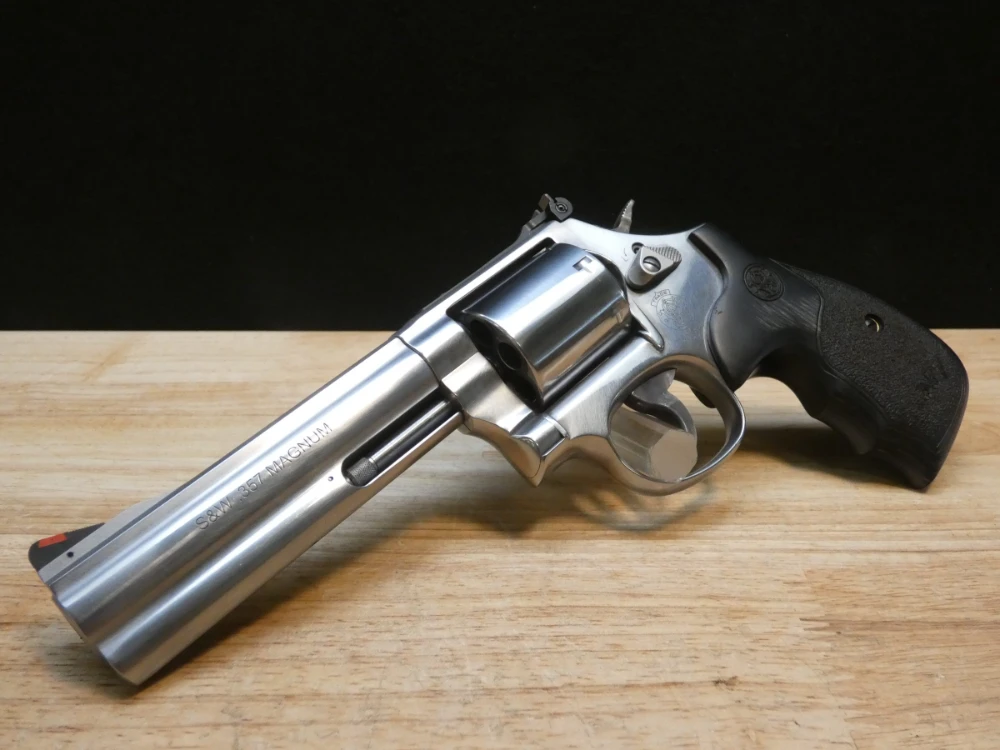
The Smith & Wesson 686 is a renowned double-action revolver built on the durable L-frame, prized for its reliability and performance. As a standard handgun, its value is determined by a blend of factors including its specific engineering revision, overall condition, and market demand. Understanding these key elements is crucial for any owner looking to accurately assess its worth, whether for a private sale, trade-in, or insurance purposes. This guide provides a detailed breakdown of what influences your 686’s price.
What Determines Your Smith & Wesson 686’s Worth
The value of a Smith & Wesson 686 is influenced by several key factors, starting with its specific model and engineering revision, often indicated by a “dash number.” Early models produced before the introduction of Metal Injection Molded (MIM) parts and the internal lock are often more desirable to collectors. While a new 686 has an MSRP between $979 and $1,019, the used market sees prices from $500 to $1,000. Condition, barrel length, original accessories, and any modifications also play a significant role in determining its final price in a competitive market.
2026 Price Breakdown by Generation
Classic Pre-Lock Models (No-Dash to 686-4)
The most sought-after Smith & Wesson 686 revolvers are typically the early, pre-lock variants, encompassing the original “no-dash” models through the 686-4 revision. These firearms are highly regarded by collectors and purists because they were manufactured before the company implemented the internal locking mechanism and began using Metal Injection Molded (MIM) parts for the hammer and trigger. The traditional craftsmanship, forged components, and absence of the internal lock contribute to a perception of higher quality and classic design, often allowing them to command premium prices on the used market, especially when found in excellent condition.
Within the used market range of $500 to $1,000, these classic models frequently skew towards the higher end. A pre-lock 686 in very good to excellent condition, particularly one that retains features like a pinned barrel, can easily fetch a higher price than a newer counterpart. The inclusion of the original box, paperwork, and tools significantly enhances its value to a collector. These tangible links to the firearm’s history and originality are key drivers that can push the final sale price closer to, or even exceed, the top of the typical used price range for the model.
Modern Internal Lock Models (686-5 and Newer)
Beginning with the 686-5 revision, Smith & Wesson introduced significant changes to the revolver’s manufacturing process, including the use of Metal Injection Molded (MIM) parts and the controversial internal lock safety mechanism. While these modern iterations are functionally robust and reliable firearms, they are generally viewed as less collectible than their predecessors. They represent the standard production models available today and are primarily valued as durable, high-performance shooters rather than as collector’s pieces. Their value is more closely tied to their utility and mechanical condition rather than their historical significance or manufacturing methods, making them excellent workhorse revolvers for enthusiasts.
The value for these modern 686 revolvers typically falls within the established $500 to $1,000 used price range, with their final price heavily dependent on condition. Because they are built on the durable L-frame, these guns are known to withstand extensive use; a 686 can reportedly handle approximately 50,000 rounds of .357 Magnum before potentially requiring major service. Consequently, a high round count is less of a concern for buyers unless it has resulted in significant cosmetic wear or mechanical issues. These models are plentiful on the market, making condition and included accessories the primary differentiators in their pricing.
Specialty Models (686 Plus and Others)
The Smith & Wesson 686 Plus variant introduces a key feature that directly impacts its market value: a 7-round cylinder capacity instead of the traditional 6. This enhancement appeals to shooters seeking increased capacity for personal defense or competition without sacrificing the proven L-frame design. The 686 Plus is a popular sub-model that maintains a strong presence in the market. Its availability and compliance in restrictive states, such as the fact that at least one 686 Plus model is listed as compliant for sale in New York, can also bolster its desirability and maintain a stable resale value among a wider pool of potential buyers.
Beyond the 686 Plus, value is also influenced by other specific sub-models and configurations. Barrel length is a significant factor; shorter barrels (e.g., 2.5 or 3 inches) are often favored for concealed carry, while longer barrels (6 or 8 3/8 inches) are popular for hunting and target shooting, with each configuration appealing to a different segment of the market. Limited-run models from the Performance Center or those with unique factory finishes will almost always command a higher price due to their scarcity and enhanced features, placing them at the upper end of the valuation spectrum compared to standard production models.
Condition and Configuration Impact
Regardless of the specific generation or model, the overall condition is a paramount factor in determining a Smith & Wesson 686’s value. A firearm in excellent or like-new condition will always command the highest price. Conversely, heavy cosmetic damage can severely diminish its worth. For a mechanically sound 686, significant external flaws like deep scratches, holster wear, or pitting can result in a price reduction of 30% to 50% compared to the value of the same revolver in pristine condition. Buyers expect to pay less for a gun that shows signs of hard use, even if it functions perfectly.
While cosmetic appearance is critical, the mechanical condition is non-negotiable for most buyers. A revolver with timing issues, a loose cylinder, or a worn-out barrel is a liability that will drastically reduce its value. As the 686 is a durable firearm, buyers are often more concerned with its current mechanical state than its total round count. Furthermore, the completeness of the package matters. A used 686 sold with its original box, owner’s manual, and any included tools is more attractive to buyers and collectors alike, often justifying a higher asking price than the firearm alone, as it signals a well-maintained and complete history.
How Modifications Affect Value
Thoughtful upgrades can positively impact the resale value of a Smith & Wesson 686 by making it more appealing to discerning shooters. A common and desirable modification is upgrading the stock sights with premium aftermarket options from reputable brands like Dawson Precision or SDM. Installing a high-visibility fiber optic front sight, in particular, addresses a frequent complaint about the factory configuration and enhances the revolver’s usability. While these additions rarely provide a dollar-for-dollar return on investment, they can make a specific 686 stand out from others on the market, potentially leading to a quicker sale at a stronger price point.
When it comes to modifications that universally decrease the value of a Smith & Wesson 686, a clear market consensus is difficult to establish. Unlike permanent, irreversible changes such as amateur gunsmithing or radical alterations to the frame, most common modifications are subjective. For example, a trigger job that one shooter finds perfect, another might find too light for their preference. Because the impact of such changes varies widely based on buyer preference and the quality of the work performed, there are no specific modifications that are universally agreed upon to hurt the firearm’s value across the board.
Regional Price Variations in 2026
The value and marketability of a Smith & Wesson 686 can be significantly influenced by state-level firearm regulations. In states with strict handgun laws, such as California, a firearm must be listed on an approved roster to be sold by a dealer. The fact that certain models of the 686 are legal for purchase in California makes them readily available and maintains a stable market within that state. This roster approval can create a protected market, insulating prices from broader national trends and ensuring consistent demand for compliant models among the state’s residents, which can affect pricing compared to less restrictive states.
Similarly, states like New York have their own compliance requirements, and the inclusion of at least one Smith & Wesson 686 Plus model on its compliant list ensures its availability in that major market. For sellers in these restrictive states, owning a compliant model can be an advantage, as the pool of legal handguns is smaller. Conversely, for buyers in these regions, prices may be slightly higher due to limited supply and regulatory hurdles. These regional price variations highlight how localized laws, not just national supply and demand, play a crucial role in the final transaction value of a popular firearm like the 686.
Online vs Local Sales
Selling a Smith & Wesson 686 online to a buyer in another state involves a federally mandated process that differs significantly from a local transaction. To legally complete an interstate handgun sale, the firearm must be transferred through a Federal Firearms Licensee (FFL). The seller is required to take the revolver to an FFL in their state, who will then legally ship it to another FFL located in the buyer’s state of residence. The buyer cannot take possession until they have successfully completed a background check and all other required state and federal paperwork at their designated FFL, ensuring a regulated and traceable transfer.
While federal law permits a private individual to ship a handgun via a common carrier like UPS or FedEx, corporate policies have made this practically impossible. Both UPS and FedEx now generally prohibit private individuals from shipping firearms, requiring such shipments to be handled by an FFL. When shipped, the revolver must be unloaded, and the contents must be declared to the carrier. However, the exterior of the package cannot bear any markings that would indicate it contains a firearm, a rule designed to prevent theft during transit. These logistical hurdles often make using an FFL for shipping the only viable option.
For a local, private sale within the same state, the legal requirements can vary significantly depending on state and local laws. Some jurisdictions may require the transfer to go through an FFL even for in-state sales, while others allow for direct private transactions. In many cases, a firearm bill of sale is used to document the transaction. This document, which records buyer and seller information along with the firearm’s serial number, serves as proof of a legal transfer of ownership. While not always legally mandated, using a bill of sale is a highly recommended practice that protects both parties involved.
The FFL Buying Advantage
Utilizing a Federal Firearms Licensee (FFL) for both buying and selling a Smith & Wesson 686 offers significant advantages in security and legal compliance. For an interstate transaction, the FFL-to-FFL transfer is not just a suggestion but a federal requirement. This process ensures that the buyer is legally eligible to own a firearm by mandating a background check before they can take possession. This system creates a clear, legal chain of custody for the firearm, protecting the seller from potential liability and ensuring the buyer is acquiring the revolver in accordance with all applicable laws, which is the cornerstone of responsible firearm ownership.
FFLs serve as essential and knowledgeable intermediaries, simplifying what can be a complex process. Given that major carriers like UPS and FedEx have policies requiring firearms to be shipped by a licensee, an FFL becomes a logistical necessity for most sellers. They are equipped to handle the proper packaging, shipping, and declaration requirements. Furthermore, FFLs manage all the necessary state and federal paperwork, such as the ATF Form 4473, removing the burden from the individuals involved. This professional handling ensures the transaction is not only legal but also smooth and properly documented from start to finish.
What Increases Your Offer
High-quality photographs are one of the most effective ways to increase the perceived value of your Smith & Wesson 686 and attract higher offers, especially in online listings. To achieve professional results, use a simple, uncluttered background and soft, even lighting to eliminate harsh shadows and accurately represent the firearm’s finish. Natural light from a window is often ideal. Using a tripod will ensure your images are sharp and in focus. Capture the revolver from multiple angles, and include detailed close-ups of important features like engravings, sights, and any cosmetic imperfections to build trust and transparency with potential buyers.
A meticulously prepared firearm signals to a buyer that it has been well-maintained, which can directly translate to a better offer. Before listing your 686, perform a thorough cleaning of the exterior, cylinder chambers, and barrel, focusing on removing all carbon buildup. After cleaning, lightly lubricate key moving parts like the ejector rod and cylinder release, then give the entire revolver a final wipe-down with a clean cloth for a pristine presentation. It is crucial to avoid over-lubricating and to be careful not to damage the barrel’s crown with the cleaning rod, as this can negatively impact accuracy and value.
Including the original factory case, owner’s manual, and any accompanying tools or accessories can significantly increase your offer. This completeness is highly valued by collectors and discerning buyers, as it suggests the firearm has been cared for since its initial purchase. For older, more collectible “no-dash” or pre-lock models, having the original, numbers-matching box can add a substantial premium to the final price. Providing a clear history of ownership, potentially through previous bills of sale, also adds a layer of confidence for the buyer, making your firearm a more attractive and valuable proposition compared to one without documentation.
When to Sell Your Smith & Wesson 686
Market data suggests that one of the most opportune times to sell a used handgun like the Smith & Wesson 686 is during the spring. This period, typically running from February through June, often sees an uptick in consumer spending, partly fueled by tax refund season. As the weather improves, more people are heading to the shooting range and participating in outdoor activities, which naturally increases the demand for firearms. Listing your 686 during this window allows you to capitalize on this heightened seasonal interest, potentially leading to a faster sale at a more favorable price point.
Another strategic window for selling your 686 occurs in the late summer and early fall, specifically around August and September. During this time, many outdoor enthusiasts and hunters are actively preparing for the upcoming hunting seasons. While the .357 Magnum may be used for certain types of hunting, this period generally sees an overall increase in firearm-related purchases and activity. This pre-season excitement can create a seller’s market, as individuals are looking to acquire new or different firearms for their sporting pursuits, making it a favorable time to list a versatile and powerful revolver like the 686.
Beyond predictable seasonal trends, the political climate can be a powerful, albeit unpredictable, driver of firearm demand. Major political events, particularly national elections or discussions of new firearm legislation, often lead to surges in sales as consumers become concerned about potential future restrictions. While this is not a seasonal pattern that can be planned for years in advance, sellers who are aware of the current political landscape can often leverage these periods of high demand to their advantage. Selling during such a surge can result in a significantly higher selling price due to increased market urgency and consumer interest.
Common Pricing Mistakes
One of the most common pricing errors is failing to realistically account for cosmetic damage. While a Smith & Wesson 686 may be mechanically perfect, sellers often overestimate its value if it has significant holster wear, scratches, or dings. Buyers, especially in a market with many options, will not pay a premium price for a firearm that looks heavily used. According to market analysis, heavy cosmetic flaws can justify a price reduction of 30% to 50% compared to an identical model in excellent condition. Ignoring this reality and pricing a worn gun too high will only deter potential buyers.
Another mistake is placing too much emphasis on a high round count as the primary factor for a low price. The Smith & Wesson 686 is built on the robust L-frame and is known for its durability, reportedly capable of handling around 50,000 rounds of .357 Magnum before needing major service. For most potential buyers, the revolver’s current mechanical and cosmetic condition is far more significant than an estimated round count. Unless the firearm is showing clear signs of excessive wear and tear directly attributable to its usage, sellers shouldn’t drastically lower their price based on round count alone.
For a standard production Smith & Wesson 686, paying for a professional appraisal is often an unnecessary expense and a financial misstep. The market value for these popular revolvers is well-established and typically falls within a predictable range of $500 to $1,200, depending on the specific model, condition, and accessories. With numerous free online resources and completed auction listings available for price comparison, a formal, paid appraisal is unlikely to provide information that justifies its cost. Sellers can accurately price their firearm through simple market research, saving money that would be better spent elsewhere.
Market Outlook for 2026
While a precise future price prediction for the Smith & Wesson 686 is unavailable due to fluctuating market dynamics, the model’s long-standing reputation suggests a stable outlook for 2026. As a durable, stainless steel L-frame revolver chambered in the potent .357 Magnum, the 686 fills a timeless role as a reliable tool for defense, recreation, and sport. This inherent utility and proven design ensure that it will likely remain in consistent demand. Unlike trendy or niche firearms, the 686’s classic appeal and robust construction provide a solid foundation for retaining its value over time, barring any major market shifts.
The market outlook is also bolstered by strong collector interest, particularly in specific variations. Early “no-dash” and pre-lock models (up to the 686-4) are expected to continue appreciating in value as they become scarcer and more sought-after by enthusiasts who prefer the classic manufacturing techniques. This collector-driven demand for older models helps elevate the entire 686 family’s profile and perceived value. As newer models enter the used market, these classic variants will likely further distinguish themselves, creating a two-tiered market where both functional shooters and collectible pieces hold their value well for different reasons, ensuring a positive overall outlook.
Frequently Asked Questions
Why are older “no-dash” 686 models often more valuable?
Older “no-dash” through 686-4 variants are generally more valuable to collectors and firearms purists for several reasons. These models were produced before Smith & Wesson implemented the internal locking mechanism and began using Metal Injection Molded (MIM) parts for key components. Many enthusiasts prefer the aesthetics and traditional craftsmanship of the earlier revolvers, which featured forged hammers and triggers and, in some cases, pinned barrels. This combination of pre-lock design and classic manufacturing methods gives them a higher perceived quality and historical significance, which directly translates to a higher price on the collector’s market compared to their modern counterparts.
How much does heavy cosmetic damage affect my 686’s price?
Heavy cosmetic damage can significantly reduce the value of a Smith & Wesson 686, even if the revolver is in perfect working order. According to market data, a 686 with substantial external wear—such as deep scratches, extensive holster wear, or pitting in the stainless steel finish—will typically see its price reduced by 30% to 50% compared to the same model in excellent condition. Buyers expect a significant discount for a firearm that shows signs of rough handling or neglect, as the aesthetic condition is a major component of its overall value, especially in a competitive used market.
Is a high round count a major problem when selling a 686?
A high round count is generally not a primary concern for potential buyers of a Smith & Wesson 686, as long as the firearm is in good condition. The 686 is a famously durable L-frame revolver, reportedly capable of handling approximately 50,000 rounds of full-power .357 Magnum ammunition before potentially needing major service. Therefore, buyers are typically more focused on the revolver’s current mechanical soundness—such as cylinder timing and lockup—and its cosmetic appearance. Unless the round count is exceptionally high and has led to noticeable wear or damage, it is not the main driver of value reduction.
Do I need a professional appraisal to sell my standard 686?
For a standard model Smith & Wesson 686, a professional appraisal is likely an unnecessary expense. The market value for these common revolvers is well-documented and quite stable, typically ranging from $500 to $1,200 depending on its specific variant, condition, and included accessories. With a wealth of free resources available online, including completed sales on auction sites and dealer listings, an owner can accurately determine a fair market price through basic research. The cost of a formal appraisal would likely outweigh any new information it provides for such a well-established firearm.
Will adding aftermarket sights increase my 686’s value?
Upgrading the stock sights on a Smith & Wesson 686 with quality aftermarket options can positively impact its resale value, though it may not provide a dollar-for-dollar return. Sights from respected brands like Dawson Precision or SDM, especially fiber optic front sights, are a common and desirable modification that addresses a frequent critique of the factory setup. This type of practical, reversible upgrade makes the revolver more attractive to potential buyers who prioritize performance. While it won’t drastically inflate the price, it can make your 686 stand out and justify a higher asking price within its condition bracket.
Get a Cash Offer Today
Ready to sell your Smith & Wesson 686? We make the process simple and secure. Avoid the hassle of private listings, shipping regulations, and finding a qualified buyer. Our streamlined system ensures you receive a fair, competitive cash offer for your firearm based on its specific model and condition.
Simply submit your firearm’s information through our secure portal, and our team of experts will provide you with a no-obligation quote. We handle all the FFL paperwork and logistics, making the sale of your revolver fast and easy. Get your cash offer from a trusted name today.