
What Are the Legal Ways to Sell a Gun in Nevada?
Where you can sell a gun in Nevada depends on whether you want a licensed buyer, a local shop, a private sale, or consignment. You can sell a gun in Nevada directly to a licensed buyer, to a local gun store, to another private person under the process in NRS 202.2547, or through consignment. Nevada’s private-transfer statute governs sales between unlicensed parties. Under the federal United States Code (U.S.C.), 18 U.S.C. § 922(a)(5) allows an unlicensed owner to transfer a firearm to a qualifying federally licensed buyer in another state.
Your choice of selling route depends on who will purchase the firearm and which part of the transaction you want to handle yourself. Each route has real advantages and costs.
| Selling route | Who buys the firearm? | How the transfer works | Main advantage | Main trade-off |
|---|---|---|---|---|
| Licensed online buyer | The licensed purchasing business | Direct acquisition by a federally licensed firearms dealer, including an eligible interstate licensed-buyer transaction | No need to find an individual purchaser | Shipping and inspection take place before the sale is completed |
| Local gun store | The store | Direct purchase by the dealer, with the dealer’s required acquisition records | In-person discussion and no shipment | The shop decides which firearms it wants and what it will offer |
| Private-party sale | Another person | Dealer-assisted background check under NRS 202.2547, unless an exception in NRS 202.2548 applies | You negotiate directly with the buyer | You arrange the buyer, dealer, and any service fee |
| Consignment | A later buyer, through a licensed consignee | Dealer records the firearm and handles the eventual sale | You can wait for a market buyer | It takes longer and involves a consignment fee |
A consignment arrangement lets the owner retain title until the firearm sells, rather than accept a direct purchase offer. Cash My Guns also offers Firearm Consignment.
If you are comparing selling routes, start with a free firearm identification and appraisal before choosing whether to sell.
Do I Have to Go Through a Dealer to Sell a Gun in Nevada?
Most private sales between two unlicensed Nevada residents must go through a licensed dealer for the buyer’s background check under NRS 202.2547. The requirement applies to a sale agreed to in person, online, or at a gun show. A dealer who agrees to facilitate the sale processes the buyer’s check and the required records.
Nevada’s NRS 202.2548 allows certain transfers without that dealer-assisted check. These include transfers of antique firearms, qualifying transfers between immediate family members, transfers to an executor or other covered estate representative by operation of law at death, and narrowly defined temporary transfers. A general concealed-firearm permit is not an exception in NRS 202.2548.
A licensed dealer can buy a firearm directly for inventory. When the store purchases a Nevada owner’s firearm, the dealer records the acquisition under federal law.
Do I Need a License to Sell My Own Guns in Nevada?
You can sell firearms from your personal collection in Nevada without obtaining a federal firearms dealer license merely because you own them, under the personal-collection exception in 18 U.S.C. § 921(a)(21)(C). The federal business standard concerns repetitive purchasing and resale predominantly to earn a profit, rather than qualifying personal-collection and hobby sales. 18 U.S.C. § 922(a)(1)(A) requires licensing for those engaged in the firearms-dealing business.
Nevada NRS 202.2546–202.2548 imposes no separate firearm seller’s permit on an owner disposing of personal firearms. Nevada’s general business licensing and rules for businesses dealing in secondhand property concern commercial operations and should not be treated as permits required of every personal seller.
How many guns can I sell in Nevada before I need a license?
Nevada NRS 202.2546–202.2548 and federal 18 U.S.C. § 921(a)(21)(C) set no fixed number of personal firearm sales that triggers a dealer license. The federal test looks at the purpose and repeated business activity, rather than a five-gun or ten-gun allowance.
The Bureau of Alcohol, Tobacco, Firearms and Explosives (ATF) proposed changes to its dealer-definition regulations in May 2026. ATF’s May 2026 proposed rule does not create a numerical exemption for personal sellers or repeal the federal statutory standard.
Can I Sell My Gun to a Gun Store or Licensed Firearms Buyer?
Yes. A Nevada owner can sell a lawfully transferable firearm directly to a federally licensed firearms dealer that agrees to buy it. Federal 18 U.S.C. § 922(a)(5) permits the licensed-recipient route, and NRS 202.2547 addresses transfers between unlicensed people rather than purchases made by a licensed dealer.
When you sell directly to a dealer, the dealer becomes the purchaser and records the acquisition under ATF dealer recordkeeping guidance. When you find an individual purchaser and use a dealer to conduct a Nevada private-transfer check, the individual remains the purchaser. A federally licensed firearms dealer is a Federal Firearms Licensee (FFL).
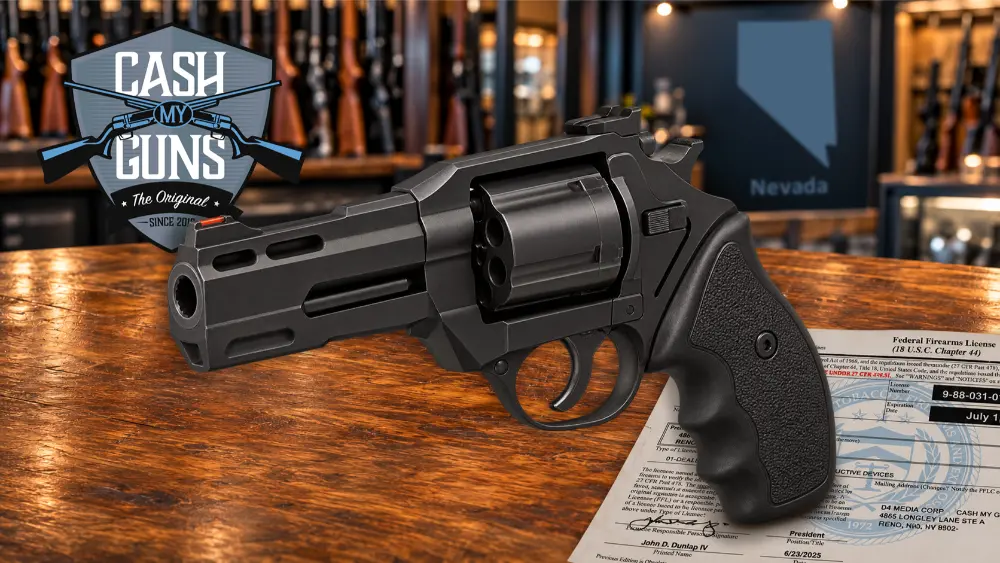
Cash My Guns is a federally licensed firearms dealer with a Nevada location. Nevada owners can use the Sell Your Gun service or arrange an in-person drop-off in Nevada by appointment. Acceptance depends on the firearm and the applicable law.
To identify a firearm or compare a licensed-buyer offer with local options, request a no-obligation appraisal.
Can I Sell a Gun Online From Nevada?
Yes. You can advertise or arrange a Nevada firearm sale online, but the transfer must follow Nevada’s NRS 202.2547 and federal 18 U.S.C. § 922 rules based on who buys the firearm. An online listing does not replace the dealer-assisted check for a private sale that requires one.
An online licensed buyer can purchase directly as the receiving dealer. If the buyer is another unlicensed Nevada resident, the private-transfer requirements and exceptions control. If the individual buyer lives outside Nevada, the interstate transfer rules control where that person receives the firearm.
Can I Sell a Gun to Someone in Another State From Nevada?
You can sell a firearm directly to a qualifying federally licensed dealer in another state under 18 U.S.C. § 922(a)(5). If the purchaser is an unlicensed resident of another state, the ordinary federal route is delivery to a licensed dealer in the purchaser’s state for the buyer’s lawful receipt. A Nevada owner cannot simply deliver a sold firearm directly to an unrelated out-of-state private buyer.
Federal law separately recognizes limited exceptions, including qualifying transfers to carry out a bequest or intestate succession. The purchaser’s home-state requirements and the firearm’s classification still matter. A licensed collector’s federal privileges apply to qualifying collector firearms, rather than every firearm an ordinary dealer may acquire.
Can I ship a gun out of Nevada?
Yes. Federal law permits lawful interstate shipment to an appropriately licensed recipient, subject to the firearm’s classification, carrier rules, and destination requirements. Under United States Postal Service (USPS) Publication 52, section 432, eligible rifles and shotguns can be mailed within the published conditions, while handguns are nonmailable by an ordinary unlicensed sender except within specified exceptions. The USPS April 2026 proposed mailing rule is not the currently effective mailing rule.
Legal permission to make a transfer is separate from a carrier’s acceptance of a parcel. The recipient and the approved shipping method should be established before a firearm is dispatched.
How Does a Private Party Sale Work in Nevada?
A Nevada private sale that is subject to NRS 202.2547 is completed through a licensed dealer who agrees to handle the buyer’s background check. For a Nevada private sale covered by NRS 202.2547, the parties follow these steps:
- The seller and buyer go together to the participating licensed dealer with the firearm.
- The dealer requests the buyer’s background check and maintains the transaction records required by law.
- The seller may retain the firearm while the check is pending. If so, both parties return to the dealer with the firearm before completing the transfer.
- When the dealer can complete the transfer lawfully, the purchaser receives the firearm through the dealer’s process.
- If the buyer is found ineligible, the dealer returns the firearm to the seller and the firearm is not delivered to that buyer.
NRS 202.2547 allows the facilitating dealer to charge a reasonable fee. A buyer’s incomplete or unresolved background check may delay completion. Under Nevada’s Point of Contact Firearms Program guidance, an unresolved response differs from an approval or denial. The dealer decides whether a legally permitted transfer will proceed when a check remains unresolved.
What Does It Cost to Transfer a Gun in Nevada?
Nevada charges no state background-check fee for a qualifying private transfer processed under NRS 202.2547. Under NRS 179A.140(3)(c), the Central Repository may not charge for a background check required by that private-transfer statute. The facilitating dealer may still charge a reasonable service fee under NRS 202.2547(7).
Nevada’s Point of Contact program charges dealers $25 per background check for ordinary dealer-to-customer transactions. The charge is assessed to the dealer, and the agency recommends collecting it from the purchaser. It should not be assigned as a $25 seller charge on every private transfer.
| Cost component | Who pays or is charged? | Per firearm or per transaction? |
|---|---|---|
| State background check for a qualifying private transfer | $0 state charge for the qualifying private transfer | No state charge per check or firearm |
| Participating dealer’s private-transfer service | Dealer may charge a reasonable fee; seller and buyer arrange how it is paid | Nevada sets no single statewide per-firearm or per-transaction service price; ask the dealer how its fee is calculated |
| Ordinary retail dealer background check | $25 assessed to the dealer; Nevada recommends collection from the purchaser | Per background check |
| Seller’s direct sale to a licensed purchasing dealer | Dealer records its acquisition; a retail customer background-check charge does not apply to this dealer’s acquisition | Any separate commercial terms depend on the actual dealer purchase |
| Nevada sales tax | Depends on the transaction’s tax classification; qualifying occasional sales are exempt | Calculated for the taxable sale, rather than per firearm-transfer check |
NRS 372.320 provides an exemption for qualifying occasional sales. A transaction handled as a dealer’s retail sale or brokerage arrangement may require a different tax analysis. For a collection, there is no basis to multiply the state’s zero-dollar private-transfer check charge by the number of firearms; a dealer may nevertheless quote services based on the work involved.
Is There a Waiting Period When Selling a Gun in Nevada?
Nevada has no general fixed waiting period for an ordinary handgun, rifle, or shotgun sale under NRS 202.2547. A private sale covered by NRS 202.2547 can be completed when the required background check and dealer process permit delivery. An unresolved check can extend the time. For unresolved checks, Nevada’s Point of Contact program provides a three-business-day research period. After that period, the dealer has discretion over a legally permitted release.
A separate rule applies to certain dealer inventory. Under NRS 647.130, a covered secondhand dealer must retain individually identifiable property for 30 days after reporting in a county with at least 700,000 residents, or 15 days in a smaller county. The rule governs the dealer’s removal of the acquired property from its premises.
How Do I Transport a Gun to a Dealer in Nevada?
A Nevada owner can transport a lawfully possessed firearm by vehicle to a dealer while observing the relevant vehicle-carry and location rules. Under NRS 503.165, a rifle or shotgun carried in or on a vehicle on a public highway or way open to the public must have no live cartridge or shell in the firing chamber. Cartridges in a magazine alone do not make that rifle or shotgun loaded for this statute.
For a handgun, NRS 202.350 regulates carrying a concealed firearm upon the person without the required authorization. Nevada NRS 202.350 regulates concealed carry upon the person; it sets no universal locked-trunk requirement for every lawful handgun trip in a vehicle. Separate restrictions apply to particular locations, including school and child care property under NRS 202.265.
A dealer may have its own receiving and safety arrangements. Calling ahead lets you confirm where the dealer wants the firearm brought and how it accepts it.
How Do I Sell an Inherited Gun in Nevada?
If you have inherited a firearm in Nevada, receiving an ordinary firearm through a lawful estate transfer is not itself unlawful. Nevada imposes no firearm-specific inheritance registration form, agency notice, deadline, or fee for ordinary handguns, rifles, and shotguns under NRS 202.2548 and its estate-transfer framework. NRS 202.2548(4) expressly exempts a transfer to an executor, administrator, trustee, or personal representative that occurs by operation of law when the owner dies.
The person authorized to sell estate property is a separate question. Under NRS 143.020, a personal representative has the right to possess estate property and preserve it during administration. NRS 143.535 provides sale authority for personal property under independent administration, ordinarily with the statutory notice procedure. Under ordinary administration, NRS 148.060 provides for a report and petition for court confirmation within 30 days of a sale, subject to its stated exceptions and the estate’s administration route. These probate requirements concern the authority to dispose of estate assets, not a firearm inheritance-registration requirement.
A later sale from a Nevada estate to an unrelated unlicensed Nevada buyer generally requires dealer-assisted background-check processing under NRS 202.2547, unless an exception applies. An estate transfer does not give a purchaser unrestricted access to a firearm the purchaser cannot legally possess. Inherited short-barreled firearms, silencers, and other restricted categories also require their own classification review.
For collections too large to box, Cash My Guns arranges freight and shipping-container pickup, and direct pickup may be arranged case by case for a large or high-value collection. You can sell part of a collection, with no obligation to sell the rest.
Cash My Guns offers Sell Your Gun Collection for multiple firearms. If you are handling multiple inherited firearms, send a firearm list and photographs through the collection form for identification and appraisal, or call (775) 432-6006.
Are There Firearms That Require a Different Process in Nevada?
Yes. Nevada has specific restrictions on short-barreled rifles and shotguns, machine guns, silencers, certain rapid-fire devices and modifications, firearms with altered serial numbers, unfinished frames, and some unserialized firearms.
- Under NRS 202.275, Nevada restricts possession, manufacture, and disposition of short-barreled rifles and shotguns, with stated exceptions for qualifying federal licensees, the person to whom the item is federally registered, and specified collector classifications. An unregistered item appears to fall outside the statute’s registration-based exception.
- Under NRS 202.350, Nevada restricts machine guns and silencers unless authorized by federal law.
- Under NRS 202.274, Nevada separately restricts specified devices, parts, and firearm modifications that eliminate a separate trigger movement and increase or approximate the firing rate of a machine gun.
- Under NRS 202.277, Nevada restricts firearms with intentionally altered or removed serial numbers. NRS 202.3625–202.364 separately address unfinished frames and unserialized firearms, including a statutory exception for qualifying firearms manufactured before 1969.
Cash My Guns does not buy National Firearms Act (NFA) items, including those within a collection.
On October 9, 2026, ATF announced a federal enforcement policy under which it will not enforce specified NFA approval, registration, and related requirements for covered short-barreled firearms, silencers, and certain other weapons. The federal policy leaves Nevada’s firearm restrictions in effect. Nevada’s NRS 202.275 retains its federal-registration language, and NRS 202.350 retains its federal-authorization condition. The federal nonenforcement policy does not itself identify an unregistered firearm as registered or determine whether it meets Nevada’s authorization condition. Federal NFA requirements remain in full force for machine guns and destructive devices.
If a restricted item is found in a Nevada estate, the ordinary estate-representative exception does not establish permission to possess or transfer a firearm prohibited by a separate Nevada statute. Ask a qualified attorney about the item’s classification and the applicable state and federal requirements.
For a court-ordered or contested sale, or a situation involving a legally prohibited person, contact Cash My Guns at (775) 432-6006 rather than relying on a general eligibility answer.
Can I Sell Ammunition in Nevada?
Yes. Nevada imposes no general licensed-vendor background-check procedure on private sales of ordinary ammunition under NRS 202.273 and 202.362, which instead address specified ammunition and prohibited recipients. Nevada’s NRS 202.273 restricts the manufacture or sale of specified metal-penetrating handgun bullets, and NRS 202.362 prohibits transfers of firearms or ammunition to certain people who cannot lawfully receive them.
Cash My Guns purchases factory-sealed bulk ammunition, or ammunition included with a firearm collection. Ammunition can be sold in the same transaction as a firearm and ships in a separate box.
For qualifying ammunition, use the Sell Your Ammunition inquiry form.
How Do I Know What My Gun Is Worth Before Selling It?
A Nevada firearm’s value depends on the specific make, model, variant, condition, original finish, markings, accessories, and provenance. A proof mark, matching number, or unusual configuration can matter more than the broad model name. Completed sales of genuinely comparable firearms provide better evidence of realized value than the asking prices of unsold listings.
Identification is important when the owner inherited an unfamiliar firearm or a collection contains items with different production years and configurations.
Cash My Guns appraises against its own record of completed transactions, together with recent market activity and comparable sales. Identification and appraisal are free and carry no obligation to sell.
You can find out what a firearm is worth with a free, no-obligation appraisal.
How Does Selling to Cash My Guns From Nevada Work?
Cash My Guns is a federally licensed firearms dealer that appraises and purchases firearms directly through its Sell Your Gun service. The transaction runs through a licensed dealer and is subject to federal, state, and local law.
- Send details and photos. Cash My Guns identifies the firearm and provides a free, no-obligation appraisal.
- Review the offer. An offer is held open for 72 hours. No offer is binding until the firearm is received and examined.
- Ship with the prepaid insured label. Cash My Guns covers incoming shipping and the federal transfer fee, and the firearm is insured in transit at Cash My Guns’ appraised value. Ship within seven days of receiving the label; a longer delay may change the offer terms. If an oversized box is used instead of the standard dimensions in the shipping instructions, the difference in the carrier surcharge is deducted from the payout.
- Inspection and acceptance. Cash My Guns examines the firearm, and the seller decides whether to accept. If the seller declines after inspection, the seller pays return shipping to a federally licensed firearms dealer of their choice, plus that dealer’s transfer fee.
- Payment and documentation. Payment is submitted for processing the same business day the firearm is inspected, and the seller accepts. Cash My Guns pays by direct deposit or mailed business check. Direct deposits typically arrive within one to three business days, and checks are processed the same day. Acceptances after the daily cut-off, or on weekends and holidays, are processed the next business day. Cash My Guns issues a bill of sale on purchase.
In-person drop-off is available by appointment at the Cash My Guns location in Reno, Nevada, and Sandusky, Michigan.
Cash My Guns also offers Firearm Consignment for owners who would rather wait for a market sale. It is available for single firearms valued at $500 or more; within a larger collection, a lower-value firearm may be consigned case by case. The standard fee is 25% of the selling price, with a reduced rate possible on higher-value firearms, and it covers incoming shipping and transfer, FFL paperwork, appraisal, photography, marketing, payment processing, and normal preparation. The owner is paid when the firearm sells.
To begin, request a free firearm appraisal or speak with Cash My Guns at (775) 432-6006.
Frequently Asked Questions About Selling a Gun in Nevada
Can I give or sell a gun to a family member in Nevada?
Yes. Nevada NRS 202.2548(3) permits a firearm transfer without the ordinary private-sale dealer background check between spouses, domestic partners, parents, children, siblings, grandparents, grandchildren, aunts, uncles, nieces, and nephews, including its specified whole-blood, half-blood, adopted, and step relationships. Federal restrictions on transfers to residents of another state and on prohibited recipients still apply. A cousin is not among the Nevada statute’s listed relationships.
Do I need a Nevada firearm registration or Clark County Blue Card before selling?
No. Nevada does not require statewide registration of ordinary handguns, rifles, or shotguns before a personal sale under its firearm-ownership framework and the local preemption rules in NRS 244.364 and 268.418. NRS 244.364 and NRS 268.418 limit county and city firearm ownership records and preempt conflicting local restrictions. Clark County’s former handgun Blue Card registration is not a current prerequisite to sell. A licensed dealer’s acquisition and transfer records remain separate from owner registration.
Do I need a bill of sale to sell a gun in Nevada?
Nevada NRS 202.2547 requires dealer records for covered private transfers but does not impose a separate statewide private-seller bill-of-sale form for every lawful firearm sale. For dealer-processed transfers, the dealer must meet applicable recordkeeping duties; the buyer’s federal Form 4473 is part of the dealer’s process when required. For covered secondhand-dealer purchases, NRS 647.120 requires a dealer report containing the seller’s signed certification of the right to sell the property. A voluntary receipt alone does not replace a required private-transfer background check.
Can I sell a gun in Nevada if I have a concealed carry permit?
Yes. You can sell a firearm you lawfully own in Nevada. NRS 202.2548 provides the exceptions to the required private-transfer check, and holding a concealed firearm permit is not one of those exceptions. A private sale to an unrelated unlicensed buyer generally still proceeds through a dealer under NRS 202.2547.
Where can I sell a gun collection in Nevada?
A Nevada owner can sell a personal collection to a licensed firearms dealer, arrange a series of lawful private sales, or consider consignment. Federal 18 U.S.C. § 921(a)(21)(C) expressly distinguishes selling all or part of a personal firearms collection from repetitive business purchasing and resale predominantly for profit. Nevada’s transfer requirements apply to each transaction for which they are triggered. Dealer service prices and collection terms depend on the chosen route.
How long does it take to sell a gun in Nevada?
Nevada NRS 202.2547 imposes no general fixed cooling-off period for firearm sales. A qualifying private sale may be completed once the required dealer background check permits it, while a delayed or unresolved check takes longer. A direct licensed-buyer sale also includes appraisal, any shipment, inspection, acceptance, and payment processing, so no single time applies from first inquiry to funds received.
If you are uncertain about what you own or how to begin, start with a free appraisal and identification or call (775) 432-6006. Cash My Guns also publishes guidance on how to sell a gun by state.
This article provides general information about Nevada and federal firearm-selling rules, not legal advice. If your situation is court-ordered, contested, or involves a person legally prohibited from possessing firearms, contact Cash My Guns at (775) 432-6006 before arranging a sale.
Sources
These external sources support the article’s inline links.
- Nevada NRS 202.2547. Private transfers, dealer process, reasonable fee, and failed checks. Current 2025 codified text, revised April 15, 2026; checked November 7, 2026.
- Nevada NRS 202.2548. Family, estate, antique, and limited temporary-transfer exemptions. Current 2025 text, amended 2021; checked November 7, 2026.
- 18 U.S.C. § 921. Personal collections and engaged-in-business definition. U.S. Code 2024 edition; checked November 7, 2026.
- 18 U.S.C. § 922. Interstate transfers and dealer licensing. U.S. Code 2024 edition; checked November 7, 2026.
- Nevada NRS 179A.140. State private-transfer background-check fee exemption. Current 2025 text; checked November 7, 2026.
- Nevada Point of Contact Firearms Program dealer guidance. Retail background-check charges and dealer responsibilities. Live Nevada State Police guidance; checked November 7, 2026.
- Nevada Point of Contact FAQs. Delayed and unresolved checks. Live Nevada State Police guidance; checked November 7, 2026.
- Nevada NRS 372.320. Occasional-sale tax exemption. 2026 revised codified text; checked November 7, 2026.
- Nevada NRS 647.130. Covered secondhand-dealer property retention. Current 2025 text; checked November 7, 2026.
- Nevada NRS 503.165. Long-gun vehicle transport. Current 2025 text; checked November 7, 2026.
- Nevada NRS 202.350. Concealed carry, machine guns, and silencers. Current 2025 text; checked November 7, 2026.
- Nevada NRS 202.265. Firearms at schools and child-care locations. Current 2025 text; checked November 7, 2026.
- Nevada NRS 143.020 and 143.535. Estate possession and personal-property sale authority. Current 2025 text; checked November 7, 2026.
- Nevada NRS 148.060. Ordinary administration sale confirmation and exceptions. Current 2025 text; checked November 7, 2026.
- Nevada NRS 202.275. Short-barreled rifle and shotgun restrictions and federal registration-linked exception. Current 2025 text; checked November 7, 2026.
- Nevada NRS 202.274. Restricted rapid-fire devices and modifications. Current 2025 text; checked November 7, 2026.
- Nevada NRS 202.277 and 202.3625–202.364. Altered serial numbers, unfinished frames, and unserialized firearms. Current 2025 text; checked November 7, 2026.
- ATF NFA transfer guidance. Federal policy effective October 9, 2026, with express reservation of state restrictions; checked November 7, 2026.
- Nevada NRS 202.273 and 202.362. Certain ammunition and restricted recipients. Current 2025 text; checked November 7, 2026.
- Nevada NRS 244.364 and NRS 268.418. County and city firearm regulation preemption. Current 2025 and 2026 revised text; checked November 7, 2026.
- Nevada NRS 647.120. Covered secondhand dealer report and seller right-to-sell certificate. Current 2025 text; checked November 7, 2026.
- USPS Publication 52, section 432. Current firearm mailability. Checked November 7, 2026.
- USPS April 2026 proposed mailing rule. Proposed, not current mailing rule. Checked November 7, 2026.
- ATF May 2026 proposed dealer-definition rule. Proposed regulatory change, not statute repeal. Checked November 7, 2026.
- ATF Federal Firearms Licensee Quick Reference Guide. Dealer acquisition, records, and returns. Current agency guide; checked November 7, 2026.