
How to Sell a Gun in Arkansas Legally for 2026
- Safe • Legal • Hassle-Free
- Free Shipping & Insurance
- Over 20,000 Happy Sellers!
Tell us what you want to sell.

- 21 min read

How to Sell a Gun in AR for Cash: The 2026 CashMyGuns Guide
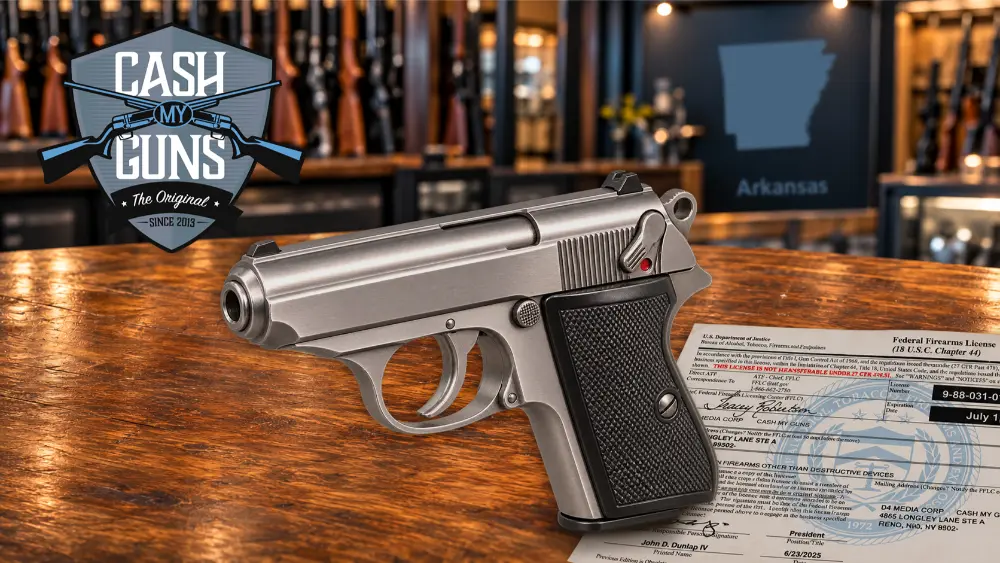
You can sell a gun in Arkansas if you lawfully own it. How to sell a gun in Arkansas depends mainly on who the buyer is and where that buyer lives. A private sale between two Arkansas residents does not generally have to go through a gun dealer. Arkansas Code § 5-73-132 prohibits a person from knowingly selling or transferring a firearm to someone barred from possessing it. Federal law also restricts transfers to prohibited people. A licensed firearms dealer can buy directly from you, including a properly licensed buyer located in another state. Selling to an unlicensed resident of another state follows a different federal process. Arkansas owners may sell lawfully owned handguns, rifles, and shotguns under the rules for their transaction; restricted firearms follow additional requirements.
What Are the Legal Ways to Sell a Gun in Arkansas?
Arkansas owners can sell firearms to a licensed online buyer, a local gun store, or another eligible Arkansas resident, and they can arrange a consignment sale through a licensed dealer. In Arkansas, you can sell a gun to local shops, private buyers in Fort Smith or Fayetteville, or licensed buyers outside the state.
| Selling route | Who purchases the firearm? | How the transfer works | Practical advantage | Main trade-off |
|---|---|---|---|---|
| Federally licensed online buyer | The licensed business | Owner transfers directly to the licensed buyer under federal law | No need to find an individual buyer | Shipping and inspection precede completion |
| Local gun store | The licensed store | The store records a direct acquisition | In-person discussion, without parcel shipment | Offer and selection depend on the store |
| Private Arkansas sale | Another eligible Arkansas resident | No general mandatory dealer intermediary; recipient restrictions apply | Seller and buyer agree on terms directly | Seller handles eligibility concerns and records |
| Firearm consignment | An eventual customer, through a licensed consignee | Dealer handles inventory and buyer transfer | An owner can wait for a market sale | A fee applies, and timing is uncertain |
If you want to compare selling options before deciding, free firearm identification and appraisal can establish what you have without an obligation to sell. You can also call (775) 432-6006 to discuss the options.
Do I Have to Go Through a Dealer to Sell a Gun in Arkansas?
No. Arkansas does not require a dealer for every private firearm sale between two unlicensed residents of the state. Arkansas Code § 5-73-132 requires that the seller not knowingly transfer the gun to a person prohibited from possessing it. Federal 18 U.S.C. § 922(d) separately prohibits transfers when the seller knows or has reasonable cause to believe the recipient falls within a federal prohibited category.
A dealer can nevertheless facilitate a private sale at the parties’ choice, handling the buyer’s federal transfer documents and any required background check. When the dealer buys the firearm from its owner, the dealer is the purchaser; the transaction is not a dealer-facilitated sale between two private people. Arkansas generally prevents cities and counties from imposing their own broad firearm-transfer regulations under Arkansas Code § 14-16-504, subject to the exceptions in state and federal law.
Do I Need a License to Sell My Own Guns in Arkansas?
You generally do not need a dealer license to sell firearms from your own personal collection in Arkansas. Federal 18 U.S.C. § 921(a)(21)(C) applies dealer licensing to regular firearms dealing through repetitive purchasing and resale predominantly to earn a profit. It expressly distinguishes occasional hobby or collection transactions and selling all or part of a personal collection. Arkansas does not require a separate general firearms-dealer license for someone making an otherwise lawful personal sale.
The Bureau of Alcohol, Tobacco, Firearms and Explosives (ATF) issued a dealer-definition rule in 2024. A June 12, 2026 judgment in Texas v. ATF vacated that rule; the statutory business test remains relevant. The June 12, 2026 judgment is under October 9 appeal. The statutory licensing requirement remains.
How Many Guns Can I Sell in Arkansas Before I Need a License?
Federal law sets no fixed number of firearms that an Arkansas owner may sell before requiring a dealer license. Under 18 U.S.C. § 921(a)(21)(C), selling a personal collection is treated differently from repeatedly purchasing firearms for resale predominantly to earn a profit. Selling six firearms, twenty firearms, or an inherited collection is not judged by gun count alone. The nature and purpose of the activity control.
Can I Sell My Gun to a Gun Store or Licensed Firearms Buyer?
Yes. A licensed firearms dealer can purchase your firearm directly, in Arkansas or from properly licensed premises in another state. Federal 18 U.S.C. § 922(a)(5) allows transfers from an unlicensed owner to a qualified licensed recipient across state lines. The dealer records its acquisition; a selling owner does not complete Bureau of Alcohol, Tobacco, Firearms and Explosives (ATF) Form 4473 merely for that purchase. Under 27 C.F.R. § 478.124, Form 4473 generally applies when a dealer disposes of a firearm to an unlicensed buyer.
Direct dealer purchase or dealer-facilitated private sale?
In a direct purchase, the store or federally licensed buyer acquires the gun and pays the seller under the purchase agreement. In a dealer-facilitated private sale, the private buyer is still the person receiving the firearm, and the dealer handles the applicable transfer process.
Cash My Guns is a federally licensed firearms dealer, a type of Federal Firearms Licensee (FFL), operating in Nevada and Michigan. An Arkansas owner may sell directly through its Sell Your Gun service, subject to the firearm being accepted. To explore that option, request a free appraisal.
Can I Sell a Gun Online From Arkansas?
Yes. An Arkansas owner can begin a firearm sale online by submitting photographs to a licensed buyer, contacting a local dealer, or finding a private buyer. What matters is whether the person receiving the firearm is licensed, whether the buyer lives in Arkansas, and whether the firearm can lawfully be transferred.
A marketplace connects a seller with a buyer; a direct licensed buyer makes the purchase. Federal restrictions on interstate private transfers continue to apply even if the parties meet through an Arkansas listing. The shipping carrier’s accepted services and rules also need to be distinguished from what federal firearm-transfer law permits.
Can I Sell a Gun to Someone in Another State From Arkansas?
Yes, through the legally required transfer route. If the buyer is an unlicensed resident of another state, federal 18 U.S.C. § 922(a)(5) ordinarily requires the firearm to go to a licensed dealer in that buyer’s state rather than directly to the buyer. The receiving dealer then completes the lawful transfer, subject to the buyer’s state rules. A buyer’s federal documents and background check are handled by that dealer.
By contrast, an Arkansas owner can transfer directly to a federally licensed dealer in another state. An Arkansas owner can transfer a firearm to a licensee in any state, subject to the special limits applicable to licensed collectors, as stated in the ATF Federal Firearms Regulations Reference Guide, Section B1.
Can I ship a firearm out of Arkansas?
Federal law permits lawful shipments to eligible licensees, but it does not guarantee that any carrier will accept a particular firearm or service. The receiving dealer and carrier must accept the shipment. For a private buyer outside Arkansas, delivery ordinarily goes to the appropriate dealer in the buyer’s state.
How Does a Private Party Sale Work in Arkansas?
An Arkansas private sale can take place directly between two residents who may lawfully transfer and receive the firearm. Arkansas Code § 5-73-132 and 18 U.S.C. § 922(d) govern prohibited recipients; Arkansas does not impose a universal dealer background-check appointment on the parties. The seller must have authority to sell and consider the buyer’s eligibility.
A sensible private-sale process has four steps:
- Confirm that you own the firearm or have authority to sell it.
- Confirm that the proposed buyer is an Arkansas resident and is not legally prohibited from receiving it.
- Agree on the firearm, price, and safe handover arrangements.
- Record the transaction in a dated bill of sale for both parties’ records.
A private bill of sale is voluntary for an ordinary Arkansas sale; it is useful evidence of what the parties agreed, not a state-issued transfer approval.
What Paperwork Do I Need When I Sell a Gun in Arkansas?
Arkansas has no general firearm-sale registration form or state filing requirement for a private transfer of a standard handgun, rifle, or shotgun between eligible Arkansas residents. Federal law likewise imposes no recordkeeping requirement on two unlicensed same-state parties. Keeping a dated bill of sale is nevertheless useful when documenting ownership and the disposition of the firearm.
Is my gun registered with Arkansas?
Arkansas has no general registration system for standard privately owned firearms. After an ordinary firearm sale, Arkansas requires no removal from a state firearm ownership database. Dealers maintain separate federal acquisition-and-disposition records.
When a dealer buys a firearm, it records the acquisition. When the dealer sells to an unlicensed buyer, federal Form 4473 and applicable background-check requirements generally concern that buyer. Cash My Guns issues the seller a bill of sale when it purchases a firearm.
What Does It Cost to Transfer a Gun in Arkansas?
Arkansas charges no general state firearm-transfer processing fee for an ordinary private sale. The Federal Bureau of Investigation (FBI) charges nothing for a National Instant Criminal Background Check System (NICS) check. A licensed dealer may charge its own fee if the parties ask it to facilitate a transfer, so the amount and whether it repeats for each firearm depend on that dealer’s terms. Special federal National Firearms Act (NFA) taxes are separate from an ordinary Arkansas sale.
| Cost or charge | Amount or basis | Who pays? | Per firearm or transaction? |
|---|---|---|---|
| Arkansas ordinary private-sale state fee | $0 | No state fee owed | Neither; no state charge |
| FBI NICS processing | $0 charged by FBI | No FBI fee owed | Background check associated with the dealer transaction |
| Optional dealer transfer service | Dealer’s quoted amount | Buyer, seller, or both as agreed | Ask the dealer; may be per firearm or per transaction |
| Shipping and transit insurance | Depends on buyer/service | As specified in the purchase arrangement | Usually shipment-based, not an Arkansas tax |
| NFA machine gun/destructive-device transfer tax | $200 when applicable | Federal statute assigns tax to transferor | Per firearm |
| Other covered NFA firearm transfer tax | $0 starting January 1, 2026 | No transfer tax at the zero rate | Per firearm statutory rate, zero |
| Qualifying NFA estate transfer on Form 5 | Tax-exempt | No federal transfer tax | Per eligible registered firearm application |
Federal 26 U.S.C. § 5811 establishes the applicable National Firearms Act transfer-tax rates. A ten-rifle sale has no Arkansas per-gun state fee; dealer service charges may still apply.
Is There a Waiting Period When Selling a Gun in Arkansas?
Arkansas has no general waiting period for a lawful firearm sale. A private sale between eligible Arkansas residents can be completed on the day the parties agree. A purchase by a licensed dealer does not place a separate Arkansas cooling-off period on the selling owner. The buyer’s background-check requirements can affect the completion of a dealer’s later transfer to an unlicensed customer.
Federal 18 U.S.C. § 922(t) generally requires a dealer to initiate a NICS check before delivering to an unlicensed buyer. An unresolved response can delay delivery, and enhanced checks involving buyers under 21 may involve additional federal review time.
ATF’s Brady Permit Chart, updated June 18, 2026, recognizes qualifying Arkansas Concealed Handgun Carry Licenses and Enhanced Concealed Handgun Carry Licenses as alternatives to a NICS check when the federal conditions are met. The permit must be valid and issued within five years, and the receiving dealer may choose to use NICS instead.
How long does selling a gun in Arkansas take?
A lawful direct private sale has no Arkansas statutory cooling-off period, while a dealer transfer depends on the required buyer checks. A shipped purchase also takes time for transit and inspection; an inherited gun may first require proof of estate authority.
How Do I Transport a Gun to a Dealer in Arkansas?
You may lawfully take a firearm to a dealer in Arkansas when you can legally possess it and the trip complies with the relevant location rules. For handguns, Arkansas Code § 5-73-120 defines the carrying offense to require a purpose to attempt to employ the handgun unlawfully against another person. It also recognizes a lawful-purpose presumption for a person in their own vehicle. An ordinary lawful trip with a handgun is not itself a crime.
That section addresses handguns, knives, and clubs; it does not impose a general locked-container or unloaded rule on every intrastate rifle or shotgun trip. For long guns, lawful possession and applicable place-specific restrictions govern. For safe handling, transport it unloaded and secured, and call the dealer about bringing it inside. This is safety advice, not a general Arkansas locking mandate.
For travel through other states, 18 U.S.C. § 926A provides conditional federal protection when the firearm may be lawfully possessed at both endpoints, is unloaded, and the firearm and ammunition are inaccessible from the passenger compartment, with a locked-container rule in vehicles without a separate compartment. These conditions are for interstate safe passage, not a blanket Arkansas local-transport mandate.
How Do I Sell an Inherited Gun in Arkansas?
If you have inherited a standard firearm in Arkansas, receiving it through a lawful estate is not itself an unlawful firearm transfer. Arkansas has no firearm-specific inheritance registration form, reporting deadline, filing office, or fee for standard handguns, rifles, and shotguns. Distinguish an heir who owns the firearm from a representative acting for the estate.
What if the firearm was left to me in a will?
A beneficiary can sell after acquiring legal ownership and confirming that the firearm and the intended buyer are lawful. Federal 18 U.S.C. § 922(a)(3) and (a)(5) have specific exceptions for a lawful bequest or intestate succession across state lines. Those exceptions do not generally apply to a lifetime gift from one out-of-state family member to another.
What if I am an executor selling estate firearms?
An Arkansas executor or personal representative should be prepared to show authority to dispose of estate property. The Arkansas Judiciary’s Letters Testamentary, Form 11, is one example of documentation of a court-authorized executor, not an Arkansas gun-registration form. The representative must also follow buyer-transfer restrictions. For a disputed estate or court-ordered sale, contact Cash My Guns at (775) 432-6006. An estate containing an NFA firearm requires qualified legal help.
For an inherited collection, you can send the inventory and photographs through the collection form with no obligation to sell everything. If you need to discuss an estate sale, call (775) 432-6006.
Where Can I Sell a Gun Collection in Arkansas?
An Arkansas owner or authorized estate representative may sell a qualifying collection to a federally licensed buyer, ask a local gun shop for an outright purchase, sell individual firearms privately when lawful, or consider consignment. Federal 18 U.S.C. § 921(a)(21)(C) recognizes sales of a personal collection separately from dealing as a regular business. Arkansas imposes no general state transfer fee calculated by multiplying the firearm count, although a dealer’s own fee structure can differ for a collection.
For collections too large to box, Cash My Guns arranges freight and shipping-container pickup, and direct pickup may be arranged case by case for a large or high-value collection. You can sell part of a collection, with no obligation to sell the rest.
To consider a complete or partial collection sale, send your gun list and photographs or call (775) 432-6006.
Are There Firearms That Require a Different Process in Arkansas?
Yes. The type and legal classification of a firearm can change its sale and inheritance rules. Arkansas Code § 5-73-104, as amended by Act 1051 of 2019, no longer expressly lists machine guns, short-barreled rifles and shotguns, or silencer-adapted firearms among its prohibited categories. Its remaining subsection (a) addresses bombs, metal knuckles, and implements designed to inflict serious injury or death that serve no lawful purpose. Subsection (b)’s reference to compliance with federal law as of January 1, 2019 matters only if an item first falls within subsection (a).
Arkansas’s separate Uniform Machine Gun Act, § 5-73-204, prohibits machine gun possession or use for offensive or aggressive purposes. The state repealed its former owner machine gun registration provision, § 5-73-209, through Act 1181 of 2001. Federal 18 U.S.C. § 922(o) continues to restrict machine gun possession and transfer, including the exception tied to lawful possession before May 19, 1986. Inheriting an item does not establish that it may be transferred.
What if an estate contains an NFA firearm?
Where the full federal National Firearms Act process applies, including to machine guns and destructive devices, 27 C.F.R. § 479.90a allows an authorized representative to possess a firearm registered to the decedent during probate. The representative must submit the transfer application no later than the close of probate. A qualifying beneficiary normally uses tax-exempt ATF Form 5; a sale outside the estate generally uses Form 4, with supporting estate documents. Unregistered machine guns have no registration cure through this process.
Beginning January 1, 2026, federal NFA transfer tax is $0 for covered categories other than machine guns and destructive devices, whose applicable transfer tax remains $200 per firearm. On October 9, 2026, ATF announced nationwide nonenforcement of specified NFA requirements for short-barreled rifles, short-barreled shotguns, silencers, and covered “any other weapons.” That policy is not repeal of the NFA and does not override Arkansas law. The separate federal interstate-transport authorization requirement for short-barreled rifles and shotguns continues to apply.
Cash My Guns does not buy National Firearms Act (NFA) items, including within a collection. If an Arkansas estate contains a machine gun, suppressor, short-barreled firearm, or destructive device, ask a qualified Arkansas attorney to review the item and the estate’s authority before offering it for sale or arranging shipment.
Can I Sell Ammunition in Arkansas?
Yes. Arkansas does not require all private ammunition sales to go through a licensed ammunition vendor or state background-check system. Arkansas Code § 5-73-111 nevertheless prohibits unlawful procurement conduct involving ammunition as well as firearms, and 18 U.S.C. § 922(d) prohibits certain transfers to persons the seller knows or has reasonable cause to believe are prohibited.
Cash My Guns purchases factory-sealed bulk ammunition, or ammunition included with a firearm collection. Ammunition can be sold in the same transaction as a firearm and ships in a separate box.
For ammunition within that scope, use the Sell Your Ammunition form before arranging shipment.
How Do I Know What My Gun Is Worth Before Selling It?
The value of an Arkansas firearm depends on what it actually is, including its manufacturer, model, variant, condition, finish, markings, originality, and provenance. Identify the exact variant before comparing prices.
A current asking price is what someone hopes to receive; a completed sale is evidence of what a buyer paid. Use recent, dated completed sales for the same configuration and comparable condition rather than an unsold listing or an unsupported statewide average. A local shop may give an immediate purchase offer without shipping, while a seller considering consignment may wait for a future buyer and incur a fee.
Cash My Guns appraises against its own record of completed transactions, together with recent market activity and comparable sales. Identification and appraisal are free and carry no obligation to sell.
To explore your firearm’s value, submit photographs for a free appraisal.
How Does Selling to Cash My Guns From Arkansas Work?
Cash My Guns is a federally licensed firearms dealer that appraises and purchases firearms directly through its Sell Your Gun service. The transaction runs through a licensed dealer and is subject to federal, state, and local law.
- Send details and photos. Cash My Guns identifies the firearm and provides a free, no-obligation appraisal.
- Review the offer. An offer is held open for 72 hours. No offer is binding until the firearm is received and examined.
- Ship with the prepaid insured label. Cash My Guns covers incoming shipping and the federal transfer fee, and the firearm is insured in transit at Cash My Guns’ appraised value. Ship within seven days of receiving the label; a longer delay may change the offer terms. If an oversized box is used instead of the standard dimensions in the shipping instructions, the difference in the carrier surcharge is deducted from the payout.
- Inspection and acceptance. Cash My Guns examines the firearm, and the seller decides whether to accept. If the seller declines after inspection, the seller pays return shipping to a federally licensed firearms dealer of their choice, plus that dealer’s transfer fee.
- Payment and documentation. Payment is submitted for processing the same business day the firearm is inspected, and the seller accepts. Cash My Guns pays by direct deposit or mailed business check. Direct deposits typically arrive within one to three business days, and checks are processed the same day. Acceptances after the daily cut-off, or on weekends and holidays, are processed the next business day. Cash My Guns issues a bill of sale on purchase.
Cash My Guns also offers Firearm Consignment for owners who would rather wait for a market sale. It is available for single firearms valued at $500 or more; within a larger collection, a lower-value firearm may be consigned case by case. The standard fee is 25% of the selling price, with a reduced rate possible on higher-value firearms, and it covers incoming shipping and transfer, FFL paperwork, appraisal, photography, marketing, payment processing, and normal preparation. The owner is paid when the firearm sells.
You can start with a free appraisal and photographs or call (775) 432-6006 if you prefer to speak with someone first.
Frequently Asked Questions About Selling a Gun in Arkansas
Can I give a gun to an Arkansas family member?
Yes. Arkansas allows an owner to give a firearm to an eligible resident family member under the same prohibited-recipient restrictions applicable to other private transfers. Arkansas Code § 5-73-132 and 18 U.S.C. § 922(d) continue to apply. A gift to someone who lives in another state follows federal interstate-transfer rules unless a specific statutory exception, such as a lawful bequest or intestate succession, applies.
Can an 18-, 19-, or 20-year-old receive a handgun privately in Arkansas?
An otherwise eligible 18- to 20-year-old can receive a handgun in an Arkansas same-state private sale. Federal 18 U.S.C. § 922(x) addresses handguns and juveniles under 18; it does not establish a blanket private-sale age-21 minimum. Federal dealer handgun-sale statutes are a separate question. The Justice Department’s September 17, 2026 opinion addresses dealer criminal enforcement, not every licensing or NICS detail.
Does being an Arkansas medical-marijuana patient determine firearm eligibility?
Arkansas Code § 20-56-308(c) prevents State Police from using qualifying-patient or designated-caregiver status alone to decide eligibility for an Arkansas concealed-handgun license. It does not determine every federal purchase or possession issue. In United States v. Hemani, decided June 18, 2026, the Supreme Court rejected the particular federal marijuana-user prosecution and left broader addiction-related questions unresolved. Anyone facing a prohibited-person or contested eligibility issue can contact Cash My Guns at (775) 432-6006 before discussing a proposed sale.
What happens if a dealer cannot complete a private-party transfer?
A dealer cannot deliver a firearm to a private buyer after a NICS denial. A seller who retained possession can usually leave with the firearm after a denied background check, according to ATF’s guide to facilitating private sales. If the dealer took the firearm into its exclusive inventory, a return to the unlicensed seller may require a new Form 4473 and background check. ATF also requires transfer records and a check for the return of a consigned firearm. Ask the dealer about those terms before leaving the firearm for a private sale or consignment.
For further state-by-state resources, see How to Sell a Gun by State. If you are ready to identify a firearm or compare selling options, send photographs for a free, no-obligation appraisal, or call Cash My Guns at (775) 432-6006.
This guide provides general information, not legal advice. Every transaction is subject to applicable federal, state, and local law. Confirm current requirements with the receiving dealer and obtain qualified legal advice for circumstances involving disputed ownership, court orders, or restricted firearms.
Sources
These external sources support the article’s inline links.
1. Arkansas Code § 5-73-132, 2025 edition: private-sale prohibited-recipient restriction; checked November 8, 2026.
2. Arkansas Code §§ 14-16-504 and 14-54-1411, 2025 edition: state preemption of local firearm regulation and exceptions; checked November 8, 2026. Section 14-54-1411 provides the corresponding municipal provision.
3. Arkansas Code § 5-73-120, 2025 edition: carrying a handgun, vehicle context, and lawful-purpose presumption; checked November 8, 2026.
4. Arkansas Code § 5-73-104, 2025 edition: state prohibited weapons and fixed-date federal-law exception; Act 1051 of 2019 removed enumerated categories; checked November 8, 2026.
5. Arkansas Code § 5-73-204, 2025 edition: Uniform Machine Gun Act; Arkansas Act 1181 of 2001 repealed former owner registration; code checked November 8, 2026; Act checked November 13, 2026.
6. Arkansas Code § 5-73-111, 2025 edition: unlawful procurement of firearms and ammunition; checked November 8, 2026.
7. Arkansas Code § 20-56-308, 2025 edition: state concealed-carry license and medical-marijuana status; enacted by Act 757 of 2023; checked November 8, 2026.
8. Arkansas Judiciary, Letters Testamentary, Form 11: example of executor appointment documentation; checked November 8, 2026.
9. 18 U.S.C. § 921: dealer-business definition and personal-collection exception; U.S. Code through Pub. L. 119-124, October 15, 2026; checked November 8, 2026.
10. 18 U.S.C. § 922: interstate transfers, prohibited recipients, licensed-dealer sales, background checks, inheritance exception, and machine guns; U.S. Code through Pub. L. 119-124, October 15, 2026; checked November 8, 2026.
11. 18 U.S.C. § 926A: federal interstate safe passage; U.S. Code through Pub. L. 119-124, October 15, 2026; checked November 8, 2026.
12. 26 U.S.C. § 5811: NFA transfer tax and transferor liability; amended by Pub. L. 119-21, effective January 1, 2026; U.S. Code through Pub. L. 119-136, October 22, 2026; checked November 8, 2026.
13. 27 C.F.R. § 479.90a: estate transfer procedure for registered NFA firearms, Form 5, Form 4, and submission by close of probate; current eCFR, checked November 8, 2026.
14. 27 C.F.R. § 478.124: licensed dealer Form 4473 records and acquisition/disposition distinctions; 2026 regulation, checked November 8, 2026.
15. ATF Federal Firearms Regulations Reference Guide, Section B1: interstate transfers to licensed recipients and licensed-collector restrictions; September 2014 edition; verified November 13, 2026.
16. ATF Facilitating Private Sales guide: dealer-facilitated transfers, denied checks, and returns; checked November 8, 2026. ATF Federal Firearms Licensee Quick Reference and Best Practices Guide: consigned-firearm return background checks; checked November 13, 2026.
17. ATF Brady Permit Chart: qualifying Arkansas concealed carry permit alternatives, updated June 18, 2026; checked November 8, 2026.
18. ATF Update to NFA Transfer Guidance: October 9, 2026 nonenforcement policy, surviving GCA requirements, and interstate-transport conditions; checked November 8, 2026.
19. Texas v. ATF, final district-court judgment: June 12, 2026 vacatur of 2024 regulatory dealer-definition rule; checked November 8, 2026. Notice of appeal filed October 9: pending litigation, checked November 8, 2026.
20. United States v. Hemani, Supreme Court opinion: June 18, 2026 marijuana-use holding and unresolved issues; checked November 8, 2026.
21. DOJ Office of Legal Counsel, young-adult dealer handgun opinion: September 17, 2026 federal criminal-enforcement interpretation; checked November 8, 2026.
2026 Arkansas Gun Sale FAQ's
Can I legally sell a gun in Arkansas in 2026?
Yes, you can legally sell a firearm in Arkansas in 2026 as long as you follow state and federal laws. Private sales between Arkansas residents are permitted, provided both parties are legally eligible to own firearms.
Do I need a background check to sell a gun in Arkansas?
No, Arkansas does not require background checks for private firearm sales between residents. However, federal law requires background checks when selling through a licensed dealer (FFL).
Can I sell a handgun to another person in Arkansas?
Yes, private sales of handguns are allowed in Arkansas if both the buyer and seller are state residents and legally eligible to own firearms. The buyer must be at least 21 years old to purchase a handgun.
Do I need a permit to sell a gun in Arkansas?
No permit is required to sell or transfer firearms in Arkansas. Still, it’s recommended to ensure the buyer is not prohibited from firearm ownership under state or federal law.
Can I sell my gun online in Arkansas in 2026?
Yes, Arkansas residents can sell firearms online. However, federal law requires that any gun shipped to a buyer in another state must go through a federally licensed firearm dealer (FFL) who will complete the background check and transfer.
What’s the safest way to sell a gun in Arkansas?
The safest way to sell a gun is by verifying the buyer’s eligibility and keeping documentation of the transaction. Many sellers also choose to complete the transfer through an FFL for added peace of mind and legal protection.
Do I have to register my gun before selling it in Arkansas?
No, Arkansas does not have firearm registration requirements. You can sell your firearm without registering it, though maintaining a bill of sale for your records is strongly recommended.
Can I sell my gun to a licensed dealer or online buyer like CashMyGuns?
Yes, selling to a licensed dealer or an established online buyer like CashMyGuns is a secure and convenient option. These platforms ensure that all firearm sales comply with Arkansas and federal transfer laws.
What should be included in a firearm bill of sale in Arkansas?
A firearm bill of sale should include the make, model, caliber, and serial number of the gun, along with the buyer’s and seller’s names, addresses, signatures, and the date of sale. Keeping a copy protects both parties legally.
Are there any restrictions on the types of guns I can sell in Arkansas?
Yes, federally regulated firearms such as fully automatic weapons, short-barreled rifles, and suppressors fall under the National Firearms Act (NFA) and require special transfer procedures. Always confirm compliance before selling these types of firearms in Arkansas.
Sell Your Gun by State – 2026 Guides
- Sell a Gun in Alabama
- Sell a Gun in Arizona
- Sell a Gun in Colorado
- Sell a Gun in Connecticut
- Sell a Gun in Delaware
- Sell a Gun in Florida
- Sell a Gun in Georgia
- Sell a Gun in Hawaii
- Sell a Gun in Idaho
- Sell a Gun in Illinois
- Sell a Gun in Indiana
- Sell a Gun in Iowa
- Sell a Gun in Kansas
- Sell a Gun in Kentucky
- Sell a Gun in Maine
- Sell a Gun in Maryland
- Sell a Gun in Massachusetts
- Sell a Gun in Michigan
- Sell a Gun in Minnesota
- Sell a Gun in Mississippi
- Sell a Gun in Missouri
- Sell a Gun in Montana
- Sell a Gun in Nebraska
- Sell a Gun in Nevada
- Sell a Gun in New Hampshire
- Sell a Gun in New York
- Sell a Gun in North Carolina
- Sell a Gun in North Dakota
- Sell a Gun in Ohio
- Sell a Gun in Oklahoma
- Sell a Gun in Oregon
- Sell a Gun in Pennsylvania
- Sell a Gun in Rhode Island
- Sell a Gun in South Carolina
- Sell a Gun in South Dakota
- Sell a Gun in Tennessee
- Sell a Gun in Texas
- Sell a Gun in Virginia
- Sell a Gun in Washington
- Sell a Gun in West Virginia
- Sell a Gun in Wisconsin
- Sell a Gun in Alaska
- Sell a Gun in Arkansas
- Sell a Gun in Guam
- Sell a Gun in Louisiana
- Sell a Gun in New Jersey
- Sell a Gun in New Mexico
- Sell a Gun in Puerto Rico
- Sell a Gun in Virgin Islands
- Sell a Gun in Utah
- Sell a Gun in Vermont
- Sell a Gun in Wyoming