
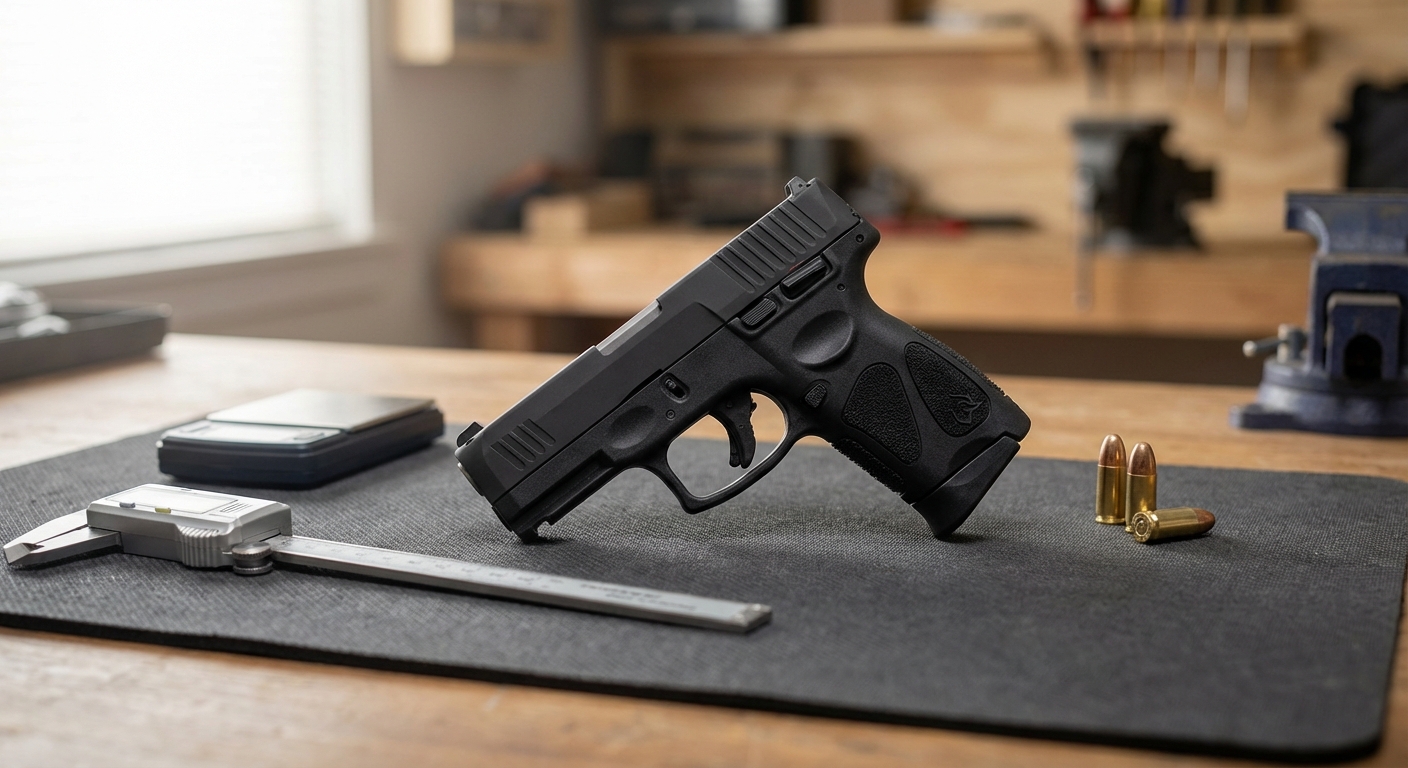
The key insight is that “value” isn’t whatever someone is asking today, it’s what a comparable G3C actually sold for, and that number shifts depending on who’s buying. A dealer, a private buyer, and an online buyer each price the same pistol differently. Location matters too, because magazine-capacity restrictions can shrink the buyer pool for a 12-round-standard G3C in restricted states, which changes demand and how fast it moves.
That’s why quick online guesses miss. People constantly confuse asking prices with completed sales, and the only honest way to measure the asking vs sold gap is per listing, by matching the completed-auction final price to that same listing’s asking or Buy Now, or its starting bid, not by averaging unrelated listings. On auction sites, a listing can show one number during the run, then close at a final bid that’s different. The spread is computed per listing as (asking price − final sale price), then averaged across qualifying completed sales.
Even two “identical” G3Cs don’t sell the same if one is a clean, stock pistol and the other is padded by extras or a weird package. The fix is straightforward: anchor on sold data, compare like-for-like stock guns, filter out bundles, multi-gun lots, parts, frames, slides, and atypical packages, then factor in buyer-pool limits. That’s the real tradeoff this article resolves: speed and certainty vs maximum money, and the simple answer vs the real market answer. You’ll walk away able to estimate a realistic range for your G3C and pick the selling path that fits your priorities.
Resale Value vs Retail Price
There isn’t one “Taurus G3C value”, there are multiple benchmarks people casually call “value.” Before you price yours, you have to pick the right number type, because MSRP, retail, private-party, and dealer offers are built for different goals. MSRP, the Manufacturer Suggested Retail Price, is a reference point a maker recommends, not a guarantee of what your gun actually sells for.

MSRP is the headline reference number on spec sheets, and it helps you anchor the model, but it ignores condition entirely, a like-new G3C and one with heavy finish wear can share the same MSRP even though buyers will not treat them the same.
Street price is the typical real-world new-in-box retail price buyers actually pay, usually below MSRP once you account for sales and competition, and it assumes true “new” condition, meaning unfired and unmodified with clean factory finish.
Private-party price is what one individual will typically pay another individual, and condition does the heavy lifting here, a G3C in perfect working order with no corrosion or pitting and only minor cosmetic marks sells to more people and closer to used retail than a rougher example.
Dealer cash offer is what a dealer (or an online buyer like Cash My Guns) will pay immediately to buy the gun, and it drops faster as condition falls, because obvious wear, rust, pitting, or questionable function narrows resale demand and forces the dealer to price in risk plus resale margin.
Trade-in credit is the value applied toward another purchase, and it often runs higher than a cash offer because the credit is captured inside a higher-margin retail sale. This is the retail vs trade-in, or wholesale, split you see in gun pricing: trade-in is intentionally lower than retail so the shop can resell at a profit, and beat-up condition pushes you harder toward this discounted channel.
Across every tier, higher condition means perfect working order, no corrosion or pitting, and only minor cosmetic marks, and lower condition narrows buyer interest and pushes you toward faster, discounted channels. The same G3C that looks “Very Good” on a counter will get treated like a problem child if it shows rust freckles, mismatched parts, or unreliable function, and every benchmark slides downward accordingly.
One quick reality check: published “average” numbers vary by source. One source pegs the Taurus G3C around $240.63 new and $218.54 used, while another puts used around $152.91, with a 12-month used average around $151.80, which is a big spread before you even factor in condition.
Listings swing even harder and they are not market truth by themselves. You can see a Taurus G3C listed at $488.00 in one place and $234.99 in another, with other retail-style prices showing up around $269.99 to $278.99, which is exactly why you need the right benchmark before you trust any single number.
Pick the benchmark that matches your goal, max money (private-party), speed (cash offer), or convenience (trade-in), before you start scrolling listings. Once you’ve picked the right “value” target, the next question is what details on your specific G3C push that number up or down (see this Taurus value basics guide for broader context).
What Changes a G3C’s Price
Once you separate resale value from retail, the biggest lever left is simple, what exact G3C you have, and what came with it from the factory.

Commonly listed specs: G3c vs G2c vs G3
- Taurus G3c
- Barrel length: 3.2 inches (Citation needed)
- Standard capacity: 12+1 (Citation needed)
- Typical factory magazines: 3 mags (Citation needed)
- Manual safety: Frame-mounted thumb safety (Citation needed)
- Taurus G2c
- Barrel length: 3.2 inches (Citation needed)
- Standard capacity: 12+1 (Citation needed)
- Typical factory magazines: 2 mags (Citation needed)
- Manual safety: Frame-mounted thumb safety (Citation needed)
- Taurus G3
- Barrel length: 4.0 inches (Citation needed)
- Standard capacity: 15+1 (Citation needed)
- Typical factory magazines: 3 mags (Citation needed)
- Manual safety: Varies by variant (Citation needed)
Even within G3C listings, you’ll see “compact” paired with a 12-round capacity. That baseline is what most buyers expect before they’ll pay extra for anything else.
Variant details matter because listings can contradict assumptions, for example a product page calling out “non-manual safety” with an MSRP of $364.99. If your slide, SKU, or box label doesn’t match what your buyer expects, your price gets negotiated down fast.
You can see how tight the spread gets at retail between configurations, with search results showing a G3C at $269.99, a G3C T.O.R.O at $277.99, and another G3C listing at $278.99. That’s why “optics-ready” only adds real money when the buyer actually wants it, and you can prove what it is.
Buyers pay for what they can verify, not what they’re told. Finish wear, rust, chewed-up screw heads, and a dirty bore move the number more than a round-count estimate (Citation needed).
- Confirm you have the correct factory magazines for your package, missing mags get priced as a replacement cost (Citation needed).
- Include the OEM case and paperwork if you have them, it signals the gun wasn’t bounced around loose in a drawer (Citation needed).
- Photograph wear points clearly, muzzle, slide flats, feed ramp, and frame rails stop haggling.
Taurus markets a Limited Lifetime Warranty for defects in materials and workmanship, with repair or replacement at Taurus’ discretion (Citation needed). The catch for resale is that Taurus states it applies to the original retail purchaser and is not transferable (Citation needed), so a second-owner buyer doesn’t price your gun like it comes with factory coverage.
Warranty exclusions also matter in negotiation, Taurus lists categories like misuse, abuse, improper maintenance, unauthorized alterations or repairs, normal wear, and damage from improper or non-standard ammunition including reloaded or handloaded ammo (Citation needed). If you ran reloads or heavily modified the pistol, don’t be surprised when the “but it has a lifetime warranty” argument gets ignored.
Taurus’ widely publicized safety notice programs have covered certain Millennium and 24/7 models, and the G3C is not listed in those specific recall families (Citation needed). Buyers still ask, so having the exact model markings handy keeps the conversation short.
Optics cuts, stippling, triggers, and spring kits usually don’t add dollar-for-dollar resale because they narrow the buyer pool, and buyers can’t easily verify who did the work or whether it stayed within safe tolerances (Citation needed). The clean way to protect your number is to keep the OEM parts and be ready to sell it as “factory plus extras,” not “custom.”
Cash My Guns explicitly factors in make and model, condition details like finish and bore, aftermarket parts, and market data from dealer listings and auctions when appraising firearms (Citation needed). Translation, mods get considered, but the fastest path to a strong offer is still a correct, complete, clean, clearly identified G3C.
All of that detail is useful because it lets you stop guessing and start placing your gun into a realistic bracket. The next section turns those condition and variant differences into price ranges you can actually use.
Realistic Taurus G3C Price Ranges
Reliable Taurus G3C pricing isn’t a single magic number, it’s a range anchored to completed sales, then adjusted for your exact condition and how you’re selling. That range keeps you from chasing inflated asking prices or underselling because you grabbed one random “average” from a site that measures the market differently.
Those published “average” numbers you see online can be all over the place depending on the source’s data mix and time window. That’s exactly why the goal here isn’t to hunt for a perfect average-it’s to use a condition-based range and then sanity-check it against sold comps for your exact variant.
Typical stock G3C ranges by condition
- Like new
- Private sale range: $200-$240
- Dealer-style offer range: $140-$190
- Nuance that moves it: “Like new” only lands if wear is basically nil and it’s the standard variant, not a different SKU.
- Excellent
- Private sale range: $180-$220
- Dealer-style offer range: $125-$175
- Nuance that moves it: Small holster wear is normal, pricing stays stronger when it’s clean and unmodified.
- Good
- Private sale range: $155-$200
- Dealer-style offer range: $110-$160
- Nuance that moves it: This is where most used guns live, the exact number swings with regional demand and seasonality.
- Fair
- Private sale range: $120-$170
- Dealer-style offer range: $80-$135
- Nuance that moves it: Visible wear or unknown round count pushes buyers to “deal” territory fast.
A quick gut-check: asking prices for a standard “Taurus G3C 9mm” commonly sit in the mid-$200s (example shown at $234.99), which is why verified sold prices matter more than what’s listed.
- Pull completed sales (comps), meaning verified sold prices from finished transactions used to estimate current market value.
- Prefer “sold” over “asking”; asking prices are optimism, sold prices are the market clearing.
- Exclude bundles (extra mags, lights, holsters) if you’re pricing a stock pistol.
- Cut outliers on both ends so one weird deal doesn’t set your expectation.
- Match the correct variant; a TORO optic-ready G3C is a different pricing universe than a standard G3C.
One final reality check: offer prices shift by channel and timing. Services like Cash My Guns are built around market data inputs (and the real-world friction of a fast, compliant sale through an FFL), but the Cash My Guns materials provided here do not publish model-specific cash-offer or trade-in ranges for a used Taurus G3C.
Actionable takeaway: pick a condition tier, set a private-sale range and a dealer-offer range, then spend 10 minutes validating with sold comps that match your exact variant (see this Taurus G3C current worth guide for a condition-and-market reality check). You’ll price with confidence, and you’ll recognize immediately when an offer is fair for your region and the time of year.
Once you have your range, it also helps to understand why the G3C can feel “easy” to buy but tougher to sell compared to some other names. That difference is less about your specific pistol and more about the market it sits in.
How G3C Value Compares
Here’s the part that surprises a lot of G3C owners: the “value experience” isn’t just about how well the pistol works. It’s mostly about demand, brand reputation, and how many ready buyers exist in your area, which is why two perfectly serviceable carry guns can feel totally different to sell.
Liquidity is the real gap. If one listing has multiple active bidders and another sits quiet, the final sale feels completely different, even if both guns are equally functional. In many markets, higher-demand names pull more inbound messages, more serious meetups, and fewer lowball attempts, simply because more buyers are already shopping that platform.
Compared with a Taurus G3C, these models generally move faster and draw a wider buyer pool. They also tend to benefit from deeper aftermarket support, meaning more holsters, magazines, optics-ready paths, and common “known-good” setups. That accessory ecosystem can broaden interest and stiffen your negotiating position, even on a plain, stock gun.
These often sell less like “a tool” and more like “a specific version.” Condition, configuration, and small details can matter more, and buyer demand can cluster into pockets. A G3C is usually judged more as a straightforward budget carry option, which can invite tougher negotiation even with a low entry price.
These markets can behave differently than utilitarian carry guns. Collector interest, originality, and timing tend to steer offers, so the resale pattern doesn’t translate cleanly to a G3C.
One caution: this research set doesn’t include verified, model-specific street or used pricing, or depreciation ratios, for the current worth of a Glock 19, the current worth of a P320, the current worth of a Beretta 92, or the S&W, CZ, Walther, Springfield, or Colt models listed, so keep comparisons conceptual and non-definitive. Use MSRP (Manufacturer Suggested Retail Price) as a reference point, not a guarantee, and anchor your expectations to what actually sells in your local market, not what a different model “usually” does.
That’s the “why” behind the experience. The “how” is choosing a selling path that matches your priorities-maximum money, minimal hassle, or something in between.
Selling Your G3C Without Headaches
How you sell your G3C matters almost as much as what it’s worth. After you’ve priced it realistically, your selling channel is the biggest lever you control because it determines your net proceeds, how fast you get paid, and how much risk you’re taking on.
Private sale (where legal) usually leaves you with the highest net because there’s no dealer margin baked in. The catch is you’re doing the work, screening messages, setting meetups, and managing your own risk exposure.
Consignment at a local shop cuts the hassle because the store handles showing and paperwork, but it’s slower and fees reduce what you take home. Many shops charge consignment fees around 20 to 25% of the final sale price, which is a real haircut if you’re optimizing for net.
Trade-in or a straight dealer buy is the fastest, lowest-friction path. You’re paying for speed and simplicity with a lower offer versus a clean private sale.
Direct-sale and online buying services sit in the middle: structured process and less legwork, usually with the same net-versus-speed tradeoff as a dealer buy. For example, Cash My Guns is a nationwide online purchasing service operated by an FFL, so the transfer routes through a licensed dealer process instead of a meetup.
If the buyer is out of state, plan on an FFL (Federal Firearms Licensee), a federally licensed firearms dealer authorized to conduct regulated firearm transfers and sales under federal law. Federal law generally bars a non-FFL from transferring a handgun directly to a non-FFL in another state, so interstate transfers typically run through an FFL in the recipient’s state (18 U.S.C. § 922(a)(5)).
If you’re shipping to an FFL for a lawful sale, consignment, or transfer, federal law allows that path if you comply with federal and state requirements (18 U.S.C. § 922(a)(2)(A), § 922(a)(3)). If you ship a handgun by common or contract carrier as a non-FFL, you must give written notice to the carrier, and the carrier cannot require external markings that advertise a firearm (18 U.S.C. § 922(e)).
If you’re meeting locally in-state, the safest “works almost anywhere” move is to use an FFL transfer anyway, or at minimum confirm your state’s rules using official state resources.
Texas is a good example of why you check: Texas does not require private-party handgun transfers to go through an FFL or include a background check, but transferring to someone you know is prohibited is a crime (Texas Penal Code §46.06). Texas also has no permit-to-purchase requirement, no statewide waiting period, and no state firearm registration requirement.
Beyond the obvious store cut, watch the small bites: consignment fees commonly run about 20 to 25%, credit-card processing is often around 3% when it’s passed along, and some auction sites offer free basic listings but charge for optional visibility upgrades (GunBroker is a common example). Add shipping, insurance, and the receiving FFL’s transfer fee, and your “good price” can shrink fast.
Channel choice is also where those buyer-pool limits show up in real life: if your area has capacity restrictions, or your buyer is across state lines, your “easy sale” options can narrow quickly—so it helps to review state-by-state gun selling options before you commit to a route.
Quick Checklist to Price It
You can get to a realistic G3C number fast if you combine (1) the right benchmark, (2) the right condition and variant facts, and (3) sold-data validation. The only time it gets messy is when you price off active listings, mix up a G3C with a G3 or G2c, or forget that missing mags and mods change who will even want it.
- Confirm the exact model and variant (G3C vs G3 vs G2c) before you compare prices.
- Document condition that drives comparability, especially finish wear and bore condition.
- Count magazines and note original box, case, and papers.
- Validate against completed sales, then align the number to your goal, private-party price vs dealer cash offer (dealer buy-now price) or trade-in credit.
- Pick a selling channel based on net vs speed vs risk, and use an FFL route when needed. Mods can help or hurt, but in practice it’s buyer-pool dependent.
If you want a speed plus safety option, Cash My Guns is a nationwide online purchasing service that buys guns, ammunition, and accessories, and it markets the process as “Safe • Legal • Hassle-Free.” It’s operated by Dunlap Gun Buyers (an FFL), and it says valuation factors include make/model and condition, including finish and bore.
That’s the same framework from the start: don’t let a random asking price steer you, anchor on what comparable guns actually sold for, and then decide how much “speed and certainty” you’re willing to trade for maximum money. If you do those two things-sold comps plus the right channel-most of the pricing noise disappears.