
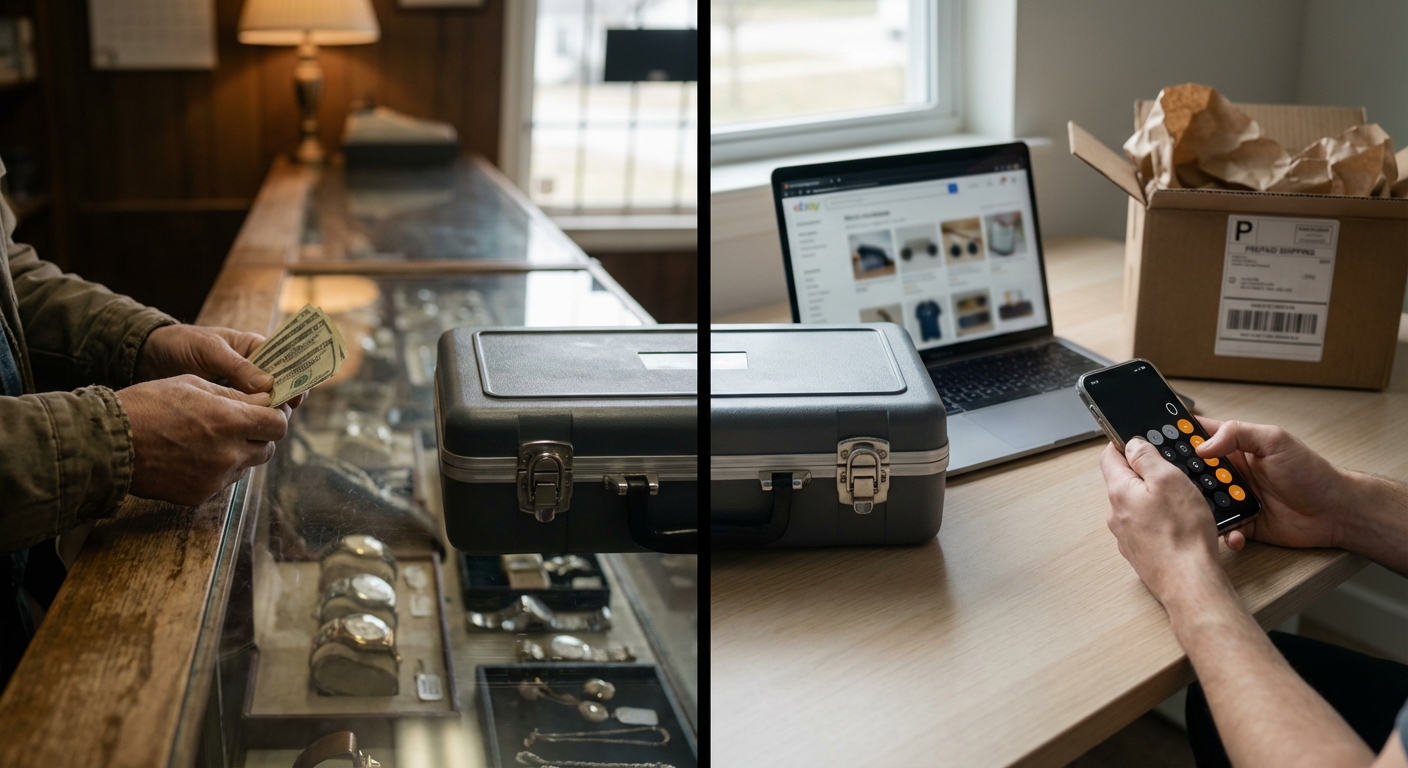
The clean way to think about this is net cash, what you actually keep after interest, fees, shipping or transfer costs, value deductions, and your own time. Pawn is the classic example of speed with strings attached: a pawn loan is secured by personal property you leave as collateral until you repay the loan. That cash is quick, but it can get expensive, and if you don’t pay it back, your “sale” wasn’t really a sale, you paid heavily for short-term access to your own money.
Online buyers flip the tradeoff. The headline number can look higher, but your net cash depends on what happens after the gun arrives, inspection standards, potential deductions for condition or missing parts, plus the logistics and wait time to get paid.
The right answer changes based on what you’re selling, its condition, what’s in demand locally, and how urgently you need cash. You’re going to compare options with a simple, repeatable process that forces every choice into one apples-to-apples number you can trust.
That starts with getting your gun described the way buyers and appraisers actually price it, so your quotes are based on reality instead of vague labels.
Step 1
- Confirm the exact make, model, and variant, down to the details people skip: caliber or gauge, generation, finish, and barrel length. “Glock 19” is a start, but Gen 3 vs Gen 5, MOS vs non-MOS, and a specific barrel length are the difference between a clean comp match and a guess. If you’re unsure, use a gun identification guide before you price it.
- Document what’s actually included, because buyers price the whole bundle, not your memory: factory case, extra mags, optics, sling, and any boxes or papers. Put it in one “listing packet” note so you can copy and paste it anywhere without changing the story midstream.
- Separate factory-original parts from modifications, and be brutally honest about it. Trigger swaps, stippling, slide cuts, optic milling, and refinishing change what the next buyer can easily resell, even if they were expensive to do, so the market rarely credits you dollar for dollar for accessories or custom work.
- Grade condition using condition grading terms a buyer recognizes, because that’s the shorthand they use to decide how quickly it will move. NRA and Blue Book-style grading runs New/Factory New, Perfect, Excellent, Very Good, Good, and Fair; “New” means not previously sold at retail, and “Perfect” means New in every respect.
- Sanity-check your baseline with recent sold comps, meaning completed sales, not optimistic asking prices. Search the way real sellers do: “how much is my Glock 19 worth,” “Glock 17 value,” “Sig Sauer P320 value,” “Smith & Wesson M&P value,” “Beretta 92 value,” “CZ 75 value,” “Walther PPK value,” “Springfield 1911 value,” “Taurus G3C value,” “Colt Python value,” “Ruger GP100 value,” plus long guns like “how much is my Remington 870 worth,” “Mossberg 500 value,” “Ruger 10/22 value,” “Winchester Model 70 value,” “Henry lever action value,” “Browning A5 value,” “SKS rifle value,” “Marlin 336 value,” and “Savage 110 value.” Then match your details, not just the family name.
One reason this packet matters is that valuation is tied to the exact make and model plus condition details like finish, bore, matching numbers (on guns where that applies), and aftermarket parts, and it also states it uses market data including dealer listings and auctions. If you want a quick primer on estimating what your gun is worth before you compare offers, start there. Your goal is the same no matter who you sell to: give the market enough specifics to price your gun accurately, fast.
Condition grading is where most people accidentally give away money. Bore and finish condition are value multipliers, and originality matters because it reduces buyer uncertainty. Factory parts, factory finish, and matching-number configurations price cleaner than “project guns,” even when the project work was high-quality.
Common mistakes that cost you money: misidentifying a variant (especially generation, finish, and barrel length) and then pulling the wrong comps. The other big one is assuming accessories “add up” at full retail. Most buyers only pay extra for add-ons they already wanted, and even then they discount them because they still have to resell the base gun.
Once your packet is tight, you can walk into a pawn shop (or request an online quote) without leaving room for guesswork to get priced against you.
Step 2
Pawn-shop offers aren’t a judgment on your gun, they’re a reflection of the shop’s resale math. They need enough spread to resell it at a profit, they want fast turnover so cash isn’t trapped in inventory, and they price in risk, including condition surprises, local demand swings, and the chance you never come back to redeem.
If you sell outright, the gun leaves with the buyer and you walk away done. A pawn loan is different because the gun is collateral, you receive cash now, and you keep the right to redeem it by paying back what the ticket requires.
Either way, the cash is immediate once the shop agrees to buy it or write the pawn ticket, usually right after their appraisal and ID/check-in steps. The key is what happens next: selling ends the story; pawning starts a clock.
Before you sign, read the pawn ticket like a contract, because it is. Under the Truth in Lending Act (TILA) / Regulation Z, pawn transactions are generally treated as consumer credit when you get money and have a right to redeem, so the shop must give written disclosures you can keep, typically showing the finance charge and APR.
The cash you “keep” shrinks on pawn loans because of monthly interest and fees. Typical pawn interest is commonly cited around 10% to 25% per month, which is often described as roughly 60% to 240% APR depending on fees and assumptions, and longer terms generally cost more.
The other cost is deadline pressure. Miss the redemption date and you risk losing the gun, which turns “short-term cash” into a permanent sale on their terms.
Step 4 inputs to write down now:
Sell: Net cash today = offer today minus immediate costs (travel, time off work, transfer-related costs if any).
Pawn loan: Net cash = cash today minus total finance charges and fees you’ll pay to get it back.
Mini-example (placeholder numbers): Pawn $400 today. Ticket shows 20% monthly interest plus a $15 monthly fee. Redeem in 2 months, fees and interest total $190, so your pawn-side net cash input is $400 minus $190 = $210.
- Bring your baseline packet (ID, your notes, and a clean list of what’s included like mags, box, and accessories).
- Show sold comps that match your make/model and configuration, then ask what assumption in their offer is driving the gap.
- Ask for two numbers: “What’s your buy price, and what’s your pawn loan amount?” They’re often not the same.
- Confirm the exact fees, interest rate, and redemption date in writing, then do the math on the spot.
- Walk if it’s under your number. Your walk-away figure is the only leverage that always works.
Those numbers give you the true local baseline. If you also want to test national demand, the online-buyer route can work well, as long as you treat the quote as the beginning of the process instead of the final payout (and understand what you need to pawn a gun and whether it’s a good idea before you commit).
Step 3
Online gun buyer offers often look higher than a local counter offer, but the number that matters is the post-inspection payout. Reputable buyers price off national demand and what they need in inventory right now, then protect themselves against condition risk by treating your quote as “pending inspection,” which is where deductions and return risk show up. Most interstate sales also route through a Federal Firearms Licensee (FFL) so the transfer is handled lawfully, which adds a couple of logistics steps you need to plan for.
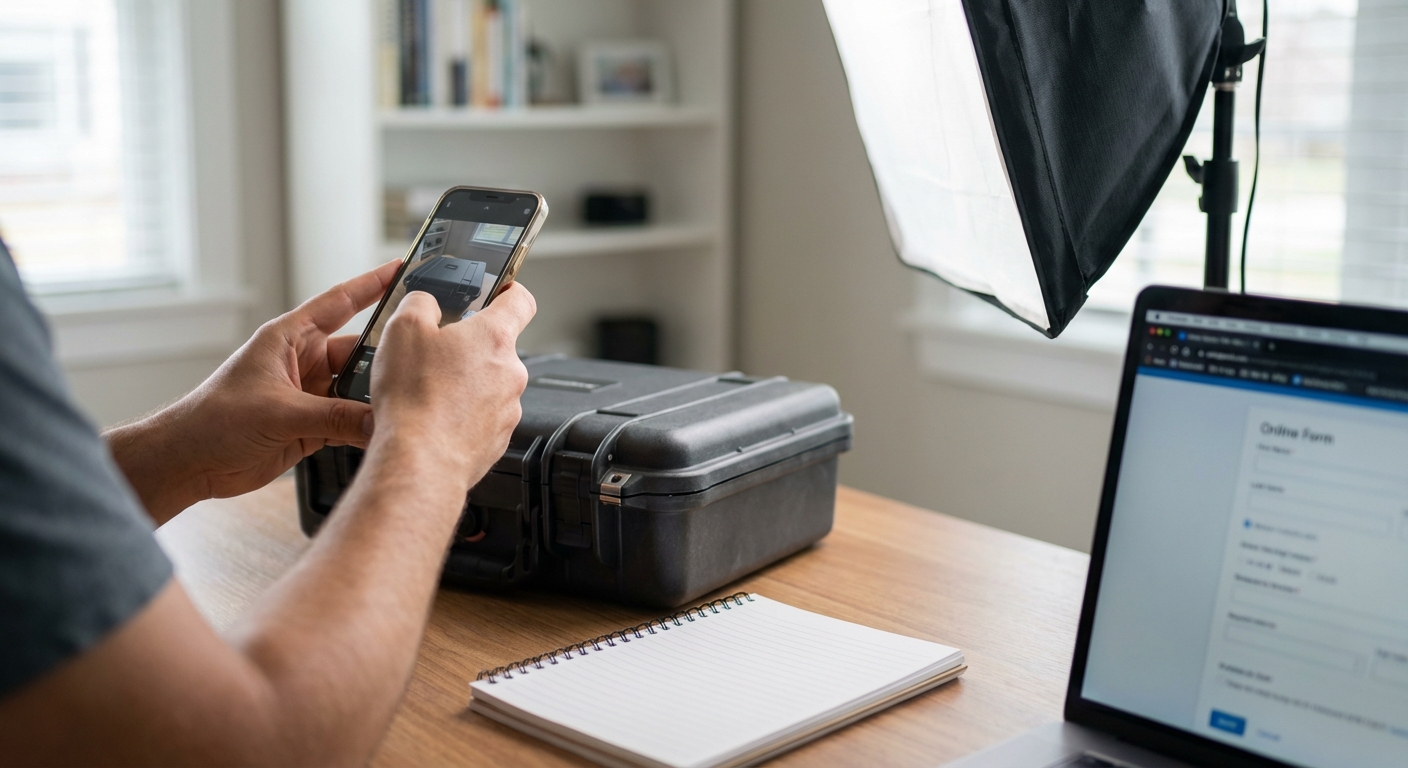
- Request a quote using the exact model details and an honest condition description, then document condition with a few clear photos so there’s no argument during inspection.
- Confirm who you’re selling to and how the transfer is handled. Cash My Guns is a nationwide online firearms purchasing service operated by Dunlap Gun Buyers (an FFL) that buys guns, ammunition, and accessories directly from private individuals. It lists a prepaid, fully insured shipping label among its free services.
- Send the firearm through the buyer’s intake process, which typically means shipping it to an FFL for receiving and logging. At a high level, federal law generally allows a non-FFL to ship a firearm to an FFL in another state for sale, transfer, or repair (ATF guidance; 18 U.S.C. §922(a)(2)(A), §922(a)(3), §922(a)(5)). USPS rules prohibit an unlicensed person from mailing a handgun, but allow mailing rifles and shotguns to an FFL when compliant (USPS Pub 52 / DMM §601/432).
- Pass inspection, which is where condition is verified, parts are checked, and any non-OEM changes get evaluated against the quote.
- Get paid after inspection acceptance, usually by the payment method the buyer offers once the final number is confirmed.
- Finish wear, bore condition, rust, or function issues that didn’t match the description, triggering a lower post-inspection offer.
- Missing parts that were assumed included, especially extra magazines, factory grips, choke tubes, or the correct OEM case.
- Non-OEM mods (trigger parts, stippling, refinishes) that reduce buyer resale confidence and get valued as a deduction, not an upgrade.
- Accessories that arrive incomplete, like optics without mounts, missing turrets or caps, or no serial-matching components on collectible guns.
- Unexpected cost buckets you still need to track for Step 4, like shipping or insurance if not covered by the buyer, plus any local FFL or transfer-related fees if your situation requires a dealer intake on your end.
The point of tracking those risks isn’t to scare you off, it’s to make sure your final comparison uses the same net-cash logic no matter where the offer came from (and that you understand how to sell a gun online from quote to inspection to payout).
Step 4
Your “best offer” isn’t a decision tool until it becomes one consistent net cash number. The problem is each channel hides costs in different places, pawn hides it in loan charges or haircutting the offer for fast resale, online hides it in deductions risk and waiting time. Your gut will overweight the biggest headline number and ignore the small leaks that add up.
- Write your Pawn Sale cash offer today: $______
- Subtract your Pawn Sale out-of-pocket costs you actually eat today (travel/time cost + any immediate fees): $______ + $______ = $______
- Write your Pawn Loan cash today: $______ (pawn shops typically hand you cash in-person the same visit once you accept the deal)
- Add your Pawn Loan total finance charges and fees by your redemption date: $______
- Write your redemption reality check: likelihood you’ll redeem on time: ______% (if that number isn’t high, treat the loan like a forced sale and flag it as higher-risk cash)
- Write your Online Buyer quoted offer: $______
- Subtract everything that reduces what hits your pocket (expected deductions + any shipping/insurance/FFL-related costs you pay + your personal urgency cost for waiting): $______ + $______ + $______ = $______
On the shipping line item specifically, some online buyers remove a big chunk of friction. Cash My Guns provides a prepaid shipping label and full insurance coverage, so your typical out-of-pocket shipping and insurance numbers for that channel often drop to $0 (still, it helps to understand shipping insurance for firearms when you compare net cash).
Net cash comparison worksheet (same data as the table, reformatted):
- Cash/offer (headline)
- Pawn sale: $______
- Pawn loan: $______
- Online buyer: $______
- Travel/time cost (your $ value)
- Pawn sale: -$______
- Pawn loan: -$______
- Online buyer: -$______
- Immediate fees
- Pawn sale: -$______
- Pawn loan: -$______
- Online buyer: -$______
- Total finance charges by redemption date
- Pawn sale: n/a
- Pawn loan: -$______
- Online buyer: n/a
- Expected deductions risk
- Pawn sale: n/a
- Pawn loan: n/a
- Online buyer: -$______
- Shipping/insurance/FFL-related costs you pay
- Pawn sale: n/a
- Pawn loan: n/a
- Online buyer: -$______
- Urgency cost (what waiting is worth to you)
- Pawn sale: $0 (same-visit cash)
- Pawn loan: $0 (same-visit cash)
- Online buyer: -$______
- Net cash (your comparable number)
- Pawn sale: $______
- Pawn loan: $______
- Online buyer: $______
Channel fit matters once the math is honest. Commodity, high-demand models usually price efficiently locally because a pawn counter knows they can move them fast. Niche, collectible, or slow movers often benefit from national demand signals online, and timing matters because valuations shift with market data, seasonality, and regional demand.
If one option beats the others by $X after costs, take it, unless speed or legal friction changes the risk for you. If you’re worried about taxes, ask a tax pro.
Before you hand anything over, make sure the transfer itself is set up the right way, because fixing a legal mistake costs a lot more than a slightly lower offer (and it’s worth knowing how to avoid paying transfer fees when you’re calculating net proceeds).
Step 5
The fastest way to blow up a good deal is getting the transfer wrong. Price negotiations are easy compared to untangling a sale that crossed a legal line, especially once state residency and paperwork enter the picture.
Two federal rules trip up normal, honest sellers all the time. First, 18 U.S.C. § 922(a)(5) generally prohibits a nonlicensee from transferring a firearm to a nonresident, with limited exceptions such as certain bequests. Translation: don’t “just meet a guy” across state lines to do a private sale. If the buyer is from another state, route it through an FFL (licensed firearms dealer).
Second, frequent flipping for profit can create real risk. 18 U.S.C. § 922(a)(1)(A) restricts dealing in firearms without an FFL, and 18 U.S.C. § 921(a)(21)(C) defines “engaged in the business” as devoting time, attention, and labor to dealing as a regular course of trade with the principal objective of livelihood and profit.
State rules are where the “simple private sale” story falls apart: some states require private transfers through a dealer and background check, others add permits, waiting periods, or specific forms. Texas, for example, does not require private-party transfers to go through an FFL or background check, and has no state permit-to-purchase or waiting period. Florida generally does not require private-party transfers to go through an FFL or background check under state law. Verify current rules where you live, and where the buyer lives, before you set a meeting (use a state-by-state guide to selling a gun as a starting point).
If you’re searching “how to sell a gun in Texas” or “how to sell a gun in Florida,” the safe baseline is the same: confirm residency, avoid interstate handoffs, and use an FFL when anything feels unclear.
- Is the buyer a resident of your state, and can they show a valid government photo ID?
- Is an FFL transfer required for your state, your city or county, or this firearm type?
- Does your state expect a bill of sale or other documentation for private transfers?
- Any waiting period, permit-to-purchase, or mandatory background check trigger?
- Any red flags: buyer dodges ID, pushes “no paperwork,” asks you to “put someone else’s name on it,” or gives straw-purchase vibes?
- Ask your local FFL/shop: “Can you handle this transfer, and what ID and forms will you require from each of us?”
- Ask your state police or licensing agency site: “Do private sales require a dealer transfer or specific documentation?”
Once the paperwork path is clear, the last place most people lose money is the simplest one: how the gun shows up for inspection or appraisal.
Step 6
Most “lost money” happens after the quote, through presentation mistakes and inspection mismatches that trigger easy deductions. Cash My Guns says its valuation looks at finish, bore condition, matching numbers, and aftermarket parts, and its founder John Dunlap is described as having nearly 20 years of hands-on experience and personally evaluating tens of thousands of guns. Their appraisals also incorporate market data from dealer listings and auctions, plus seasonality and regional demand, which is exactly why a clean, complete, easy-to-verify package wins you a stronger final number.
- Clean for inspection, not for vanity. Wipe off grime, surface dust, and old fingerprints, then lightly oil metal where appropriate. Skip “restoration” moves like refinishing, aggressive polishing, or sanding, because condition, especially finish and bore, is a pricing lever that can swing an offer fast.
- Revert to OEM parts when you can. Swap back factory trigger, sights, grips, or other originals if you still have them, then bag and label the aftermarket parts separately. Buyers discount unknown mods for good reasons, aftermarket components do not always have the same fit and testing as OEM parts, which can create magazine incompatibility and increase the chance of malfunctions.
- Organize accessories into a no-brainer bundle. Lay out mags, holsters, boxes, chokes, and manuals, then list them clearly so the buyer can value the package in one pass instead of guessing what’s included.
- Document what the buyer will actually check. Take sharp, well-lit photos of both sides, serial area (share only where appropriate), bore view if you can, and any wear spots. Add honest notes about scratches, pitting, or non-matching parts so you do not get hit with surprise deductions later.
- Confirm the deal in writing before you hand it off. Lock in the exact price, what’s included, and who pays shipping or transfer costs, then follow the buyer or FFL instructions and verify your state’s requirements.
- Record the basics and move on. Keep a simple receipt, the agreed terms, and transfer confirmation so you can prove what happened if questions come up.
On common production guns, clean presentation and OEM configuration usually boosts confidence and protects your offer from reliability and parts-fit questions.
On collectible or high-value pieces like a Colt Python, Winchester Model 70, or Browning A5, your job is to avoid harming value. Do not refinish, do not replace original parts unless you keep them, and do not toss the box, papers, or provenance. Photograph markings, keep original components together, and write down any history you can support (and consider the crucial role of expert appraisers in valuing firearm collections when the stakes are high).
- Agreed price and terms confirmed (what’s included, fees, shipping, timelines)
- Buyer or FFL instructions followed, state requirements verified
- Payment method selected for safety and traceability
- Receipt and transfer confirmation saved
Put together, this is how you keep the deal from drifting after the first quote: clear details up front, clean condition proof, and no surprises at handoff.
Conclusion
You don’t “pick the best option,” you pick the option that leaves you with the most net cash for your timeline. Your decision rule is simple: start with a baseline packet and real sold comps (Step 1), then decide if you’re selling or borrowing, because pawn loans stack monthly interest and fees fast (Step 2). After that, account for the online-buyer inspection, condition calls, and any deductions that can change the final number (Step 3). Your worksheet is the tie-breaker, plug every fee and timing cost in until one path clearly wins (Step 4), then verify the transfer is legal where you live (Step 5) and present the gun cleanly and completely to avoid avoidable deductions (Step 6).
Do three things today: fill in your worksheet numbers, pick the channel that wins on net cash given your urgency, and complete the transfer the safe, legal way. If the online route wins for you, Cash My Guns is operated by Dunlap Gun Buyers, a federally licensed firearms dealer (FFL), and it describes itself as a nationwide online firearms purchasing service with a “Safe • Legal • Hassle-Free” process. It also includes a prepaid shipping label and full insurance coverage as free services, so your worksheet stays focused on the offer and any inspection-based adjustments.