

You’ve got a CZ 75, you google “CZ 75 value” or “used CZ 75 price,” and suddenly nothing makes sense. Two “CZ 75” listings can be hundreds of dollars apart, and neither one tells you what you’d actually walk away with after a real sale.
You’re not trying to become a full-time appraiser, you just don’t want to leave money on the table. You also don’t want to accept the wrong kind of deal and end up in a transfer headache because the buyer lives across a state line.
Here’s the tension: quick online price checks ignore the small details that swing what buyers will pay, and they ignore the selling constraints that change what you can legally do and what you actually net. Federal rules generally don’t let you privately transfer a firearm directly to an out-of-state resident, so an out-of-state handgun sale typically ends at a Federal Firearms Licensee (FFL), where the buyer completes the ATF Form 4473 paperwork and the background-check process. The standard lawful out-of-state path is you ship the firearm to the buyer’s chosen FFL to complete the transfer.
There isn’t one magic price, there’s a realistic range that depends on a few controllable details and the route you choose, sell fast versus sell for more, local convenience versus wider demand and higher proceeds. By the end, you’ll know how to pin down what you have, describe it in a way buyers trust, and choose a legal, efficient selling route.
Identify Your Exact CZ 75
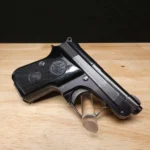
The fastest way to misprice your gun is to misidentify which CZ 75 you actually have. “CZ 75” is a whole CZ 75 family of closely related pistols that share the same basic layout, but they sell to different buyers, carry folks, duty-ish buyers, competition shooters, and collectors. If your listing name doesn’t match what’s on the gun, your comps won’t match either, and your price will be wrong.
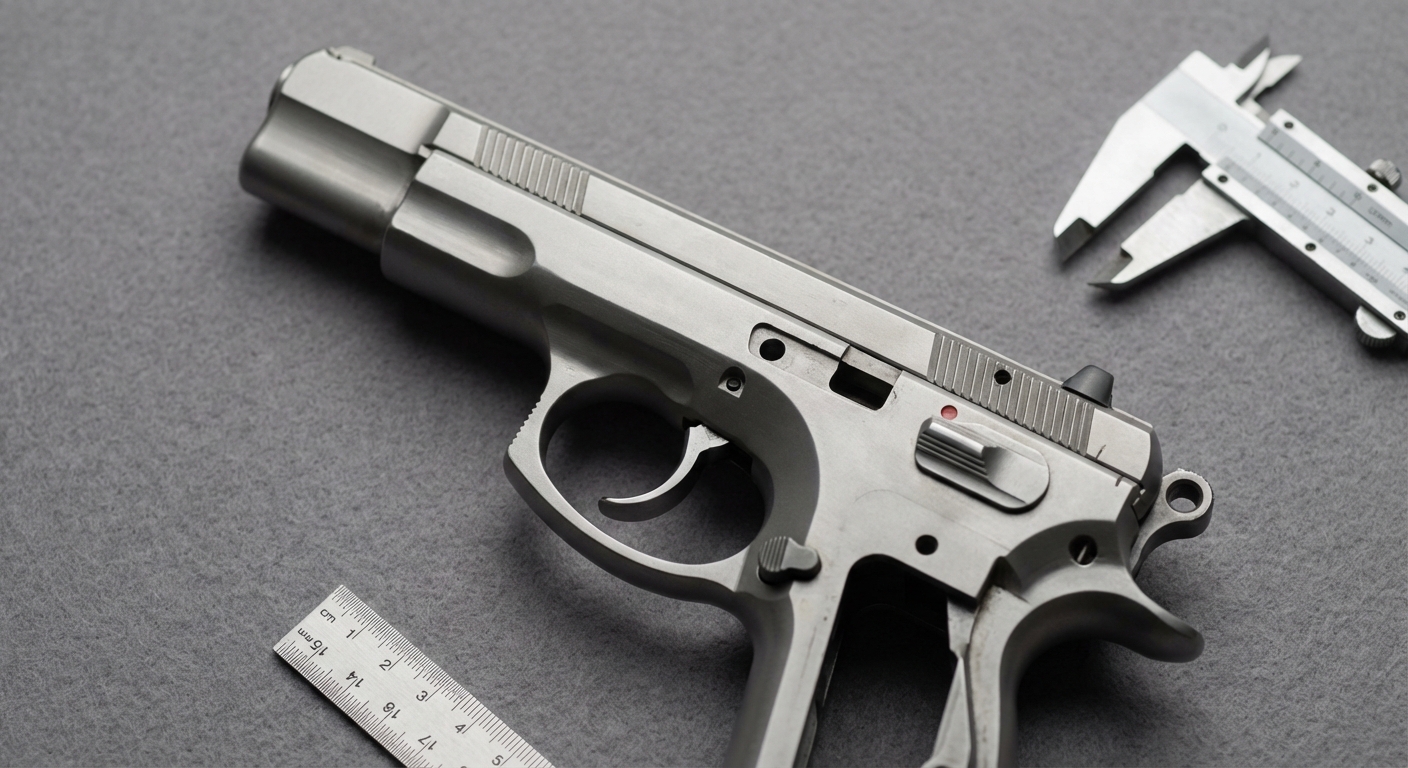
Start with the literal truth source: the slide and frame markings. Buyers search by the exact model name, not the story you remember. “CZ 75,” “CZ 75B,” and “CZ 75BD” are not interchangeable labels, and the roll mark is what lets you price against the right pool of listings. Write it down exactly as stamped, including any extra words like “Compact,” “SP-01,” or “Shadow.”
Next, look at the left-side controls. The original CZ 75 pattern is a full-size, steel-framed, DA/SA pistol that uses a manual thumb safety, not a decocking lever. A decocker is the lever that safely drops the hammer to a double-action first shot, and that single feature changes how buyers plan to run the gun, and how they filter searches. If you’re still unsure, use a step-by-step gun identification guide to confirm what you’re seeing before you price it.
On CZ 75 variants, “B” denotes a firing pin block, an internal safety that blocks the firing pin until the trigger is pulled. That matters in buyer confidence and in how people compare generations. “BD” is a CZ 75B variant that keeps the firing pin block but swaps the manual safety for a decocker, so the same base gun lands in a different “how I’ll carry it” demand bucket.
A lot of pistols get lumped into “CZ 75” searches: SP-01 (rail, longer dust cover), Shadow and Shadow 2 lineage (competition-leaning), Compact, PCR, P-01 (shorter carry-leaning frames), Omega trigger variants, plus stainless and limited runs. Add country-of-origin and importer markings to that, and you can see why sloppy naming costs real money.
- Exact model/roll marks: copy them character-for-character
- Serial number: record it cleanly (and keep it private in public ads)
- Safety or decocker: say which it is, don’t assume
- Rail or no rail: quick visual on the dust cover
- Sights: plain irons vs night sights (and any obvious aftermarket)
- Finish/material: blued, polycoat, stainless, etc.
- What’s included: box, papers, and exact mag count
If you’re trying to pin down a manufacturing date, skip random serial-number tables. CZ-USA does not publish an official public serial-number-to-date lookup. Contact Customer Service with the model and serial number, and know that confirmation can be limited if your pistol was not imported or distributed through CZ-USA.
Once you can name your CZ correctly, you’ve already eliminated the biggest source of bad pricing data: mismatched comparables.
Condition, Round Count, and Extras
Even within the same exact variant, condition and completeness are what separate a strong offer from a string of lowballs. That’s why the “what model is it?” work from above matters: it sets the baseline so condition can do the fine-tuning.
The fastest way to get lowballed on a used CZ 75 is leading with your round-count story. Buyers pay for condition signals they can see, and for completeness, the stuff that tells them you took care of the pistol.
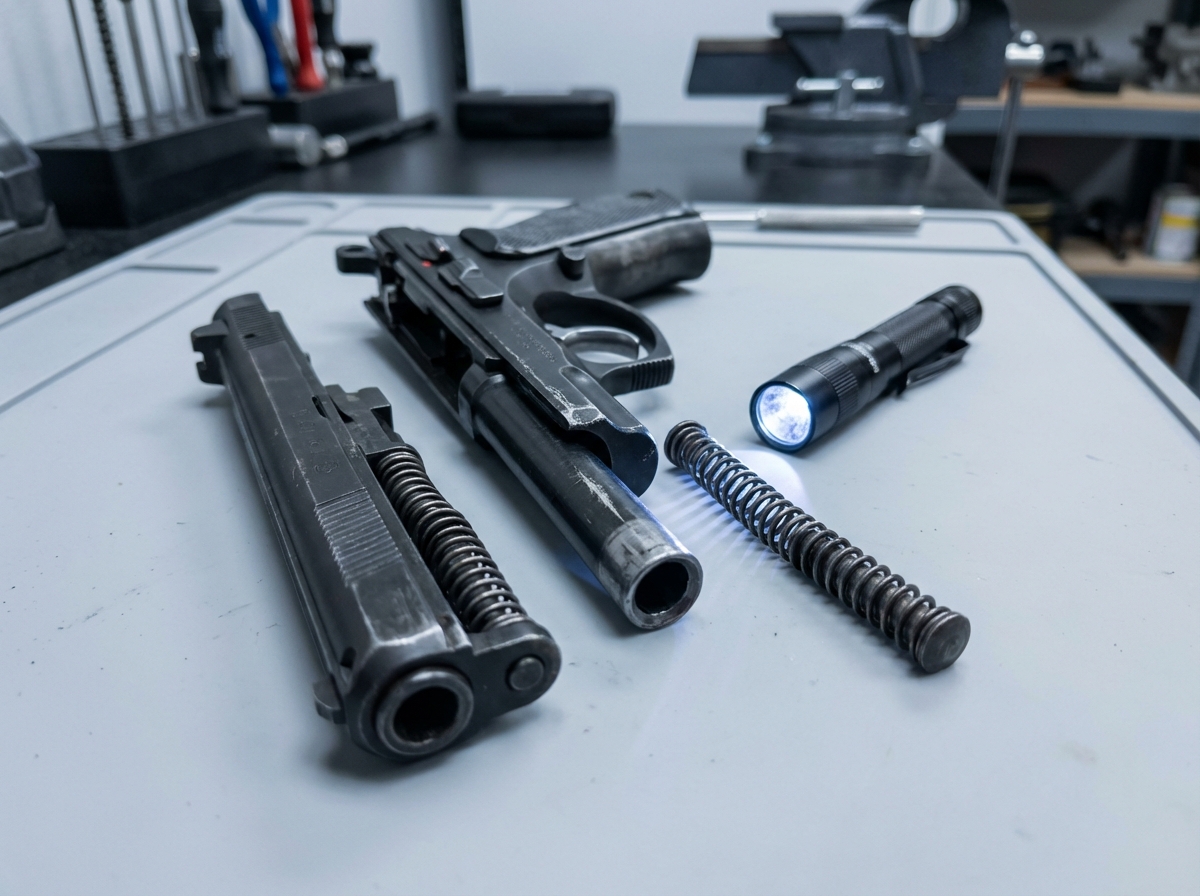
Start with finish wear, because it’s the first thing anyone notices in photos. Honest holster and handling wear usually shows up on sharp edges and high spots: slide corners, muzzle end, dust cover edges, along the beavertail, and on controls like the safety and slide stop. Describe it like a person who actually carried it, not like a catalog listing: “edge wear on the front of the slide and light rub marks on the left-side safety” reads confident, “like new” next to visible shiny spots reads like you’re hiding something.
CZ 75-series pistols run on internal slide rails (the slide rides inside the frame), so bright, burnished metal on the bearing surfaces is commonly normal. What looks “normal” is uniform, smooth contact wear that matches side-to-side. What worries buyers is galling (smeared or raised metal), deep scoring, or burrs, because those patterns suggest debris, poor lubrication, or abnormal friction.
Keep barrel talk high-level and confidence-based. A clean bore with sharp rifling, a crisp crown without obvious dings, and a track record of reliable operation are the signals buyers care about, because they translate to “this gun shoots like it should” instead of “this is a project.”
Sights are a quiet value lever. If it has night sights, treat their brightness as a condition item, not a bonus mystery. Dim or dead sights change buyer expectations, and your price has to acknowledge that reality.
Extras don’t just add stuff, they add trust. The box, manuals or papers, extra magazines, factory grips if you swapped them, and receipts for parts or service all do the same job: they prove you cared for it and reduce the buyer’s uncertainty. If you’re selling without the box or papers, be upfront and lean harder on clear photos and documentation.
Mods need clean disclosure. Reversible upgrades like grips or sights are easy to accept when you name the parts and include the originals. Permanent changes like milling, refinishing, stippling, or anything that removes metal change the buyer pool, so be direct and include paperwork if you have it. Cash My Guns, which buys firearms and accessories, explicitly treats condition and aftermarket parts as factors that can move an appraisal depending on what was done and how well it’s documented.
Photos should match your description: clear overall views, plus a few honest close-ups of the wear you called out. The practical goal is simple, write a listing that matches what a careful buyer will notice in the first 30 seconds, and you’ll spend a lot less time defending your price.
Build a Realistic Price Range
Once you know the exact variant and you can describe the condition without hand-waving, the pricing part gets a lot less mystical. You’re basically doing the same thing serious buyers do: compare, adjust, and verify.
The only way to get to a realistic CZ 75 worth range is to anchor on what actually sold, then adjust for your exact variant, condition, and what’s included. Sold evidence beats internet noise every time, because asking prices are hopes, and completed sales are proof.
- Collect sold comparables.
Start with sold comparables, meaning recently completed sales of genuinely similar CZ 75s that you use as your evidence base instead of forum guesses. “Similar” has two non-negotiables: same variant class (don’t mix a basic CZ 75B comp with a scarce, different-trim variant and call it close enough), and similar condition tier. If your pistol has honest holster wear, don’t anchor to a pristine safe queen sale just because it’s the first listing you found.
Where do you get those sold signals? Stick to places that show completed online listings and auction results whenever possible. Local shop tag prices can be useful context for what’s being tried at retail, but they’re still asking prices unless you can confirm they actually moved. - Adjust into a range, not a single number.
Once you have a small stack of sold comps, turn them into a defendable range by adjusting for what changes the deal in real life. Included magazines matter because they’re not “free,” they carry real value and replace-cost, so two extra factory mags is a legitimate bump versus a one-mag sale.
Do the same for accessories and documented work. A verified action job or reputable sights installation is different from “trust me, it’s been tuned.” The point is simple: prioritize completed sales as your anchor, then adjust for magazines, accessories, and documented work, because those differences explain why two “same gun” listings don’t close at the same number.
Also adjust for variant and rarity, using a CZ 75 current worth guide as a cross-check when your exact configuration shows up rarely in sold results. If your exact configuration shows up rarely in sold results, widen your range and be picky about what you treat as a true comp. - Sanity-check timing and local demand.
Demand swings, and your range moves with it, which is why it helps to understand how supply and demand affects firearm resale prices. A practical proxy is FBI NICS background checks, published monthly and annually and widely used to track demand pressure. In 2020, total NICS checks hit 39,695,315, and 2021 stayed near that level at 38,872,985, which is exactly the kind of “hotter market” environment that tends to lift what buyers are willing to pay.
Keep one more reality check in mind: some valuation services explicitly bake in seasonality and regional demand alongside market data pulled from dealer listings and auctions. Cash My Guns describes its appraisal approach that way, and it matches what you see on the ground, the same pistol can behave differently depending on where and when it’s listed.
If you follow that loop, sold comps first, adjust for your exact details, then sanity-check timing and local demand, you end up with a range you can defend. That range is your decision tool for picking a selling channel and setting an asking price you can justify.
How CZ 75 Resale Compares
Your CZ 75’s resale behavior will feel different than the internet’s most-searched guns, and that’s normal. Don’t force CZ pricing expectations to match Glock, 1911, or collector-revolver dynamics, those markets run on different demand engines.
Some models hold value differently because they have a broader buyer pool, common duty adoption, a massive aftermarket, or collector heat that spikes demand. Magazine and parts commonality also matters, buyers pay faster when they know they can source mags, springs, and small parts without a scavenger hunt.
The CZ 75 family spans multiple variants, which creates demand pockets instead of one single, uniform “CZ 75 value.” Parts and mag availability boosts buyer confidence, and CZ-USA maintains a factory-supported parts and accessories channel for magazines and replacement parts. One catch: “comes with mags” isn’t one-size-fits-all, CZ sells different magazine SKUs across full-size, compact, and rail-equipped lines, so buyers care which mags you’re actually including.
Modern polymer service pistols set the search baseline, think Glock 17 value, how much is my Glock 19 worth, Sig Sauer P320 value, and S&W M&P value. Metal DA/SA peers get compared differently, so you’ll see Beretta 92 value alongside CZ searches.
Collector-tilted handguns live on hype cycles, Walther PPK value and Colt Python value don’t move like duty pistols. Budget guns like Taurus G3C value chase affordability first. Long-gun searches, Ruger 10/22 value, Mossberg 500 value, how much is my Remington 870 worth, Henry lever action value, Marlin 336 value, Winchester Model 70 value, Savage 110 value, Browning A5 value, Ruger GP100 value, and SKS rifle value, are useful only as a gut-check lens.
Use those comparisons to calibrate expectations, then let local demand and your specific CZ’s condition drive the final range.
Best Ways to Sell Legally
Once you’ve got a defensible range, the next question is the one that actually determines what you take home: how you sell. How you sell your CZ 75 can change your net proceeds as much as the gun itself, because speed, fees, and compliance requirements vary by channel.
The “highest price” you see online isn’t your number if the path to get there adds transfer fees, shipping and insurance, or extra time you don’t want to spend.
If your priority is max dollars and you’re in a place where it’s lawful, a local private sale often leaves you with the best net since there’s no dealer offer spread and you can avoid some transaction fees. The friction is real though: you’re doing the legwork, screening messages, meeting safely, and making sure the transfer is legal where you live. This isn’t legal advice, but if you’re unsure about any part of a private transfer, using an FFL is the clean default.
Consignment sits in the middle. You hand the gun to a shop, they market it to their walk-in traffic and regular buyers, and they handle the paperwork. You trade time and a consignment fee for exposure and professional handling, which is a good fit when you’re not in a rush but you also don’t want to run a private sale.
Selling to a local dealer is the speed play. You can usually walk in, get an offer, and be done. The tradeoff is payout, dealers have to leave room for overhead and resale margin, so your offer is typically lower than a private-party or well-executed online sale.
Online sale routed through an FFL gives you the widest buyer pool, but it adds coordination. Federal law generally requires interstate transfers to non-licensees to be completed through an FFL in the recipient’s state, and as the seller you can ship to that receiving FFL for transfer (18 U.S.C. § 922(a)(5); 18 U.S.C. § 922(b)(3)). That bigger audience can support a stronger sale price, but your net has to absorb shipping, insurance, and whatever transfer fee the receiving dealer charges, and those fees vary by dealer.
Direct-buy, mail-in services push hard toward convenience: a predictable process, fewer strangers, and fast closure. The offer usually reflects that convenience. If you want a single-name example, Cash My Guns positions its service as “Trusted Since 2013.”
- Verify the receiving FFL using ATF’s FFL eZ Check, then confirm the name and address match what you were given.
- Independently contact the dealer using a phone number or website you looked up yourself, not the one in an email or text.
- Refuse “FFL copy only” proof; ATF warns scammers use stolen or altered FFL copies, so an emailed “FFL copy” alone can be faked.
- Match shipping details to the verified address, because a common fraud pattern is impersonating a real FFL while redirecting shipment or payment elsewhere.
Laws change, and the rules that matter most are the ones where the handoff happens, so check current official state resources for Texas, Florida, California, Georgia, Pennsylvania, Ohio, Arizona, New York, North Carolina, and Illinois. If you can’t quickly confirm what’s required, run the transfer through an FFL and keep your paper trail simple.
Texas is a good example of why the details matter. Texas doesn’t require private-party sales to go through an FFL or include a background check under state law, but it’s a crime to knowingly transfer to a prohibited person (Tex. Penal Code § 46.06(a)(1)), and transferring a handgun to someone under 18 is generally prohibited (Tex. Penal Code § 46.06(a)(2)).
To maximize value without adding risk, present the pistol cleanly (a quick wipe-down and honest photos), describe it accurately (model details, included mags and accessories, known issues), store it securely while it’s listed, and think through insurance so a shipping loss doesn’t erase your gain. Pick the channel that matches your priority, max dollars or max speed, and default to the safest compliance route whenever you’re uncertain.
Quick Checklist and Next Steps
The same three things that make online pricing stop feeling random are the things that make your final number make sense: correct ID, honest condition details, and a selling route that matches your constraints.
Fair CZ 75 value comes from alignment: your details match the market, your comps are current, and your selling plan matches what you actually care about, speed, maximum net, or minimum hassle.
Use Step 1 to lock the exact variant, because the wrong ID poisons every comp you pull. In Step 2, document condition and completeness the same way buyers and appraisers price it, include make/model and condition details like finish and bore, note matching numbers when applicable, and treat uniform internal-rail wear as normal, not damage. If you changed anything, disclose the modifications and keep receipts since aftermarket parts are part of the appraisal. Step 3 is building a realistic range from sold comparables, then re-checking close to listing day because seasonality and regional demand change outcomes. Step 4 is choosing the channel, private sale, consignment, dealer, online via FFL, or a direct buy, based on speed versus what you clear after fees and friction.
If you’re sitting on a rare variant or a collection, get an expert appraisal for a firearm collection, then get a quote or explore Cash My Guns valuation resources through Dunlap Gun Buyers (FFL), a nationwide online buying service.