
It’s frustrating because you’re trying to price yours without leaving money on the table, but you also don’t want to waste weeks chasing a buyer who never shows. The tradeoff is simple: speed versus top dollar, and certainty versus effort, and a more normalized market makes the small details show up in the final number.
Zooming out helps. People watch FBI NICS totals as a high-frequency indicator of retail transaction activity, but the FBI also says NICS checks are not a one-to-one measure of gun sales because permits, rechecks, and multiple firearms on one check are baked into the totals. With background-check volume down from the 2020 to 2021 surge and still off those highs in the years since, the market feels less “anything sells instantly,” and small differences matter.
Add lineup shifts and it gets even more obvious: the Shield Plus landed in 2021 with higher-capacity magazines, and the later expansion into premium and optics-ready variants changed what a lot of buyers chase, pulling demand toward newer configurations and away from older SKUs. If you collect the right inputs-exact variant identifiers, condition and completeness, accessories and mods, local demand, and how you sell-you’ll leave with a defensible value range and a clear next step to pin yours down.
What “Worth” Means in 2026
That price gap only makes sense once you pick which “worth” you mean. The same M&P can legitimately have five different “prices,” depending on who’s buying, who’s doing the paperwork, who’s waiting for a buyer, and who’s paying the fees.
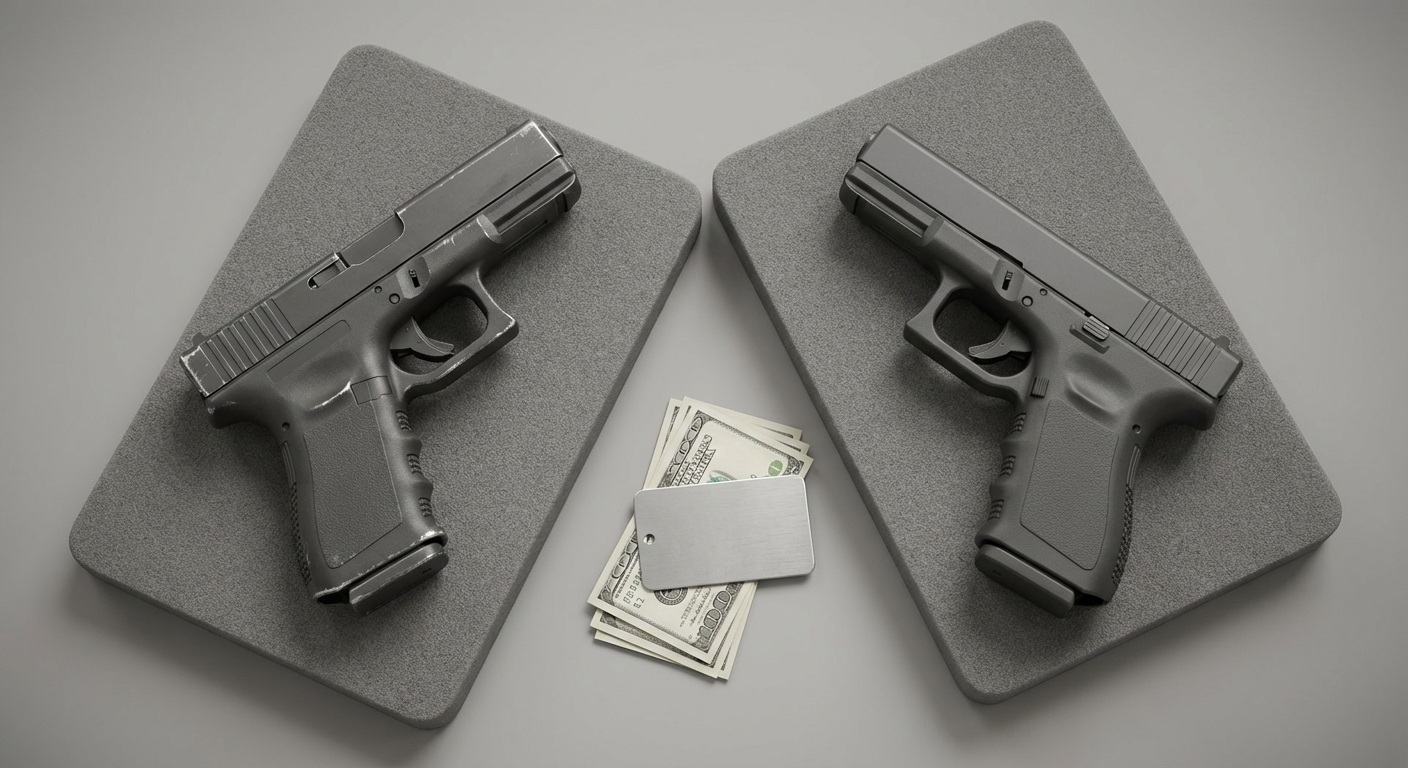
- MSRP — Useful for: Benchmarking a specific model/SKU on paper. Why it runs higher or lower: It’s the Manufacturer’s Suggested Retail Price, a published suggestion, not a guaranteed selling price, so it often overstates what buyers actually pay.
- Street price — Useful for: Sanity-checking new-gun comparisons. Why it runs higher or lower: It’s the typical real-world retail price, pushed by competition, promos, and inventory, not the manufacturer’s suggestion.
- Used private-party sold price — Useful for: Estimating what a real buyer will pay you. Why it runs higher or lower: You’re doing the legwork and waiting, so the buyer pays closer to “market.”
- Dealer offer (cash vs trade) — Useful for: Fast, predictable exit. Why it runs higher or lower: The dealer prices in resale risk, time, and overhead; trade credit is often higher because it keeps the money in-store.
- Consignment net — Useful for: Comparing consignment to other options. Why it runs higher or lower: It’s what you receive after it sells, minus the shop’s commission and any listed fees, so the “headline sale price” is not your number.
The biggest trap is anchoring to optimistic asking prices. Listings are marketing. Sold results are reality, and they’re the only clean way to keep your expectations aligned with what buyers actually do.
It also helps to be honest about what you’re optimizing for. If you need fast cash, start by getting a dealer cash offer from an FFL that can run a compliant transaction; Cash My Guns (operated by Dunlap Gun Buyers) positions this as “Safe • Legal • Hassle-Free.” If you want max dollars, start with used private-party sold data and work backward. If you want least hassle, compare consignment net, not the consignment tag price.
M&P Variants That Move Value
Your M&P’s value swing usually starts with one question: exactly which M&P is it? Platform, generation, size, and a couple high-impact features change who’s shopping, and how many of those buyers exist in 2026.

M&P9, M&P40, and M&P45 don’t pull from the same demand pool. In 2026, 9mm listings generally attract the widest audience because more buyers want common ammo and broad magazine support. If you’ve got an M&P40 or M&P45, expect a narrower buyer pool, but often a more opinionated one that knows exactly what they want.
Within the family, “Shield” and “Shield Plus” live in the carry-gun lane, while the standard M&P line (Full Size and Compact) leans duty, home defense, and range use. The M&P 5.7 is its own lane entirely; it’s not a simple “bigger or smaller” version of the others, so it tends to compare against different alternatives.
Generation is a real search filter, not trivia. Smith & Wesson’s M2.0 is marketed around an extended stainless-steel chassis and a low bore axis design, plus a more aggressive grip texture and four interchangeable palm-swell inserts. Buyers who care about feel and control routinely sort for “M2.0” first, which can leave 1.0 guns competing harder on price and extras.
Size matters in a boring way: Compacts usually fit more roles for more people. If you’re selling a Full Size, expect a smaller pool, but also buyers who are specifically chasing a duty-style setup.
Some features widen the pool, others narrow it. Optics-ready slides tend to broaden interest because more buyers want to mount a dot without milling. Threaded barrels and Performance Center variants often raise interest, but they can also narrow it to people who specifically want those upgrades.
Capacity is a demand lever too. The Shield Plus (introduced in 2021) brought higher-capacity 9mm magazines, 10+1 flush-fit and 13+1 extended, and later expanded into Performance Center and optics-ready variants. That pulls attention away from older, lower-capacity Shield configurations unless they’re priced to move.
State-compliant versions can be either a constraint or an advantage, depending on where you’re selling. California roster models are commonly identified by features like a loaded chamber indicator and, on some configurations, a magazine disconnect. Massachusetts-compliant variants are often marketed with heavier triggers or added mechanisms depending on the run. Those compliance cues can shrink the buyer pool in free states, or shift demand toward in-state buyers where that exact configuration is what’s transferable.
One outlier: rare, limited, or discontinued runs can behave differently than the “normal” market, so they’re worth a specialist look before you anchor to typical comps.
Takeaway: before you look at any prices, write down the exact model markings and cues: platform/caliber (9, 40, 45, 5.7), Shield vs Shield Plus vs standard, 1.0 vs M2.0, Full Size vs Compact, and any big flags (Performance Center, optics-ready, threaded barrel, and any compliance markings).
Condition, Round Count, and Upgrades
Condition is where “same gun” becomes “different price.” Once you’ve nailed the exact M&P variant, the swing factor is what a buyer can verify in 30 seconds: finish, bore, and whether the gun is “complete” with its mags, case, and OEM parts.
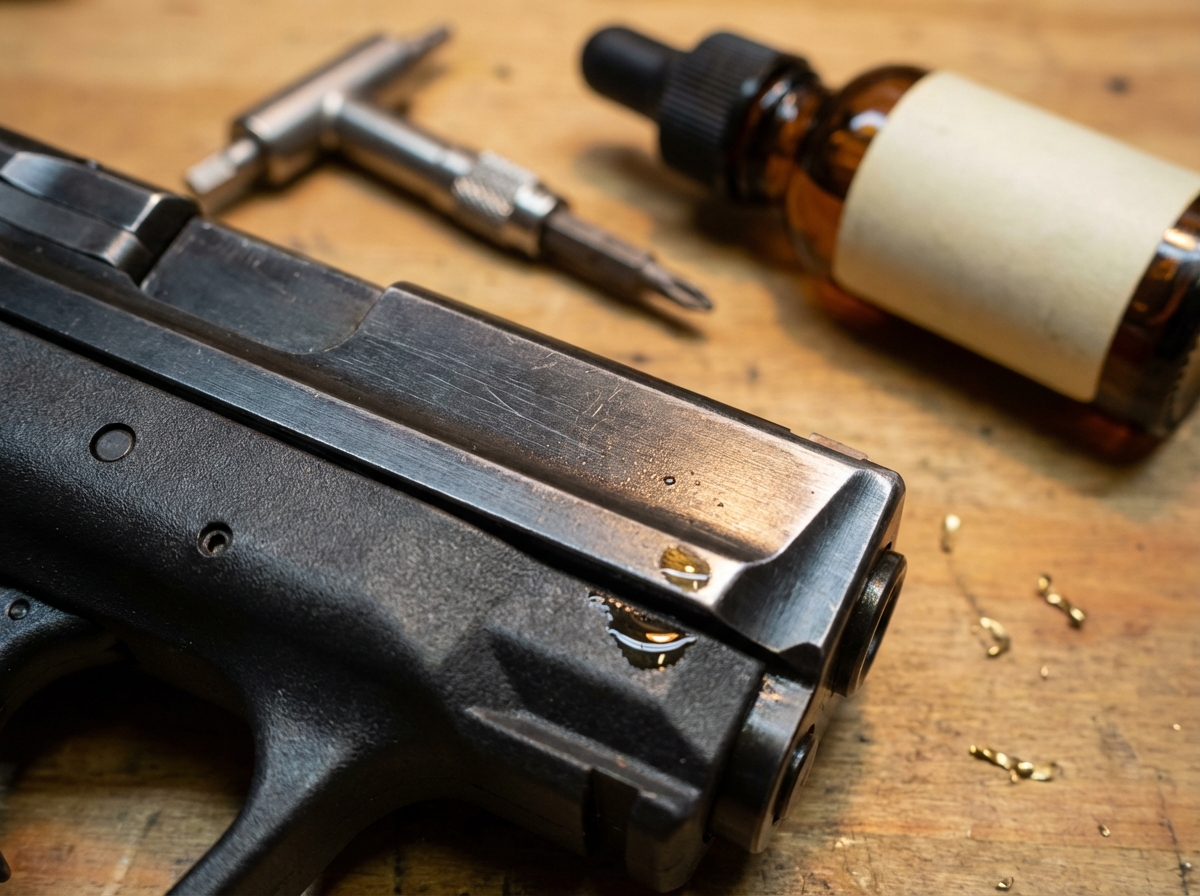
- Exterior finish and edges: look for holster burn, sharp-edge wear, scratches, and any rust or pitting, especially around slide serrations and under controls.
- Barrel, bore, crown: a clean, sharp bore and an undamaged crown signal proper care, while roughness or obvious damage raises “hard use” flags fast.
- Frame rails and contact points: check rail wear, locking surfaces, and other high-friction areas for abnormal peening or battering.
- Trigger feel and basic function: buyers care that it operates smoothly and safely. Avoid any handling that’s unsafe or beyond what you’re trained and allowed to do.
- Sights: night sight brightness is real value. Tritium’s half-life is about 12.3 years, and most people treat night sights as “effective” for roughly 10 to 12 years. TRUGLO backs its tritium handgun sights with a 12-year warranty, which tells you how the industry thinks about service life.
“Low round count” without evidence rarely moves the needle. Buyers price what they can see: finish wear at the muzzle and edges, rail wear, and the condition of the bore and crown. A clean-looking pistol with sharp markings reads as gently used, even if the exact number is unknown.
NIB means New in Box, represented as new with original packaging and typically minimal or no use. Claiming NIB while the factory case, mags, or papers are missing backfires because it signals either misunderstanding or misrepresentation. The same confidence hit happens when OEM parts are gone. Even popular “upgrades” like stippling, Cerakote, trigger swaps, or slide milling often shrink the buyer pool because originality is easier to trust, and dealer appraisals commonly factor originality, aftermarket parts, and visible condition indicators like finish and bore.
Before you price it, document this: clear photos of both slide sides, muzzle and crown, bore, frame rails, sights (in a dark room if they’re tritium), serial and markings, plus a list of included mags/case/paperwork and every non-OEM part you can identify, with OEM take-offs kept together.
Build a Defensible Price Range
Once you’ve identified the variant and documented condition, you can stop guessing and start comparing. You’re not finding “the” price; you’re proving a range. The fastest way to do that is to anchor the range in completed sales, meaning verified sold transactions (like closed auction results) that show what buyers actually paid, not what sellers hoped to get.
- Identify your exact SKU and features. Match what you have-generation, size, optic-ready cut, manual safety, and included mags-because “M&P” pricing swings hard by variant.
- Pull 10 to 20 comparable completed sales. Stay tight on the same model and configuration, and keep an eye on sale dates so you’re not mixing last year’s market with this month’s.
- Adjust for condition, accessories, and mods. Box, extra mags, and quality optics can move the number, while permanent mods and rough wear usually shrink your buyer pool and slow the sale.
- Net out fees and friction so you’re comparing apples to apples. Subtract shipping, insurance, payment or marketplace fees, and any FFL transfer costs from your expected proceeds before you decide what “worth it” looks like.
- Set a range that matches your timeline. Your “sell this weekend” number and your “I can wait a month” number should not be the same.
Sold vs listed: prioritize completed sales over active listings because asking prices float high. Sellers build in negotiation room, some listings sit forever, and a few are pure wishful thinking. Sanity-check outliers by tossing weird bundles, obvious pricing errors, and one-off condition extremes that don’t match your gun.
Fees are where good pricing plans die. Example: GunBroker charges buyers a 1% Marketplace Service Fee added at checkout, but sellers still eat their own costs, so you still need to price from your net proceeds. If you consign, fees can be bundled; one stated arrangement uses a flat 25% consignment fee covering shipping and insurance, FFL transfer, and GunBroker auction fees, but treat that as an example, not a rule.
Takeaway rule: pick your list price inside your proved range based on urgency-low end for speed, high end for patience (see this step-by-step guide to selling a gun for the best price for common pricing pitfalls). If seasonality or your region feels slower, shift toward the faster end and plan for more time-to-sell, not a guaranteed higher number.
Where to Sell and Net More
A price range is only half the story, because you don’t keep the headline number. Net dollars = price minus friction. Two M&Ps can sell for the same headline number, but the channel decides how much you actually keep once you account for time, risk, paperwork, fees, and the chance the deal falls apart.
If you want the most money, a legal private-party sale often has the highest gross potential because you’re not selling to a middleman. The catch is coordination: screening buyers, meeting safely, and completing whatever transfer steps your state requires.
If you want broad reach without winging the paperwork, selling a gun online through a marketplace usually ends with the firearm transferring through an FFL, a Federal Firearms Licensee, meaning a person or business licensed under federal law to engage in firearm transactions and transfers. In practice, you find the buyer online, then the transfer is completed through an FFL so the receiving side can run the required checks and record the transfer.
If you want the fastest, lowest-hassle local exit, a gun store offer is the cleanest handoff. Expect two numbers: an outright purchase offer (the shop needs margin for overhead and inventory risk) versus a trade-in credit (often higher because the shop keeps the value in-store, not as cash leaving the register).
If you want someone else to handle buyers, consignment trades speed for exposure. The shop lists and sells it for you, then you get paid after it moves, minus the consignment cut. Think in net, not the tag price on the shelf.
If you want a direct, structured process, specialized buyers exist. For example, Cash My Guns is operated by Dunlap Gun Buyers (an FFL) and positions its process as “Safe • Legal • Hassle-Free,” with an expert appraisal, a prepaid shipping label, full insurance coverage, and state-law compliance handling listed as included services.
- An unlicensed person generally may not transfer a firearm directly to a nonlicensee in another state; interstate transfers to nonlicensees generally must be completed through an FFL in the recipient’s state.
- A nonlicensee may ship a firearm to a licensed importer, manufacturer, dealer, or collector (FFL) in any state.
- Verify residency and your state’s transfer rules before you line up a buyer.
- Use the proper transfer pathway, especially if an FFL is required.
- Document the firearm accurately (make, model, caliber, serial number) and follow any FFL and carrier requirements tied to your chosen route.
In states with universal background check requirements for private-party firearm transfers, the transfer is typically routed through an FFL. As of Feb 2026, jurisdictions commonly tracked as requiring them include CA, CO, CT, DE, DC, HI, IL, MA, MN, NV, NJ, NM, NY, OR, RI, VT, VA, and WA (and others).
Pennsylvania has its own wrinkle: most private handgun transfers generally must go through an FFL or a sheriff.
Choose the channel that matches your timeline and risk tolerance, then compare your options using net proceeds, not the sticker price.
Market Benchmarks and Next Steps
You don’t need one perfect “appraisal number” to make a smart call on your M&P. What you need is a reality check on your expectations, plus a short checklist you can actually execute so “worth” becomes a defensible range.
- Exact variant identifiers (SKU-level details beat “M&P 9”)
- Condition, originality, completeness (finish, bore, factory parts, box and mags)
- Real sold comps and net proceeds (after fees, shipping, transfers)
- Channel choice plus timeline (fast sale vs top-dollar patience)
- Document model markings, caliber, barrel length, sights, and any aftermarket parts.
- Photograph it like a buyer will inspect it-clear, well-lit, multiple angles, plus close-ups of markings, wear, and mods; GunBroker’s listing guidance pushes this because it cuts uncertainty and disputes.
- Gather sold comps that truly match your configuration and condition.
- Pick your selling channel based on how much effort and risk you’ll tolerate.
- Price for your timeline-aggressive if you need speed, tighter if you can wait.
Benchmarks can help you sanity-check, but premiums on commonly searched models come from configuration and production distinctions, then condition and originality, not the name on the slide. That same principle is why two “similar” guns clear very different net proceeds.
If you want a credible range fast, get a professional appraisal or an offer, then keep learning in the Cash My Guns blog hub so your next move is based on data, not scrolling.
Conclusion
In a 2026 market where the “anything sells instantly” vibe has cooled, the small details really do show up in the final number. Identify the exact M&P variant, grade condition and completeness, anchor your range to sold comps, then pick the channel and price to your timeline.
Variant identity sets the buyer pool; condition, originality, and night-sight age move you within the range.
Focus on net proceeds, because the selling channel changes what you actually take home.
If you want a fast, structured offer, Cash My Guns-operated by Dunlap Gun Buyers, a federally licensed firearms dealer (FFL)-positions itself as “Trusted Since 2013,” “Safe • Legal • Hassle-Free,” and authorized and compliant in all 50 states.