

You searched “sell my gun for cash” because you want money soon, not a weeks-long project. Then you start calling around or messaging people, and the deal feels like it’s sliding toward confusing, sketchy, or both.
Most fast-cash attempts go sideways for three predictable reasons: the legal boundaries feel fuzzy, your pricing expectations don’t match cash offers, and the channel you picked doesn’t match your real priority. A big piece of the legal confusion is where casual selling starts looking like dealing, the ATF’s final rule on the “Definition of ‘Engaged in the Business’ as a Dealer in Firearms” was signed April 10, 2024, and the practical takeaway is simple: repetitively buying and selling predominantly for profit can require a license.
On top of that, there are federal baseline tripwires you can’t ignore: don’t transfer to a “prohibited person” (someone barred from possessing firearms under 18 U.S.C. § 922(g)), and be careful with interstate private transfers, since 18 U.S.C. § 922 restricts them and they often need to route through a licensed dealer.
Speed, payout, and hassle rarely line up in the same option, and rushing makes you a target for scams. The FBI’s IC3 has long warned about overpayment and non-payment patterns where money looks “available” before it actually clears, then gets reversed. In this guide, you’ll see the real tradeoffs across a local dealer, a pawn shop, a private in-state sale, an online marketplace or auction, and an online buyer that routes through licensed dealers, so you can pick the right route and keep the process safe, legal, and headache-free.
Step 1
Before anyone can price your gun accurately (or take you seriously), they need to know exactly what it is and what shape it’s in. The fastest way to get lowballed later is listing a vaguely described gun with fuzzy condition details.
- Confirm the exact make, model, and variant from the gun’s markings (slide, barrel, receiver, frame, and sometimes the box label), not your memory. If you’re unsure, use a guide to identify your gun before you list it. Variant accuracy changes offers because buyers and appraisers price using make/model plus market data, and small submodel differences can sit in totally different price bands.
- Record the serial number privately, then read it twice, digit by digit. One transposed number wastes everyone’s time and can stall an offer. Keep the serial out of public listings and photos, if someone needs it later, share it directly and only with the party you’re actually dealing with.
- Assess condition using the inputs that drive real cash offers: finish wear (high points, edges, scratches, rust), bore condition (shine, pitting, fouling), and matching numbers where applicable (common on some revolvers and surplus guns). Also list every aftermarket part or modification, optics cuts, triggers, muzzle devices, refinishing, stippling, or drilled and tapped holes change value and buyer confidence. Cash My Guns explicitly calls out finish condition, bore condition, matching numbers (when applicable), and aftermarket parts or modifications as appraisal factors.
- Gather accessories and documents you’re actually including: magazines, original box, manuals, backstraps, choke tubes, slings, mounts, lights, optics, extra barrels, and any spare parts. If you plan to keep something, do not photograph it as included. Some buyers even purchase accessories alongside firearms and run the process with an expert appraisal plus shipping guidance and insured labels, but only if your included items are clearly identified.
- Clean lightly and safely: verify unloaded, remove obvious dust and fingerprints, wipe exterior with a light oil, and run a basic bore pass if it’s dirty. Skip polishing, sanding, or “touch-up” work that can hide wear in photos or create new marks.
- Photograph the key areas that prove what you’re claiming: both sides full-length, close-ups of muzzle and crown, ejection port or forcing cone area, feed ramp (if applicable), rails and locking lugs, grip panels or stippling, optic and mount markings, and clear shots of model and caliber markings. Photograph the serial for your records, but do not post it publicly, cover part of it if you must show it. A tight photo set speeds offers because condition and included accessories materially move cash numbers.
Do this once, and you’re ready for pricing, you’ve got the exact ID, the condition notes buyers actually use, and photos that back it up.
Step 2
With your make/model nailed down and your condition documented, pricing stops being a guessing game and becomes simple math. The number that matters isn’t the biggest listing price, it’s what you’ll actually keep when the deal is done. When you price off completed/sold listings (closed results, not hopeful asking prices), you’re using what buyers actually paid, and that’s the only anchor that holds up when you want to sell a firearm for cash.
On GunBroker, don’t trust what you see in Quick Search because it only searches active listings. To see real outcomes, use Advanced Search and switch to Completed Items, which flips your results to closed, ended auctions.
- Pull real comps from “completed/sold listings” (not active listings) so you’re anchoring to what people paid.
- Filter comps by condition (New vs Used) and obvious match factors so you don’t compare apples to oranges.
- Adjust for your gun’s condition/mods/accessories based on what you documented in Step 1.
- Subtract the channel’s fee stack to estimate your net proceeds.
- Sanity-check your range for seasonality and regional demand swings before you commit to a number.
A practical trick when you’re pulling comps is to search by a consistent identifier (like a model number) instead of relying on listing titles, since sellers spell and describe the same gun a dozen different ways.
Then do the math sellers skip: net proceeds. Two sales at the same price can leave you with totally different net proceeds, the cash you keep after fees, shipping, insurance, and transfer costs. If it sold for $600 but you spend $80 in total expenses, you didn’t “get $600”, you cleared $520.
One more reality check: “cash value” pricing trends closer to trade-in math than top-dollar private-sale pricing because the buyer is building in their costs and margin. And prices move around—supply and demand affects firearm resale prices, which is why the same model can land in different ranges depending on timing and location.
Once you’ve got a realistic net target and a defensible range, choosing a selling channel gets much easier-and you’ll spot bad offers faster. If you need a baseline, use a what is my gun worth checklist to keep expectations realistic.
Step 3
There isn’t one “best” place to sell a gun for cash, there’s the best match for what you care about most: net proceeds, speed, hassle level, and how much risk you’re willing to carry.
- Local gun store/dealer
- Typical speed: Often same day
- Typical net proceeds: Typically lower than private sale
- Effort: Low
- Paperwork/transfer friction: Usually straightforward
- Risk: Low
- Pawn shop
- Typical speed: Often same day
- Typical net proceeds: Typically lowest
- Effort: Low
- Paperwork/transfer friction: Usually straightforward
- Risk: Medium
- Private in-state sale (where lawful)
- Typical speed: Days to weeks
- Typical net proceeds: Often highest
- Effort: High
- Paperwork/transfer friction: Varies by situation
- Risk: Higher
- Online marketplace/auction + proper transfer
- Typical speed: Days to weeks
- Typical net proceeds: Often strong, fees reduce net
- Effort: High
- Paperwork/transfer friction: Higher, shipping and transfer coordination
- Risk: Medium
- Specialized online buyer via licensed dealers
- Typical speed: Often fast once shipped
- Typical net proceeds: Typically mid-range
- Effort: Low to medium
- Paperwork/transfer friction: More standardized
- Risk: Low to medium
- Decide your deadline. If you need cash today, you’re choosing between a dealer and a pawn shop, not an online listing.
- Set your “minimum net” number. If your floor is close to what retail listings show, same-day buy offers will feel disappointing, and that’s normal.
- Choose your hassle budget. Meeting strangers, taking photos, answering messages, packing and shipping, and coordinating transfers are all “effort,” even if they don’t show up as a fee.
- Pick your risk tolerance. When an FFL (a federally licensed firearms dealer) is involved, the transfer process is usually clearer and more standardized. If you want fewer gray areas, bias toward FFL-involved routes.
From here, the five options look less like “where do I sell?” and more like “what am I willing to trade for speed and simplicity?”
If your goal is to walk in with a firearm and walk out with cash, a local dealer is the cleanest trade: fast, predictable, and typically low-risk. The surprise for most sellers is the spread, you’re getting a buy offer, not “what it’s listed for online.” Dealers have to cover overhead, time-in-inventory, and the risk that your exact model sits for months.
One move that changes the math is asking about consignment, a selling arrangement where a store lists and sells your firearm for a commission, paying you after it sells. Consignment often nets more than a same-day buy, but you’re explicitly trading speed for patience.
Tip: Ask two questions before you hand it over: “Is this a cash buy today, or consignment?” and “What’s your commission and payout timing if it’s consignment?” Get the terms in writing.
If the dealer route feels straightforward but the first offer stings, pawn shops are the other common same-day option-and they’re built for speed. If you need cash today and you don’t want to shop multiple dealer offers, a pawn shop is the fastest on-ramp. The catch is you’re usually accepting the hardest discount because the shop is pricing in resale uncertainty and margin.
The other thing sellers underestimate is confusion between a pawn loan and a sale. Those are different transactions with different outcomes for your firearm and your money (and it’s worth knowing what you need to pawn a gun before you walk in).
Tip: Use direct language: “I want to sell this outright today,” or “I’m pawning this and plan to redeem it.” If you’re selling, ask for the out-the-door number and don’t negotiate against yourself.
If you can give up “today” in exchange for a better number, private sales are where the payout tends to improve. If maximizing net proceeds is the whole game, private sale is where you usually keep the most value because you’re not paying a middleman spread. The friction is real, you’re doing the marketing, vetting, scheduling, and follow-up.
The part that surprises people is how quickly “more money” turns into “more exposure,” flakes, lowballers, and uncomfortable meetups are common. You also carry more responsibility for making the transaction clean and well-documented.
Tip: Decide your rules before you post: safe meeting location, acceptable payment types, and your walk-away line if anything feels off.
Online sales can solve a different problem: you’ve got something local buyers aren’t showing up for. If you’re selling something niche, collectible, or just hard to move locally, online marketplaces and auctions widen your buyer pool fast. The tradeoff is complexity: listing quality matters, fees bite into net proceeds, and you’re coordinating packing, shipping, and an FFL transfer on the receiving end.
Most sellers get surprised by how much “admin work” is hidden in an online sale: answering questions, taking better photos, handling payment timing, and dealing with returns or disputes if your listing wasn’t precise.
Tip: Before you list, write down your non-negotiables: minimum acceptable net after fees and shipping, and how much back-and-forth you’re willing to do per buyer.
If all of that sounds like too much overhead, the last option is essentially “sell it like a trade-in,” but online and more standardized. Cash My Guns is operated by Dunlap Gun Buyers and is a Federal Firearms Licensee (FFL), and it positions the service as “Safe • Legal • Hassle-Free” and “Trusted Since 2013.” It operates as a nationwide online purchasing service that buys guns, ammunition, and accessories, and its valuation is driven by your make and model; condition details like finish, bore, matching numbers, and aftermarket parts; market data from dealer listings and auctions; seasonality; and regional demand. On the logistics side, its process includes a prepaid shipping label and full insurance coverage, which is exactly the kind of risk-reducer you’re paying for when you prioritize convenience and standardization over squeezing every last dollar out of the sale.
The clean takeaway: pick the option that best protects your target net proceeds and your risk tolerance. Speed costs money, top-dollar takes effort, and the safest-feeling route is usually the one that keeps the transfer and recordkeeping inside a clear, repeatable process (see how to sell a gun: your options for a broader breakdown).
Step 4
Step 3 is about the channel and the tradeoffs; Step 4 is about making sure the transfer itself holds up later. The “fastest” sale isn’t worth it if the transfer isn’t clean. Compliance is the part that protects you after the money changes hands, and the friction is that the rules aren’t uniform from state to state.
- Confirm your state’s current private-transfer rules using a reputable, up-to-date source. Federal law sets a baseline for dealers, but private-transfer requirements vary by state, and federal law generally doesn’t mandate background checks for same-state private transfers unless your state adds that requirement (ATF guidance; 18 U.S.C. § 922). If anything about the deal crosses state lines, treat it as “extra care required” and slow down.
- Prefer an FFL for transfers when required-or when you just want a clearer paper trail. Federally licensed dealers (FFLs) must run a background check through NICS before transferring a firearm to a non-licensee (Gun Control Act; ATF guidance).
- Avoid any sale that looks like you’re transferring to someone who can’t legally possess a firearm (keep this reminder high-level; no deep category list). If the buyer is evasive about eligibility or pushes weird workarounds, walk away.
- Document the transfer the way your state expects, and keep your records. A bill of sale isn’t universally required under federal law for private transfers, state and local law drives documentation. Even when it’s not strictly required, keeping the sale legal and well-documented helps you prove when the gun left your possession.
Where to check: your state police or DOJ firearms page, official state statutes, and regularly updated 50-state summaries from Giffords Law Center, Everytown, and NRA-ILA. The point isn’t memorizing laws, it’s building a quick habit of verifying the current rule before you meet.
States really do differ: Virginia requires a criminal history record information check before a firearm is transferred (Va. Code § 18.2-308.2:2), while California requires most transfers, including private-party, be processed through an FFL with a background check (CA DOJ guidance; California Penal Code summaries).
Step 5
Once you’ve chosen your channel and confirmed the rules, the last place you want surprises is payment and handoff. Most seller losses happen at the finish line, not the pricing stage. Payment that looks “done” can still reverse, and transfer rules change the moment state lines get involved, so this is where you lock down the money, the transfer, and your documentation.
- Choose a payment method that fits the risk. Treat “verified” as “cleared and irreversible,” not “I got a screenshot.” If the method can be disputed or recalled, only hand over the firearm after funds are fully settled in your account and you can independently confirm it.
- Meet smart for local sales. Pick a public place in daylight, bring a friend if you can, and keep the pace slow enough to think. If the buyer tries to rush you, change the location, or change the deal terms mid-meet, walk.
- Route interstate transactions through the right transfer path. Under the Gun Control Act, an unlicensed person generally cannot transfer or ship a firearm directly to an unlicensed person in another state, the usual path is an FFL (licensed dealer) in the recipient’s state (18 U.S.C. § 922(a)(3) and 18 U.S.C. § 922(a)(5)).
- Verify the receiving dealer before you ship using ATF FFL eZ Check. You can verify an FFL license using the first 3 digits and the last 5 digits of the FFL number.
- Ship in a way that matches USPS rules at a high level. USPS Publication 52 generally allows non-FFLs to mail rifles and shotguns where lawful, but generally prohibits non-FFLs from mailing handguns, handgun mailing is generally limited to FFLs and other authorized entities. Keep tracking and every receipt (and follow practical instructions for packaging and shipping a firearm).
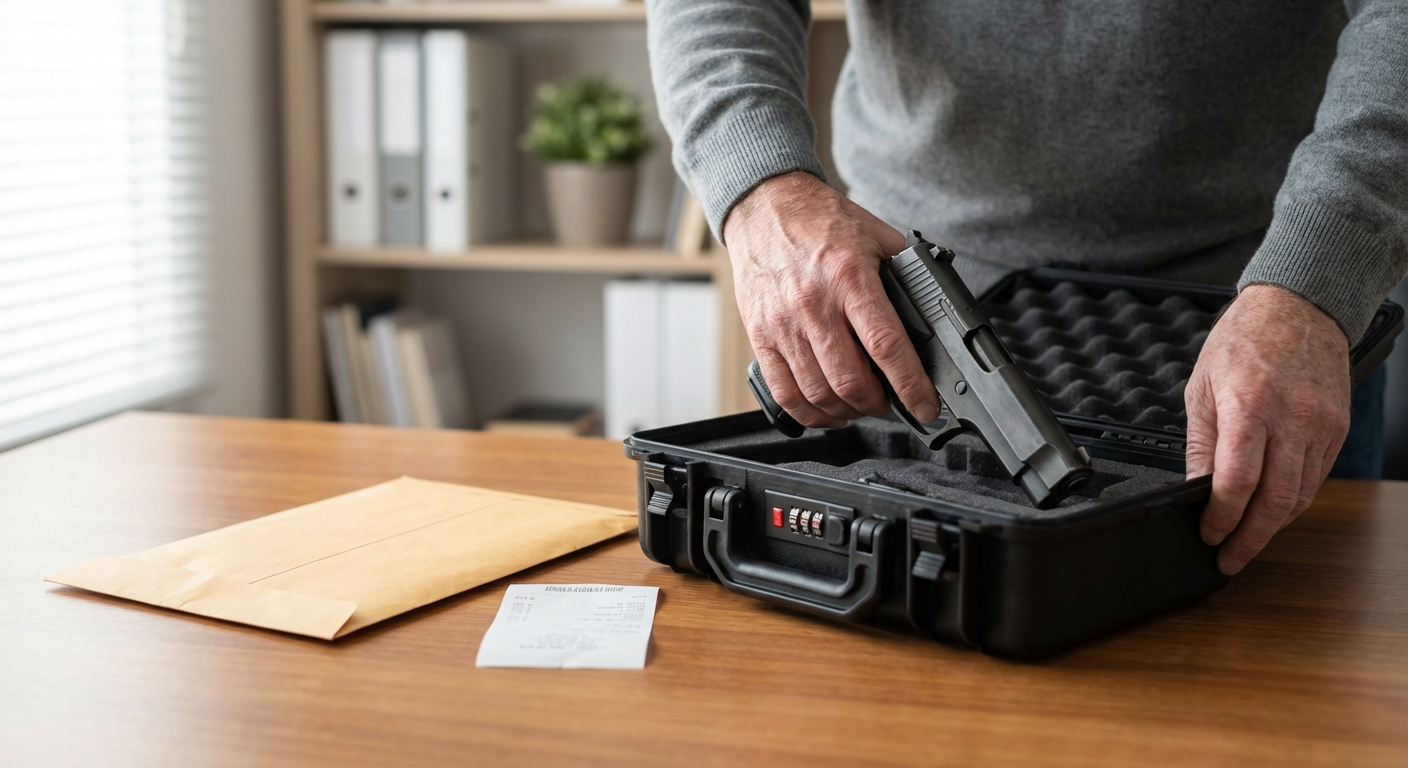
- Keep your post-sale records and confirm what’s included or excluded. Save the bill of sale (transfer record) or receipt, photos of the firearm and serial number, and shipping proof. Remove slings, optics, mags, or cases you did not agree to include, and confirm the receiving FFL has completed the transfer on their end.
Do this every time and you protect your money, stay on the right side of the transfer rules, and close the loop cleanly.
Conclusion
The “best” way to sell my gun for cash isn’t a single winner, it’s the option that matches your speed vs net-cash vs effort tradeoff.
Your Step 1 notes on condition and any issues are what prevent the ugly surprise of a lower offer later. Step 2 keeps your price grounded in completed and sold listings, then forces the only number that matters, your net cash, meaning price minus fees, transfer, shipping, and risk costs. And Steps 4 and 5 are where people lose money fast by rushing, clean transfers and a safe close protect you.
If you want “Safe • Legal • Hassle-Free,” Cash My Guns, “Trusted Since 2013,” is an FFL-run nationwide online purchasing service operated by Dunlap Gun Buyers. Do this next: prep your details, set a net-cash price from sold comps, choose your channel, confirm your state rules, then close with a clean transfer and documented payment.