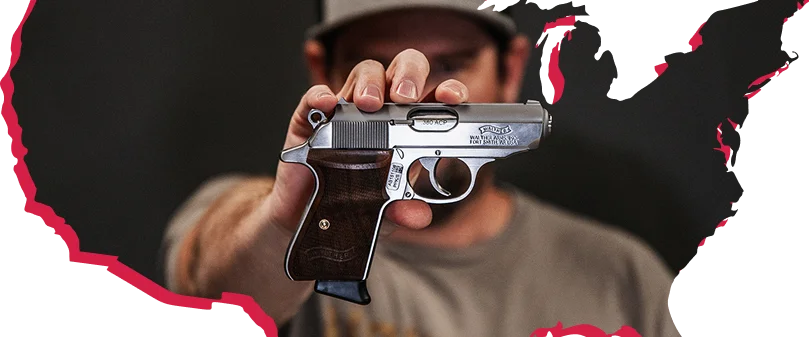

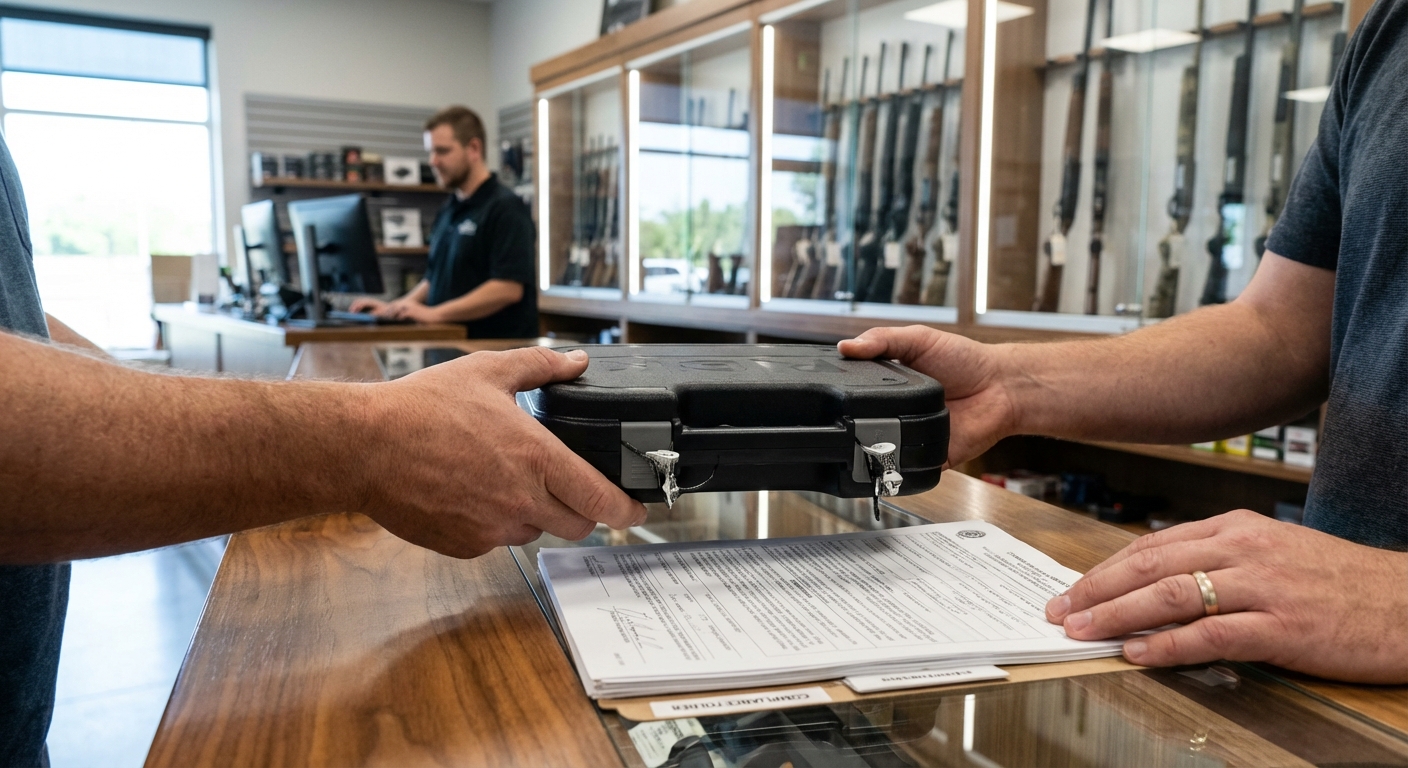

You find a buyer fast. They’re solid on price. The only wrinkle is the state line, so you start thinking, “We’ll just meet halfway in a parking lot and do it like any other private sale.”
It feels normal because the conversation is normal. You’re not trying to skirt the law, you’re trying to avoid doing something dumb that turns a clean sale into a problem.
The tradeoff is convenience versus compliance. Federal law doesn’t care that the meetup spot is close, it cares about residency, and treating an interstate deal like an in-state handoff is how people stumble into felony exposure. The ATF’s public FAQs spell it out: unlicensed people generally can’t transfer a firearm directly to an unlicensed resident of another state. The statute that captures the “private seller to out-of-state buyer” problem is 18 U.S.C. § 922(a)(5), and “transfer” is broader than “sale”, selling, trading, giving, loaning, or even delivering can count. Willful violations are punishable by up to 5 years under 18 U.S.C. § 924(a)(1)(D).
The safest default is simple: if the buyer is out of state, route it through an in-state dealer on the buyer’s side, an FFL transfer. That basic idea is the backbone of everything below, including the narrow exceptions, the practical steps to ship or hand off legally, and the state-level rules and fees that can change how (and whether) the deal closes.
Federal Rules in Plain English
Once the buyer and seller live in different states, federal rules push most legal pathways through a dealer transfer. In practice, a do-it-yourself interstate transfer is where people get tripped up, because the law treats “crossing state lines” as the moment the transaction stops looking like an ordinary private sale and starts looking like a regulated transfer.
Federal law draws two big red lines for nonlicensees. First, you generally cannot transfer a firearm directly to someone you know, or have reasonable cause to believe, is a resident of a different state, 18 U.S.C. § 922(a)(5). Second, you generally cannot receive, or bring into your State of residence, a firearm you bought or otherwise obtained outside your state, 18 U.S.C. § 922(a)(3). Both statutes have limited exceptions, but for normal buyer-to-seller transactions, the baseline rule is simple: making sure a firearm sale is legal means private-to-private across state lines is usually not the lawful path.
Everything turns on the buyer’s State of residence, and “my driver’s license says X” is not the whole story. Federal regulations define State of residence as the state where a person is present with the intention of making a home there, 27 C.F.R. § 478.11. That same regulation also recognizes dual residency, if you maintain a home in more than one state, you can be treated as a resident of each state while you are actually living there.
That’s why common real-world situations matter. ATF guidance applies this to college students, a student can be a resident of the state where the school is located while they’re there with the intent to make a home there. ATF also addresses active-duty military situations, and 27 C.F.R. § 478.11 treats an active-duty service member as a resident of the state where their permanent duty station is located.
A Federal Firearms Licensee (FFL) is the legal “gate” that makes most interstate transfer scenarios workable, because the buyer can only take possession after the dealer does the required compliance work. Conceptually, that means the buyer fills out ATF Form 4473 and the dealer runs the National Instant Criminal Background Check System (NICS), or uses a qualifying alternative, before the firearm can be transferred, 18 U.S.C. § 922(t)—which is why selling a gun without a background check often isn’t an option in interstate scenarios.
Dealer rules also explain why the plan changes depending on what you’re selling. Under 18 U.S.C. § 922(b)(3), an FFL generally cannot sell or deliver a firearm to a nonresident, but there’s a practical exception for a long gun (rifle or shotgun): a dealer can transfer it to certain out-of-state buyers when the sale is completed in person at the dealer’s premises and the transfer complies with the laws of both states. Handguns do not get that same exception under § 922(b)(3), so the clean baseline assumption is: plan on the handgun going through an FFL in the buyer’s state for final pickup.
Age can derail the deal too, even if both parties are otherwise on the same page. Federal dealer age limits apply to FFL transfers, including the under-21 restriction for dealer handgun sales, 18 U.S.C. § 922(b)(1). The practical takeaway is straightforward: expect the dealer paperwork and background check to be part of the transaction, and confirm the buyer’s residency status up front.
Exceptions and Common Edge Cases
Those federal “red lines” are the baseline, but there are exceptions, and they matter most in real-life situations like inheritances or short-term hunting trips. The key is that the exceptions are specific and fact-driven, not general-purpose loopholes.
Exceptions exist, but they’re narrower than internet advice makes them sound. This is where people get tripped up: the exceptions people rely on are real, but most “workarounds” (gift to a buddy, border meet-up, gun show handoff) don’t magically bypass the interstate rule because residency and intent still control the analysis.
Federal law builds in a narrow inheritance lane in 18 U.S.C. § 922(a)(5): the interstate transfer can be allowed when it’s made to carry out a bequest or intestate succession (a transfer through a will, or inheritance when there is no will). The catch is baked into the same sentence, the recipient has to be permitted to acquire or possess the firearm under the laws of their state of residence. That means “Grandpa told me I could have it” isn’t the exception, the transfer has to be part of the actual inherited firearms transfer process. If the heir can’t legally possess it where they live, the federal exception doesn’t rescue the transfer.
18 U.S.C. § 922(a)(5)(B) allows temporary loans or rentals for temporary use for lawful sporting purposes. The limiting condition is the purpose and the timing: it’s tied to the sporting use and it’s supposed to come back, not turn into a permanent change of ownership. If what you’re really doing is handing it over indefinitely, or “loaning” it until the money clears, you’re outside the exception.
At a gun show, buying from an out-of-state FFL is still constrained by the dealer’s rules under 18 U.S.C. § 922(b)(3), so the show floor doesn’t create special permission. And a private-party interstate sale doesn’t become legal just because it happens under the same roof as licensed dealers. Border meet-ups fail for the same reason: the question is who resides where, not which parking lot you picked. “It’s a gift” doesn’t change that either, if your intent is to transfer to someone you know is a nonresident, the interstate restriction is still in play. Here’s the narrow version that actually holds up: if your situation doesn’t cleanly match one of these exceptions, treat it like a standard interstate transfer and use an FFL path, for example a compliance-forward service like Cash My Guns.
How to Sell Interstate Legally
Once you accept that most interstate paths run through an FFL, the question stops being “Can we meet halfway?” and becomes “Which dealer is receiving it, and what do they require?” That planning step is what keeps the sale clean.

The easiest way to keep an interstate sale clean is to decide, before money changes hands, which FFL (licensed dealer) will receive it and what that dealer requires. Most headaches come from mismatched assumptions: the dealer will not accept shipments from individuals, the buyer picked a shop with weird intake rules, or your shipping method is nonmailable for that firearm type.
For a private-party interstate sale, the compliance-first path is usually Option A: you transfer or ship the gun to the buyer’s receiving FFL. Option B is selling directly to an FFL or a dealer-buyer service, which simplifies the buyer side (here’s a practical overview of how online gun sales typically work with FFL delivery).
- Confirm acceptance for the exact firearm and any destination restrictions with that dealer.
- Ask about intake rules, specifically whether they accept shipments from non-FFLs or require ship-from-FFL, because this varies by dealer.
- Get their requirements in writing, many shops want a copy of your government-issued photo ID included in the box and they charge a transfer fee.
On cost, don’t guess. Many standard FFL transfers are commonly quoted around $25 to $50, but it depends on the shop and the firearm.
- Get the FFL number from the receiving dealer.
- Verify it via ATF FFL eZ Check, the ATF-accepted online tool that uses the first 3 and last 5 digits of the 15-digit FFL number.
- Match the premises address and business name shown in eZ Check to the address you plan to ship to.
Federal law typically routes an interstate transfer to an FFL on the receiving end. The sender being an FFL is not universally required by federal law, but a receiving dealer can still make it their policy.
Keep the mailing rules straight if you use USPS. USPS DMM allows unloaded rifles and shotguns to be mailed (with restrictions). USPS also requires no external markings that indicate a firearm, and ammunition cannot be mailed in the same package as a firearm. For handguns, non-FFLs generally cannot mail them, they’re mailable only in limited circumstances under USPS DMM rules.
Treat any online or remote deal like what it is: a transaction that should be structured as an FFL transfer, with clean paperwork and a clear chain of custody.
- Bill of sale and the buyer’s written agreement on price, terms, and receiving FFL
- Copy of the receiving FFL info you verified (and your eZ Check match notes)
- Shipping or transfer receipt, tracking number, and insurance confirmation
- All emails or texts that show who instructed you to ship where
For payment, keep it boring: write down the terms, avoid reversible or prohibited payment methods for firearm sales, and don’t ship until your payment terms are fully satisfied (and follow step-by-step firearm packaging and shipping guidance so the shipment arrives intact).
State Rules That Change Everything
Federal law sets the lane lines, but the destination state often decides whether the transfer is simple, delayed, or dead on arrival. Even when you route it through an FFL correctly, the receiving dealer still has to follow their state’s rules.
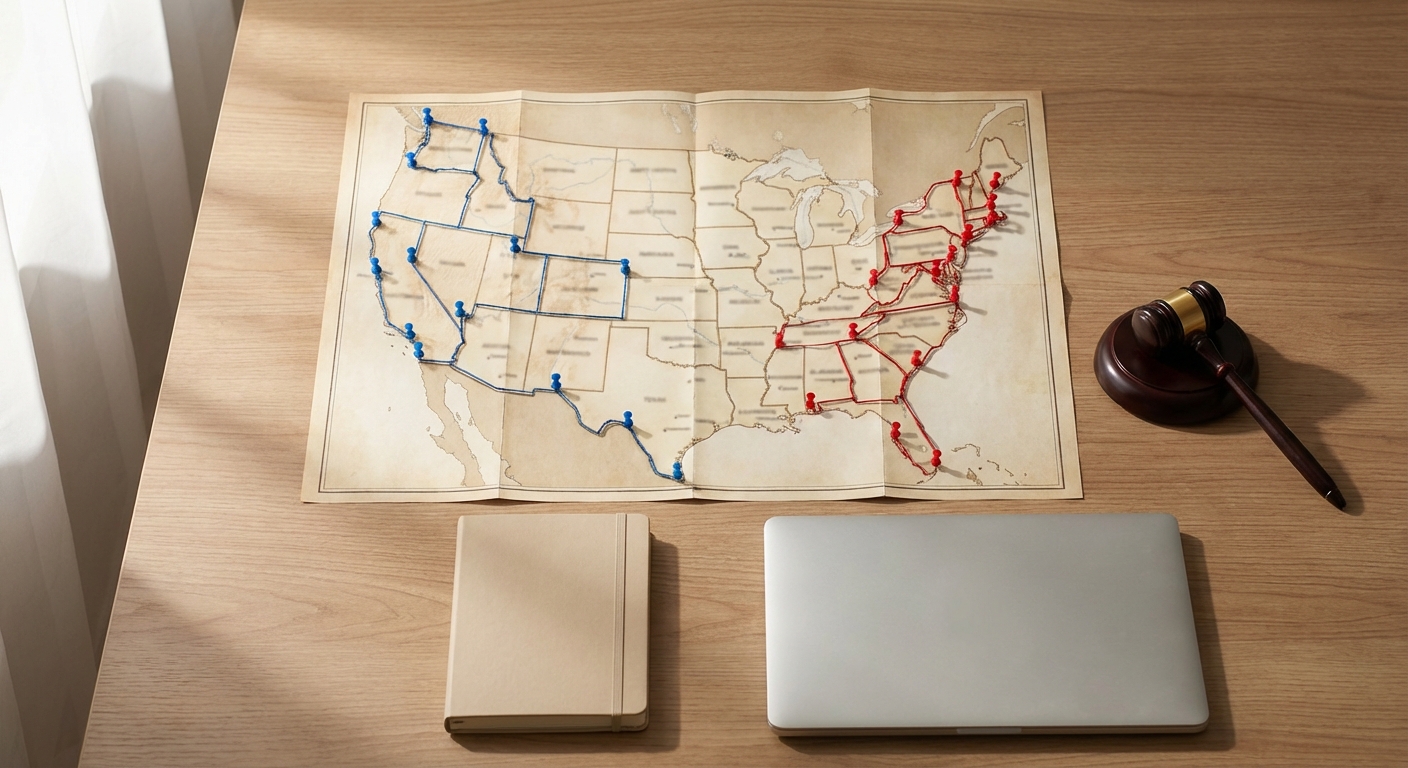
The interstate part is usually straightforward, the destination state is what blows up otherwise legal deals. A buyer’s state can add wait times, state credentials, or outright bans on specific configurations, and your receiving dealer will follow those rules even if you do everything else right.
California: Dealers can’t deliver until the state waiting period runs, and many buyers also need a Firearm Safety Certificate (Cal. Penal Code §§ 26815, 31615; CA DOJ FSC and waiting period FAQs: https://oag.ca.gov/firearms/pubfaqs). The bigger trap is hardware: “large-capacity” magazines over 10 rounds are generally prohibited to transfer or import (Cal. Penal Code § 32310), and California’s “assault weapon” definitions can be triggered by features on a semiauto centerfire rifle with a detachable magazine, or by a fixed magazine over 10 rounds (Cal. Penal Code § 30515). For a deeper walkthrough, see a complete guide to California’s gun laws.
Texas: Texas doesn’t add a state permit-to-purchase or registration layer for ordinary dealer sales, so the dealer process is usually cleaner (Texas State Law Library, “Gun Laws”: https://guides.sll.texas.gov/gun-laws). State preemption also limits local transfer rules you have to chase down (Tex. Local Gov’t Code §§ 229.001, 236.002).
Florida: Retail handgun purchases run through a statutory waiting period, three days excluding weekends and legal holidays, plus local variations allowed by the state constitution (Fla. Stat. § 790.0655; Fla. Const. art. VIII, § 5(b)).
States like NY and IL add their own deal-breakers, and even “easy” states like GA, PA, OH, AZ, and NC still vary by dealer policy and local practice. Call the receiving FFL and confirm destination-state compliance and that dealer’s policy before taking payment or shipping.
Value, Demand, and Timing Your Sale
All those compliance steps and state overlays feed directly into the part sellers actually feel: what it costs, how long it takes, and what you net. An interstate deal can be worth it, but only if you run the numbers like a grown-up.
Selling across state lines can absolutely widen your buyer pool, but the only number that matters is what you net after fees, shipping, and the time lag between “deal agreed” and “funds in hand.” A higher offer that takes longer and costs more can lose to a slightly lower offer that pays faster and cleaner.
Here’s the math I’d run before you get excited about the headline number. Transfer fees and shipping/insurance can swing your net quickly. One all-in example someone may encounter is:
- About $70 per handgun all-in (including shipping, insurance, and the transfer fee)
- About $90 per long gun all-in (including shipping, insurance, and the transfer fee)
These are not universal numbers, but they’re useful for back-of-napkin math. If you’re deciding between “fast money” and “maximize value,” remember the compliance steps and any waiting periods can slow payout, which is a real cost even when it’s not on an invoice.
I’d sanity-check “fair market value” the same way consumer laws expect clear value comparisons: don’t look at one shiny number, break it into comparable inputs.
Condition drives the swing: finish wear, bore condition, matching numbers, and whether aftermarket parts help or hurt (originality usually sells easier). Completeness matters too, extra mags, box, papers, and factory parts reduce buyer friction. Use dealer listings and auction results as inputs, then adjust for market reality: seasonality and regional demand change what the real offer looks like this week, and how supply and demand affects firearm resale prices is a useful lens when out-of-state buyers are in the mix. The provided excerpt contains no numeric price tables or ranges for common handgun models, so don’t let anyone sell you a “standard price” story.
If you’re handling an estate, have rare or unusual pieces, or you’re moving high volume, pay for a real collection-level evaluation. For example, Cash My Guns (a nationwide online firearms purchasing service operated by Dunlap Gun Buyers, an FFL) says its valuations consider condition plus market data from dealer listings and auctions, seasonality, and regional demand, and it doesn’t publish fixed price tables, which is exactly the right mindset for non-routine lots.
Quick Checklist Before You Transfer
By this point, the pattern should be clear: residency triggers the federal issue, the FFL handles the legal handoff, and the destination state can still add friction. Use this as a final gut-check before you take money or move the gun.
Default to an FFL transfer in the buyer’s state, and verify everything before you take money, hand over the gun, or ship anything.
- Use a buyer’s-state receiving FFL as the default route, because 18 U.S.C. § 922(a)(5) generally bars direct nonlicensee-to-nonresident transfers.
- Get the receiving dealer’s name, address, and phone number, and confirm you are talking to that shop directly.
- Confirm the exact firearm can be transferred where the buyer lives, and that the receiving FFL will accept it.
- Make sure the buyer understands pickup runs through the dealer’s process, including ATF Form 4473 and a background check (or qualifying alternative) under 18 U.S.C. § 922(t).
- Do not ship or hand it off until the receiving FFL confirms they are ready to receive it and how they want it documented.
- Keep personal-protection records, a bill of sale, transfer or shipping receipts, tracking and insurance details, and the receiving FFL’s contact info.
- If you want a simpler route, sell directly to a licensed buyer service like Cash My Guns.
Confirm everything with the receiving dealer first, then cross-check with official sources.
Conclusion
The “meet halfway in a parking lot” idea is exactly where people accidentally turn a normal sale into a serious problem, because federal law cares about residency, not convenience. In most private interstate situations, the clean move is still the one from the intro: route it through the buyer’s in-state FFL and confirm requirements before you ship. 18 U.S.C. § 922(a)(5) generally bars non-licensee transfers to nonresidents, so you typically ship or deliver to an FFL; § 922(t)(1) then generally requires Form 4473 and NICS, and eZ Check plus state overlays can still change timing, legality, and your net after fees, shipping, and time.

Check ATF Firearms FAQs, https://www.atf.gov/firearms, https://fflezcheck.atf.gov/, and destination-state police/firearms bureau resources.
See our related guides, this is general info, not legal advice.