
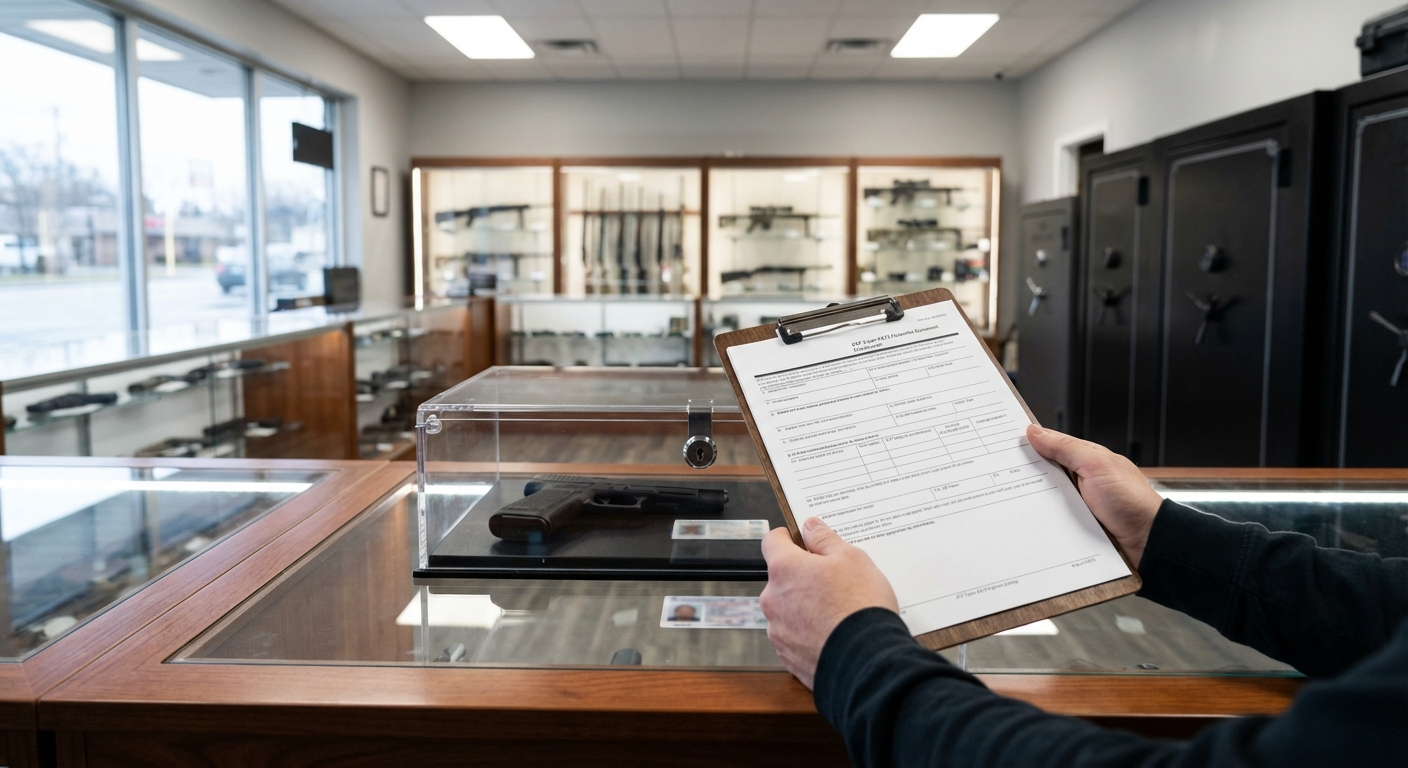

You’re standing at the gun counter thinking you’re just there to hand over the firearm, then the dealer starts talking about “the 4473” and your deal suddenly slows down. That’s the seller mistake: ATF Form 4473 isn’t “buyer paperwork you can ignore,” it’s the dealer’s compliance record that makes the transfer defensible and keeps a lawful sale from turning into a mess later.
You want the sale to be quick, clean, and final, no callbacks, no questions, no surprises. Even if you never touch the form, your sale depends on the dealer being able to document a lawful transfer to the person taking possession.
Here’s the tension: speed and convenience versus a transfer that’s properly documented through the dealer. Federal rules are blunt on this point, an FFL may not “sell or otherwise dispose” of a firearm to a nonlicensee unless it’s recorded on ATF Form 4473 (27 CFR 478.124(a)). The current form is marked “Revised May 2023,” and the ATF’s instructions say it documents an FFL-to-nonlicensee transfer and helps determine prohibited-person status. Because the same rule only applies to transfers to “any person other than another licensee,” FFL-to-FFL dispositions don’t use a 4473 (27 CFR 478.124(a)).
You’ll walk away knowing what the form is, when it shows up in real selling paths, how to prep to avoid friction, and how it changes the workflow so your sale stays fast and low-risk.
4473 Basics for Private Sellers
You usually will not fill out ATF Form 4473 as a private seller. But the moment you route your sale through a Federal Firearms Licensee (FFL), for a trade-in, consignment, or the buyer’s receiving dealer, the 4473 becomes the rulebook the transfer runs on, and you feel it if anything is off.

The roles are split on purpose. The typical private buyer or seller is a nonlicensee, meaning you are not a federally licensed dealer. The FFL is the licensed business that can transfer a firearm to a nonlicensee and keep the required records. Under the ATF Form 4473 instructions, the buyer completes and signs the transferee or buyer information and the eligibility yes/no questions. The FFL completes the firearm-identification section and the transfer certification section, including the dealer’s sign-off that the transfer complied with the rules.
The fastest way for a smooth counter transaction is simple: the buyer’s ID has to match who they are and where they actually live. Federal rules require that before an over-the-counter transfer, the buyer present a valid identification document with their name, residence address, date of birth, and photograph (27 CFR 478.124(c)(3)(i) and 27 CFR 478.11).
Where sellers get surprised is the friction from mismatches. If the buyer’s photo ID does not show their current residence address, the dealer has to get additional documentation showing the current address before they can complete the transfer (27 CFR 478.124(c)(3)(i)). That is not a “dealer preference,” it is the compliance step the FFL is required to satisfy.
The 4473 is also where the background check becomes a record. The dealer runs the check through the National Instant Criminal Background Check System (NICS), which returns a transfer status to the FFL, not a narrative explanation. Per the ATF Form 4473 instructions, the FFL records the NICS result (Proceed, Denied, Delayed, or Cancelled) and the NICS Transaction Number (NTN), the unique number tied to that specific check for traceability and record completeness.
Seller takeaway: when you choose an FFL-assisted path, assume the “gating step” is buyer ID that lines up cleanly, plus the dealer’s documented NICS check on the 4473 (part of ensuring your gun is sold legally). If you plan for that, the handoff feels routine instead of unpredictable.
When a 4473 Is Required
If an FFL is the one handing the firearm to the end buyer (a nonlicensee), expect a Form 4473 as part of that transfer. That’s the moment the dealer is legally “disposing” the gun to a nonlicensee, so the dealer paperwork shows up even if your sale started as a private deal.
Where sellers get tripped up is the “I’m selling to a dealer” pathway. If you sell directly to an FFL as a trade-in or a straight buy, the dealer is acquiring it from you, not transferring it to you. The 4473 typically appears later, when that same dealer transfers the gun from their inventory to the eventual retail buyer. Quick reminder: FFL-to-FFL transfers generally do not involve a 4473.
Consignment feels like you still “own” the gun until it sells, but the dealer has to treat it like inventory for recordkeeping. Under 27 CFR 478.125(e), the shop logs the firearm as an acquisition from you, then logs it back out as a disposition to the buyer in the dealer’s Acquisition & Disposition (A&D) record. The practical result is simple, when the buyer picks it up from the dealer, that’s a dealer transfer to a nonlicensee, so a 4473 is part of the handoff.
If your buyer lives in a different state, federal law usually forces the transfer to route through an FFL in the recipient’s state. The default constraint comes from 18 USC 922(a)(5) and 18 USC 922(a)(3), and FFL delivery rules in 18 USC 922(b)(3). In real-world terms, your “private” sale turns into a dealer transfer at the buyer’s end, which means a 4473 at pickup.
Even inside one state, the paperwork path can change. As of Feb 2026, Texas and Florida generally do not require an FFL or background check for intrastate private-party sales, while California generally requires private-party transfers to be processed through a dealer. The same “who hands it to the buyer?” question still tells you what the process will look like.
Before you promise a buyer anything, confirm whether an FFL transfer is required. That one decision determines whether your sale stays a simple meet-up or becomes a dealer-managed handoff with dealer-managed documentation—especially when weighing private-party versus FFL dealer pathways.
Seller Checklist Before the Transfer
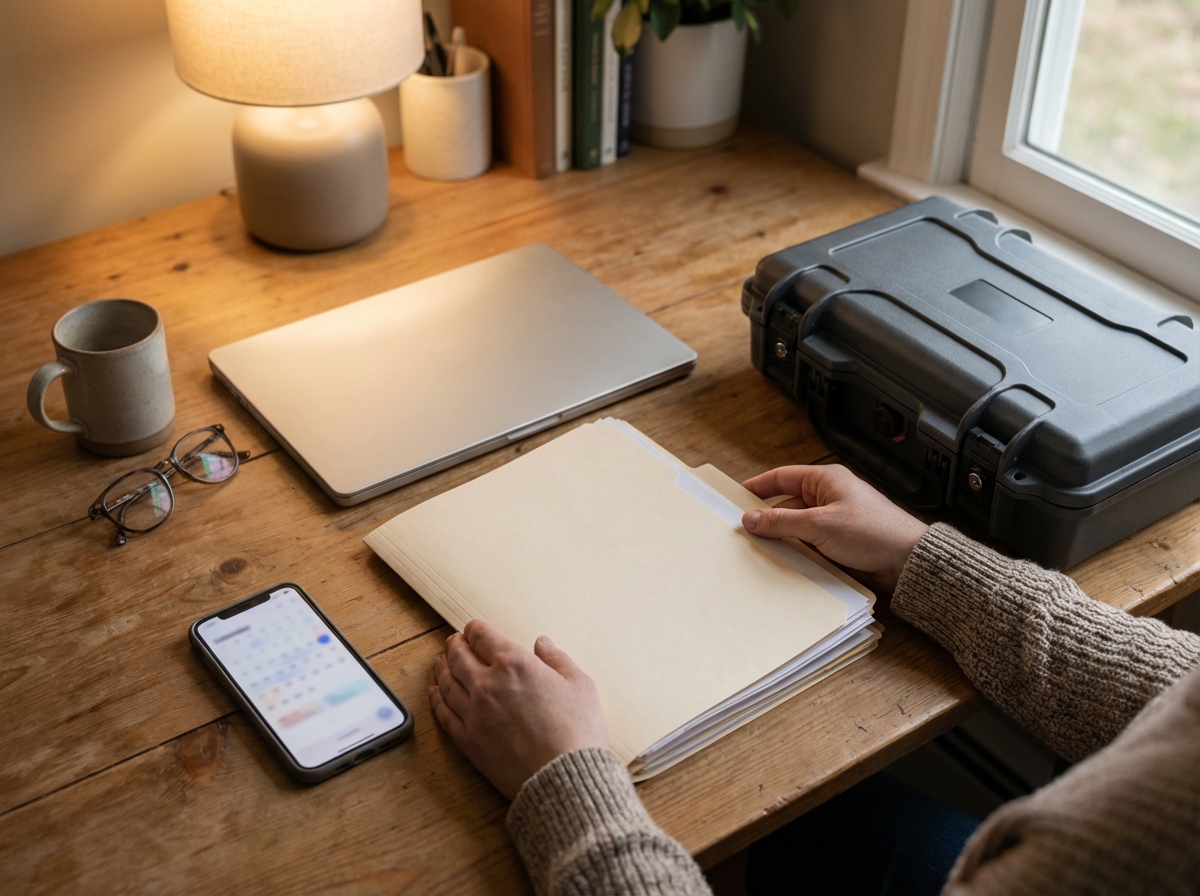
Once the transfer is going through an FFL, the fastest way to avoid delays is to show up with the exact firearm description the dealer must record on ATF Form 4473. Small discrepancies, especially serial number, model, caliber, or firearm “type,” are a common reason a transfer slows down at intake.
- Confirm the receiving FFL name, physical address, phone, and the best contact for intake questions.
- Ask about intake preferences such as appointment versus walk-in, and whether they want magazines, cases, optics, or other accessories included or removed.
- List the 4473 firearm fields needed for the entry: manufacturer and importer (if any), model, serial number, type (pistol, revolver, rifle, shotgun, receiver), caliber or gauge, and the total number of firearms being transferred (spelled out per the form instructions).
- Take clear photos of both sides plus close-ups of the serial number and any importer marks.
- Flag non-standard configurations such as caliber conversions, multi-caliber setups, or receiver-only transfers, so nothing is guessed at the counter.
Then get picky about markings, because that’s where “close enough” turns into redo work.
- Use the frame or receiver serial number, since that is the controlled part, even if other parts have matching numbers.
- Record importer markings when present, since the form calls for manufacturer and importer (if any).
- Stop if markings are missing or unreadable; most firearms must be marked (18 U.S.C. § 923(i); 27 C.F.R. § 478.92), and possessing a firearm with an obliterated or altered serial number is illegal (18 U.S.C. § 922(k)).
If you’re shipping to the receiving dealer instead of walking it in, the same “clean and complete” idea applies-just with carrier rules layered on top, including how to package and ship a firearm safely.
- Use a legal pathway; ATF allows a nonlicensee to ship a firearm by common or contract carrier to an FFL in any state.
- Follow USPS limits; nonlicensees can mail rifles and shotguns to an FFL, but handguns are not mailable by nonlicensees.
- Provide written carrier notice; 18 U.S.C. § 922(e) requires written notice to the carrier that the shipment contains a firearm, and the carrier cannot require any label indicating a firearm.
- Include sender identification details; the receiving FFL must record the sender’s name and address for its A&D record (27 C.F.R. § 478.125(e)), so confirm what documentation they want in the box.
A simple “firearm ID sheet” in the box or handed over at intake keeps the record clean: manufacturer/importer, model, serial, type, caliber or gauge, total count, and a short list of included accessories (and consider shipping insurance for firearms to reduce risk in transit).
Common 4473 Pitfalls and Delays
Even when you’ve done your prep, most “4473 problems” don’t look like paperwork problems in the moment. They show up as a sale that suddenly stalls, a call that says “we can’t transfer,” or an FFL who won’t proceed because something doesn’t line up with the buyer’s ID, the background check status, or the way the purchase is unfolding.
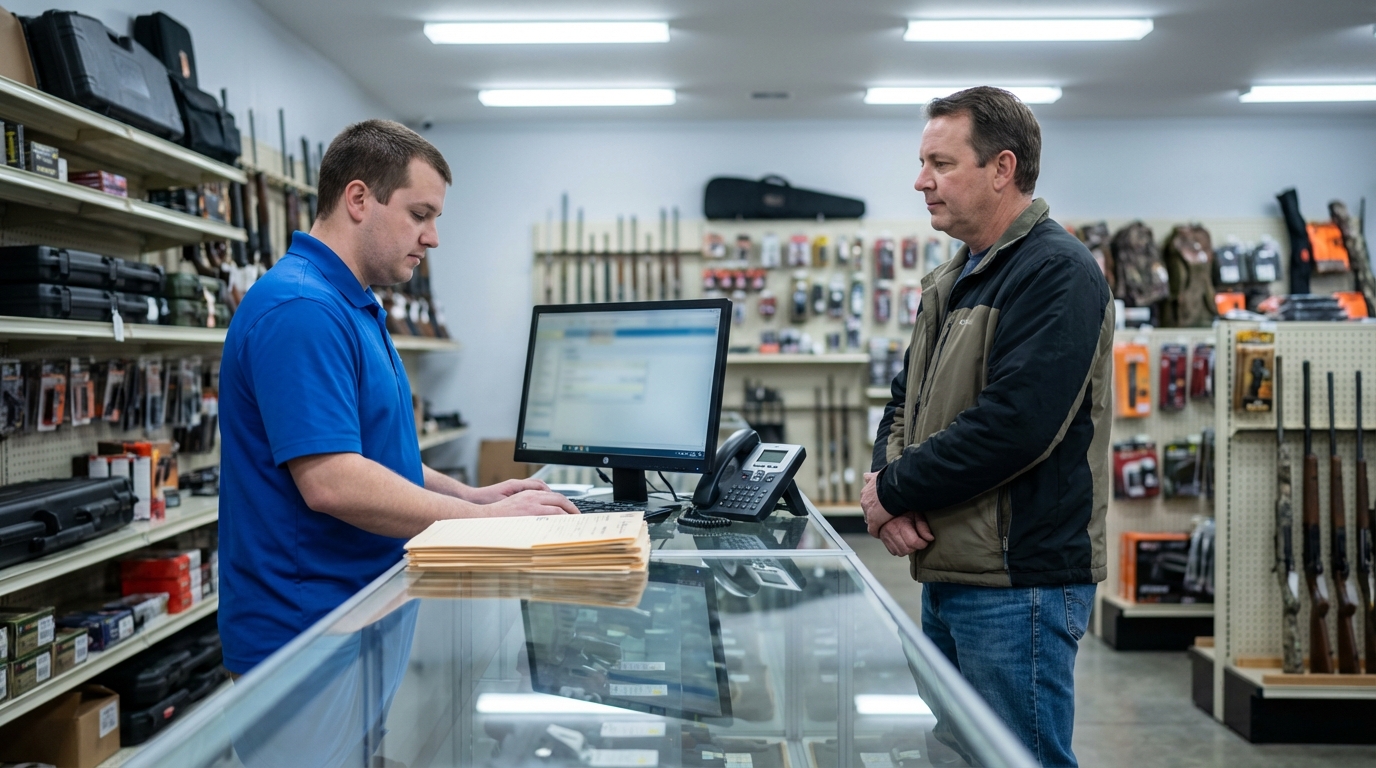
When the dealer runs the background check, the operational update you usually hear is just a standardized NICS status, not a detailed explanation. “Proceed” means no prohibiting information was found at that time, so the transfer may proceed, subject to other requirements. “Delayed” means more research is needed, which turns your handoff into a waiting game. “Denied” means the transfer may not occur. If the firearm is already sitting at the dealer when a buyer is denied, what happens next is often driven by store policy, not your preferences, so ask the FFL about their process before the gun ever arrives.
One more timing reality: buyers under 21 can take longer in some cases, so don’t promise same day pickup if the buyer is close to that age line.
FFLs get cautious fast when the buyer seems like they’re buying for someone else, because Form 4473 includes an “actual transferee/buyer” certification question (commonly 21.a), meaning the person filling out the form is the one actually acquiring the firearm. Knowingly false statements are criminally punishable under 18 U.S.C. § 922(a)(6) and 18 U.S.C. § 924(a)(1)(A), with penalties up to 5 years.
ID and residency mismatches are the quiet deal killers: an outdated address, missing supplemental documentation, or a document combo the dealer won’t accept. Requirements vary by state and by shop, so the buyer should confirm what they need before showing up. On your side, incorrect firearm details create redo work, and sometimes a full restart, so use the make, model, caliber, and serial number from the firearm itself, not memory or an old listing.
Set expectations upfront that timelines can change, pick a reputable FFL whose policies you understand, and don’t pressure a dealer to “make it work” if something feels off (especially when selling a gun online and coordinating the transfer). That decision protects your sale and your name.
How 4473 Affects Pricing and Value
The second your sale is routed through an FFL transfer, and the end buyer will complete a 4473, you are not choosing “paperwork.” You are choosing a timeline, a stack of fees, and a risk profile that directly changes what you net, and how long your gun is tied up if the transfer hits a snag.
Direct sale to an FFL: This is the fastest handoff because your buyer is the dealer, not another individual. In that setup, the private seller typically does not complete a 4473. The tradeoff is pricing, you are usually taking a dealer buy offer in exchange for speed and a clean exit.
Consignment: Consignment can support a higher sale price because the gun is marketed at retail, but you are paying for that reach with time. The dealer still transfers the firearm to the eventual buyer, which means the buyer completes the 4473, and your payout waits until the gun actually sells and the shop’s process clears.
Online sale to an out-of-area buyer (shipped to their FFL): Your audience gets bigger, but coordination becomes the real cost. You have to align payment, shipping, the receiving dealer’s rules, and transfer timing. If the buyer’s transfer can’t be completed, you are often dealing with return shipping and a longer clock before you can relist.
Transfer fees are the predictable line item. GunBroker’s educational guidance commonly cites FFL transfer fees around roughly $20 to $50, with local variation. The NICS check itself is provided to FFLs at no cost per FBI NICS information, so any “background check fee” you see is really the dealer’s service charge, or a state-mandated fee where applicable, not a federal NICS bill.
Start with the price you think the gun will actually sell for on your chosen route, then subtract the friction costs: transfer or consignment fees, shipping and insurance, and the value of your time while you wait. Your baseline should reflect how supply and demand affects firearm resale prices in your local and online market.
One process example: a service may offer a prepaid shipping label, full insurance coverage using the provided label, and an expert appraisal for valuing firearm collections, which changes both your out-of-pocket costs and how quickly you can move from “offer” to “done.”
Takeaway: Pick the route that matches your priority, speed, top dollar, or simplicity. Then confirm the dealer’s all-in steps before you commit: total fees, expected timing, and what happens if the transfer can’t be completed.
A Simple Seller Playbook
If you remember one thing, it’s that the 4473 is the hinge point any time an FFL is transferring your gun to a typical, nonlicensed buyer, and it sets your timeline, paperwork expectations, and how smooth the sale feels.
The clean split stays the same: the buyer handles the 4473 and the background check through the dealer, and you win by giving the shop clean, complete firearm details so they can log it in correctly. Consignment still runs like dealer inventory once it hits their books, even though it started as your gun, and the dealer’s policy is what controls the “what happens next” moments if the transfer hits a snag.
- “What do you need from me to log the firearm in cleanly, photos, written details, or both?”
- “Which exact make, model, caliber, and serial format do you want on my paperwork?”
- “What’s your policy if the buyer gets a delay or denial after the gun arrives?”
- “What are your fees and typical turnaround times?”
- “Do you release after three business days with no final NICS response, or do you wait?”
For peace of mind, federal rules require FFLs to retain completed 4473s for at least 20 years and denied, cancelled, or uncompleted 4473s for at least 5 years, and if a dealer closes those required records are sent to ATF’s Out-of-Business Records Center for official trace purposes, not public searching. That’s the same “quick, clean, and final” goal from the counter scene in the beginning-your part is making sure the dealer can document the transfer cleanly. If you want to double-check the fine print, pull the current Form 4473 (and instructions) from ATF, skim ATF’s Firearms Q&A, and use the FBI’s NICS FAQ for the status definitions, or sell through a buying FFL such as Cash My Guns for insured, professional handling.