

You’re trying to sell a gun, and you keep hearing you have to “report it to the ATF,” but nobody can explain what you’re supposed to file, where you’d file it, or why.
The confusion is real because people mash together dealer paperwork, special-case reporting, and ordinary private sales into one vague warning. Here’s the myth-busting part: the ATF’s Firearms FAQ for unlicensed persons says “occasional sales” from your personal collection or hobby don’t require a license, and its lawful-transfer guidance focuses on who you can legally transfer to, like not transferring to prohibited persons and generally keeping private transfers within your state, not on notifying the ATF about the sale. A lot of what people call “reporting” is actually dealer recordkeeping; ATF Publication 5300.4 describes Form 4473 as a dealer form for over-the-counter transfers, and private sellers aren’t told to complete or submit it for a private sale, and in typical retail sales it’s kept by the dealer, not routinely sent to ATF.
You’ll walk away able to choose a sale method that stays compliant and know exactly what to double-check under your state and local rules. To get there, it helps to start with what the ATF actually regulates versus what people assume it regulates.
What the ATF actually regulates
The ATF’s day-to-day focus is the licensed pipeline, not you filing a “gun sale report” every time you sell something from your safe.

If a Federal firearms licensee (FFL) is in the middle of the transfer, federal rules put the compliance burden on that licensee. For most transfers from an FFL to a nonlicensee, the dealer must initiate a background check through the National Instant Criminal Background Check System (NICS) before the firearm is transferred, as required by 18 U.S.C. § 922(t) and 27 C.F.R. § 478.102.
NICS is administered by the FBI through its Criminal Justice Information Services (CJIS) Division, and in some states a state agency runs the check as a NICS Point of Contact (POC). Either way, the dealer is the one pushing the buttons for the check in the typical dealer-to-buyer sale.
The other reason people think “the ATF gets a report” is the paperwork. For most over-the-counter FFL transfers, the buyer completes ATF Form 4473 under 27 C.F.R. § 478.124. The dealer keeps the completed 4473 for 20 years, and keeps denied or not-completed 4473s for 5 years, under 27 C.F.R. § 478.129. Dealers also maintain an Acquisition & Disposition (A&D) record, commonly called the bound book, which is the dealer’s tracking log for what came in and what went out.
Federal law draws two bright lines that create most of the risk for unlicensed sellers. First is the “engaged in the business” standard, the line between occasional personal sales and dealing as a business. If your pattern looks like repetitive buying and reselling for profit, that behavior can trigger licensing requirements under 18 U.S.C. § 923 and can violate 18 U.S.C. § 922(a)(1)(A), with “engaged in the business” defined at 18 U.S.C. § 921(a)(21).
Second is the interstate transfer baseline. If the buyer and seller are residents of different states, the transfer generally needs to be completed through an FFL, even if it started as a “private sale.”
Know those two questions, is an FFL involved and is it an interstate transfer, and you are 80% of the way to knowing how to sell a gun legally versus what the dealer handles.
Once those basics are clear, the next question is whether any situation actually triggers a real federal report or notification requirement.
When a sale must be reported
In most everyday private sales, there’s nothing you “report to ATF,” but a few real federal reporting and notification duties get mistaken for private-sale requirements.
A typical private sale that stays inside one state, an intrastate transfer, usually does not involve the seller sending any direct notification or “report” to the ATF under federal rules. This is the spot where people expect a formal filing, but federally, those kinds of filing and retention duties usually live on the licensed-business side, not between two unlicensed residents doing a lawful, same-state transfer.
If the transfer runs through an FFL, the documentation is created and kept on the dealer’s side as part of their required records (and when a background check may still be required is often the deciding factor).
Real federal reporting exists, it’s just usually aimed at FFLs. Common examples include:
- Multiple handgun sales/dispositions (FFL duty): If an FFL sells or otherwise disposes of two or more pistols and/or revolvers to the same unlicensed person at one time or during five consecutive business days, the FFL must file ATF Form 3310.4 by close of business on the day of the second (or additional) handgun disposition.
- Theft or loss from inventory (FFL duty): If an FFL discovers a theft or loss from inventory, they must report it using ATF Form 3310.11 within 48 hours of discovery, and to local law enforcement.
Then there’s tracing. When law enforcement recovers a gun, ATF traces through the manufacturer or importer and the FFL chain, and ATF can request an active FFL’s A&D and related 4473 info. A private-sale gap can limit that paper trail, which is why people assume a “report” must have been required at the time of sale.
Practical takeaway: identify which bucket you’re in before you assume you’re supposed to file anything. If you want maximum documentation and peace of mind, choosing an FFL transfer is the simplest lever you can pull.
Private sale or FFL transfer
Here’s the real difference: using an FFL transfer versus a private sale is less about “reporting to the ATF” and more about documentation and eligibility screening, especially if you don’t know the buyer well or you want the cleanest paper trail.
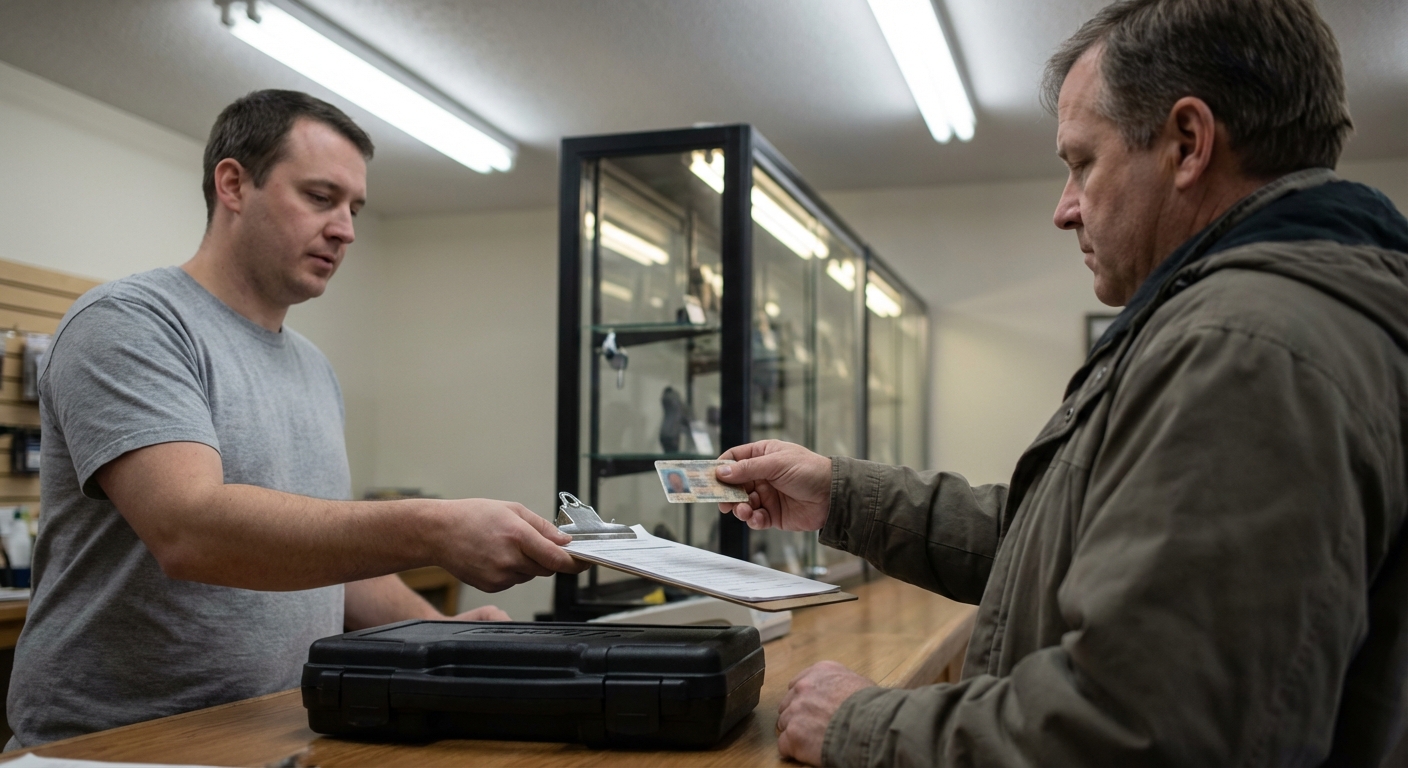
A private sale (where your state allows it) is the lightest-lift option on paperwork. For an intrastate transfer between unlicensed residents, the federal Gun Control Act does not require private-party recordkeeping. The catch is on you: you still have to avoid transferring to someone you know, or have reason to believe, is prohibited from possessing firearms. That responsibility can feel straightforward with a longtime friend, and a lot less comfortable with a stranger from an online message.
An FFL (licensed dealer) turns the transaction into a standard retail-style transfer. The dealer creates and retains the formal records and runs the background-check process as part of the handoff. You trade a little extra time and usually a transfer fee for clarity: a documented chain of custody and a built-in eligibility screen.
Federal law generally prohibits a nonlicensee from transferring a firearm to a nonlicensee who lives in a different state (18 U.S.C. § 922(a)(5) and § 922(b)(3)). That’s why online sales to out-of-state buyers typically go to an FFL in the buyer’s state for the final transfer. Shipping and mailing basics from the ATF FAQ: a nonlicensee may ship by common or contract carrier to a resident of their own state or to an FFL in any state; a nonlicensee may mail a shotgun or rifle to a resident of their own state or to an FFL in any state; a nonlicensee may not mail a handgun.
If there’s any out-of-state interest, buyer uncertainty, or you want cleaner documentation, default to an FFL transfer and sleep better.
State rules can change everything
If you feel like you “had to report” a gun sale, you’re usually reacting to a state-required process, not an ATF report. States layer on their own paperwork, credentials, and timing rules, and it can feel federal even when it’s purely state-run.

- Universal background check rules that force most private sales through an FFL
- State transaction and record systems that create a state “paper trail”
- Permits or credentials required to buy, possess, or acquire
- Waiting periods that delay delivery even after approval
Low-paperwork examples: Texas, Florida. Texas does not require private-party transfers to go through an FFL or include a background check, but it’s still a crime to transfer to someone you know is prohibited (Texas Penal Code § 46.06)—see how to sell a gun in Texas. Florida also has no statewide universal background check or FFL requirement for private-party transfers, and prohibited-person restrictions still apply (Fla. Stat. § 790.065; § 790.23); review how to sell a gun in Florida.
State-system examples: California, Illinois. California private transfers must be processed through a California dealer, and the dealer submits DROS to the CA DOJ. California also generally imposes a 10-day waiting period—see how to sell a gun in California. That’s a state process, not ATF “reporting.” Illinois confusion usually centers on FOID, a state credential required for most residents to possess or acquire firearms and ammunition, separate from federal paperwork.
States to double-check: Georgia, Pennsylvania, Ohio, Arizona, New York, North Carolina. Look up: “Do private sales have to go through an FFL?”, “Any permits or credentials?”, “Any waiting period?”, and “Any state forms or transaction numbers?” Laws change, so confirm before you meet a buyer.
Before you choose a private sale versus an FFL transfer, lock down your state’s private-sale steps, then document the transaction enough to reduce your risk. How much you can (and should) document depends heavily on those state rules.
Paper trail, safety, and fair value
You don’t need a federal “report,” but you do need a plan. The legal stress usually comes from ignoring red flags or leaving a sloppy trail, and the money stress comes from guessing what your gun is worth.
- Confirm basic identity and, where relevant, in-state residency before you hand over a firearm.
- Screen for prohibited-person red flags and take them seriously. Under 18 U.S.C. § 922(d), it’s illegal to transfer to someone you know or have “reasonable cause to believe” is prohibited, and pretending you didn’t notice warning signs is exactly how sellers get burned.
- Choose an FFL transfer when you want extra certainty and a cleaner record. In that setup, the dealer handles the required forms and retention as part of the transfer.
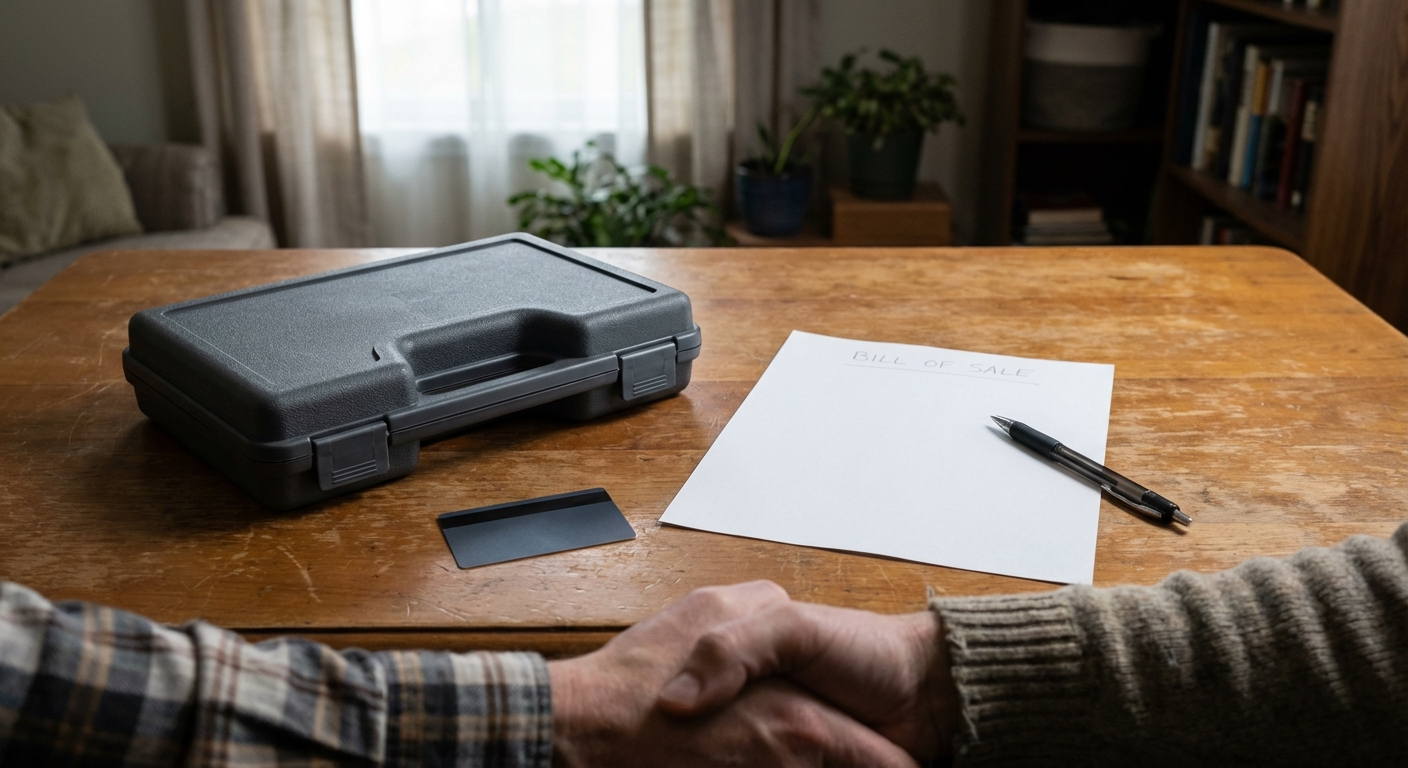
- Document the deal, where lawful and appropriate, with a bill of sale that typically includes names, addresses, signatures, date, price, and a firearm description (make, model, caliber, serial), plus optional buyer attestations (lawful possession, same-state residency when applicable). Keep your copies secure and don’t post sensitive info publicly.
Price is driven by the exact model and variant, condition, originality vs aftermarket parts, included accessories, and local demand and seasonality. If you’re wondering “how much is my Glock 19 worth” or “what’s my Sig P320 worth,” the fastest reality check is GunBroker’s Completed Items, which shows final prices for closed listings (sold and unsold) when you filter by the exact model. For scarce collectibles, realized prices from major auction houses are better comps than active listings. The Blue Book of Gun Values is a common reference, but quoting excerpts depends on permissions. The same comp logic works across popular pistols (Glock 17, S&W M&P), hunting rifles, workhorse shotguns (Remington 870, Mossberg 500/590), and collectible revolvers.
Today, pick your transfer path, then pull 3 to 5 truly comparable completed sales for your exact variant and condition. If you want to keep it simple, the checklist below covers the same decisions in a fast, practical order.
A simple checklist before you sell
You usually don’t “report a gun sale to the ATF” as a private seller. Federally, an unlicensed person may generally sell a personally owned firearm to another unlicensed resident of the same state, and that typical intrastate private sale isn’t a direct ATF report event unless another law adds a requirement.
The paperwork people associate with “ATF reporting” usually lives in the licensed lane, in dealer records like ATF Form 4473 and the A&D record (bound book), and the real reporting duties discussed earlier often sit on FFLs, not on you. Add state layers like CA DROS or IL FOID, and it’s easy to see why this gets confused.
- Confirm your state rules (and any local requirements) before meeting a buyer.
- Keep it intrastate for private sales; interstate transfers generally must route through an FFL.
- Refuse any transfer you know, or have reason to believe, violates 18 U.S.C. § 922(d).
- Document the transaction appropriately, at minimum date, parties, and firearm details.
- Price off real, current comps, not sentimental value.
If you want the most paperwork-handled path, use an FFL, or sell through Cash My Guns, operated by Dunlap Gun Buyers (an FFL), positioned as “Safe • Legal • Hassle-Free.”